


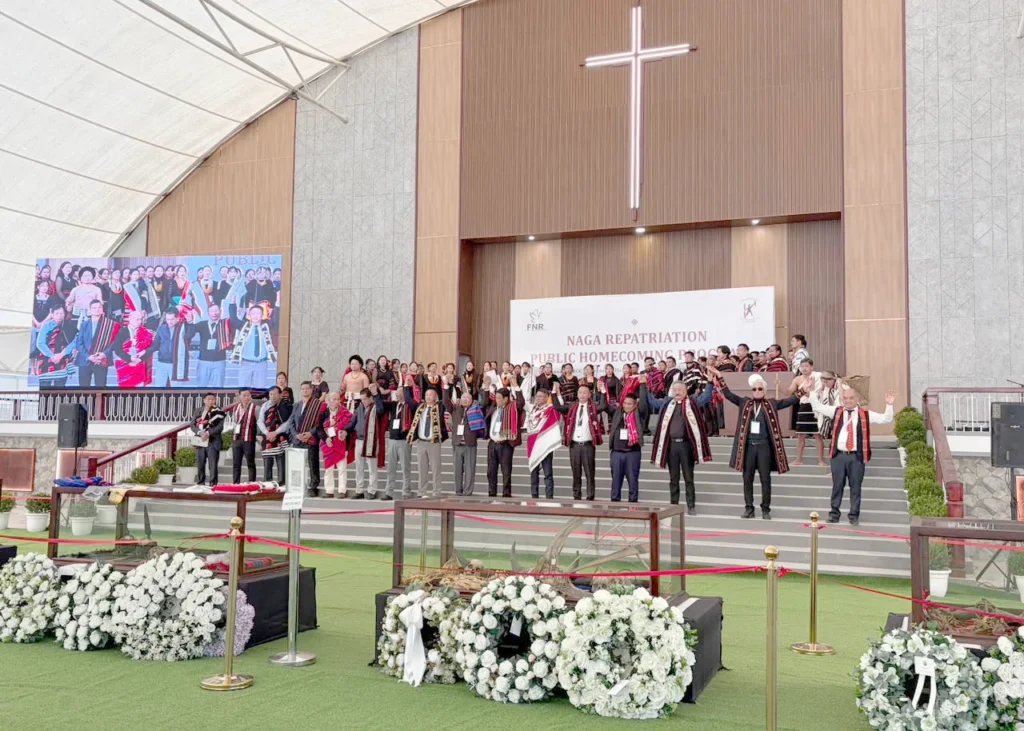
Nagaland Chief Minister Neiphiu Rio has described the return of 39 Naga ancestral human remains from the United Kingdom as a historic milestone for the Naga people. The remains, previously held at the Pitt Rivers Museum of the University of Oxford, arrived in Nagaland after more than a century away from their homeland. A public homecoming ceremony took place at the NBCC Convention Hall in Kohima on November 28, 2026, marking an important moment in the restoration of Naga identity, dignity and collective memory.
Nagaland Makes Hotel App Registration Mandatory for Out-of-State Guests Ahead of Hornbill Festival
CM Neiphiu Rio Welcomes Return of 39 Naga Ancestors
Addressing the public homecoming ceremony in Kohima, Chief Minister Neiphiu Rio described the repatriation as more than the return of historical human remains.
He said the homecoming represented the restoration of a part of Naga identity, history and collective memory. He also recalled the painful colonial history behind the removal of the remains from their homeland.
Rio emphasised that ancestors should never become objects of display or historical specimens. Instead, communities must recognise their dignity and cultural significance.
He also said the successful repatriation demonstrated what the Naga people could achieve through unity, cooperation and collective effort.
According to India Today NE, Rio thanked the organisations, researchers, tribal leaders and officials who helped bring the ancestral remains back to Nagaland.
Ancestral Remains Return from Oxford’s Pitt Rivers Museum
The 39 ancestral human remains came from the Pitt Rivers Museum at the University of Oxford in the United Kingdom.
Historical records indicate that colonial administrators and collectors took many of these remains from Naga territories between 1910 and 1940. They subsequently entered overseas museum collections, where they remained for decades.
The repatriation followed years of discussions, research and advocacy by Naga organisations and community representatives.
The process began in 2020 after the museum removed human remains from public display and initiated discussions about their future care and return.
The remains reached Indira Gandhi International Airport in New Delhi on November 25, 2026. Officials and representatives of the Forum for Naga Reconciliation (FNR) received the consignment and completed the necessary formalities before arranging its onward journey to Nagaland.
The remains later reached their homeland, where community representatives formally welcomed them during the November 28 ceremony.
The Nagaland Department of Information and Public Relations documented their arrival in India and the arrangements for the homecoming programme.
39 Remains Represent Eight Naga Tribal Communities
The repatriated collection represents eight Naga tribal communities. These include:
- Phom
- Konyak
- Yimkhiung
- Khiamniungan
- Sümi
- Tangkhul
- Pochury
- Chang
The Phom community accounts for the largest share, with 24 ancestral remains.
Representatives from different Naga tribes, community organisations and civil society groups attended the Kohima ceremony. They paid their respects through floral tributes, traditional expressions and moments of reflection.
The gathering highlighted the collective importance of the repatriation across Naga communities.
As reported by Eastern Mirror, the ceremony also featured calls for unity, healing and reconciliation.
Naga Organisations Play Key Role in Repatriation
Several Naga organisations and researchers worked for years to bring the ancestral remains home.
The Forum for Naga Reconciliation, led by Rev. Dr Wati Aier, played a central role in the process. The Recover, Restore and Decolonise (RRaD) initiative also contributed through research, community engagement and coordination.
Chief Minister Rio acknowledged the contributions of tribal Hohos, elders, researchers, volunteers and the 28-member delegation that accompanied the remains on their journey.
He also thanked the Pitt Rivers Museum and the University of Oxford for their cooperation.
During the ceremony, RRaD member and anthropologist Professor Dolly Kikon described the homecoming as a significant moment in Naga history. She highlighted the responsibility of present generations to preserve their shared heritage and pass it on to future generations.
FNR convenor Rev. Dr Wati Aier also called for healing and reconciliation. He urged the Naga people to acknowledge painful historical experiences without allowing past wounds to shape a future of hatred or revenge.
Nagaland Government Coordinated the Repatriation Process
The state government played an important administrative role in bringing the ancestral remains back to Nagaland.
Rio recalled that he wrote to the Ministry of External Affairs on October 8, 2024, seeking intervention to stop the proposed auction of a 19th-century Naga human skull in the United Kingdom.
Following the intervention, the auction house withdrew the item from sale and exhibition.
The state government subsequently formed a ministerial committee under Deputy Chief Minister Y. Patton to coordinate the repatriation.
The process required cooperation among several Union ministries and government agencies. These included the Ministries of External Affairs, Culture, Finance, Environment, Forest and Climate Change, Health and Family Welfare, and Civil Aviation.
The Archaeological Survey of India also helped secure the necessary clearances under the Antiquities and Art Treasures Act, 1972.
Rio said the state government provided administrative and financial support throughout the process. He also acknowledged the assistance of the Government of India in completing the required formalities.
Public Viewing and Final Burial in Kohima
The homecoming ceremony at the NBCC Convention Hall marked the formal welcome of the ancestral remains.
The public could view the remains and pay their respects at the convention hall on November 29, beginning at 9 am.
The authorities have scheduled the final burial ceremony for November 30, 2026, at 2 pm at Naga Solidarity Park in Kohima.
The burial will allow the ancestral remains to rest in their homeland with dignity and respect, in accordance with the community’s wishes.
This final stage will bring an important chapter of the repatriation process to a close.
A Historic Moment for Naga Identity and Cultural Heritage
The return of the 39 ancestral remains represents an important milestone in Nagaland’s efforts to address the colonial-era removal of indigenous human remains.
For the Naga people, the homecoming carries historical, cultural and emotional significance. It also highlights the importance of indigenous communities having a voice in decisions concerning their ancestors and heritage.
The successful repatriation demonstrates how sustained advocacy, research, community participation and institutional cooperation can help address difficult historical legacies.
As the ancestral remains prepare for their final burial in Kohima, the occasion offers an opportunity for reflection, healing and renewed unity among Naga communities.
Frequently Asked Questions
1. How many Naga ancestral remains have returned from the UK?
A total of 39 Naga ancestral human remains have returned to Nagaland from the Pitt Rivers Museum at the University of Oxford.
2. When did the remains arrive in Nagaland?
The remains reached India on November 25, 2026, and subsequently travelled to Nagaland. The state held the public homecoming ceremony in Kohima on November 28.
3. What did CM Neiphiu Rio say about the repatriation?
Rio described the return as a historic milestone representing the restoration of Naga identity, dignity, history and collective memory.
4. Which Naga communities do the remains represent?
The remains belong to eight communities: Phom, Konyak, Yimkhiung, Khiamniungan, Sümi, Tangkhul, Pochury and Chang. The Phom community accounts for 24 of the 39 remains.
5. Where were the ancestral remains kept?
The remains were held at the Pitt Rivers Museum at the University of Oxford in the United Kingdom for decades.
6. When and where will the final burial take place?
The final burial is scheduled for November 30, 2026, at 2 pm at Naga Solidarity Park in Kohima.