


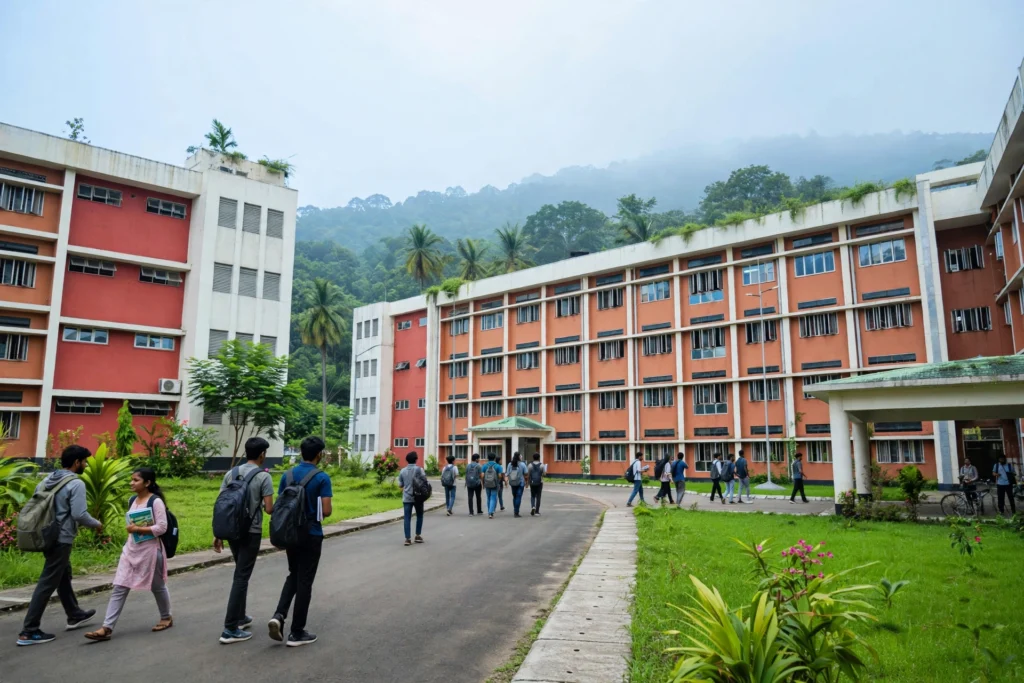
The NIT Agartala faculty probe demand has intensified after a section of teachers and employees raised concerns over recruitment, promotions, financial decisions and administrative practices under Director Professor Sarat Kumar Patra. Faculty members have called for an independent inquiry into the institute’s functioning, alleging procedural irregularities and unequal treatment of employees. The concerns involve several areas, including the Registrar’s contractual continuation after retirement, promotion opportunities, medical reimbursements and the use of institutional funds. The allegations have brought the administration of the National Institute of Technology Agartala under renewed scrutiny. However, the claims require examination through official records and responses from the authorities concerned.
Manik Saha Orders Probe Into Masked BJP Rally
Tripura Dense Fog Alert Warns Commuters
Faculty Members Seek Independent Inquiry
A section of NIT Agartala faculty members and employees has questioned decisions taken under Director Professor Sarat Kumar Patra. Their complaints extend beyond one appointment or administrative dispute.
Instead, they point to a series of concerns involving recruitment rules, seniority, financial approvals and employee welfare. They argue that the institute must follow transparent procedures because it receives public funding and operates as an Institute of National Importance under the Union Ministry of Education.
The NIT Agartala faculty probe demand centres on whether the administration followed applicable rules while taking important institutional decisions.
Faculty members want an independent authority to examine the allegations and establish whether officials followed the prescribed procedures. They also want the institute to provide clear explanations and relevant documents.
Registrar’s Contractual Continuation Raises Questions
One major issue concerns Registrar Dr. Asish Badola, who reportedly continued in the position on a contractual basis after retiring from his parent organisation in May 2025.
A complaint has questioned whether the arrangement complied with the Recruitment Rules governing Registrar appointments across NITs.
The complaint refers to the Ministry of Education’s February 20, 2019 notification, which established recruitment conditions for the post. It also questions the Selection Committee’s recommendation and the Board of Governors’ decision to allow the Registrar to continue after retirement.
Another concern involves the Registrar’s reported exercise of administrative and financial powers, including responsibilities as the Drawing and Disbursing Officer.
The complaint has also questioned whether institutional funds supported legal representation in a High Court case where the Registrar reportedly appeared as a private respondent alongside the institute.
These issues require examination of the recruitment advertisement, selection committee minutes, Board resolutions, appointment documents and legal expenditure records. The allegations do not, by themselves, establish that the appointment or related decisions violated the rules.
Promotion Process and Seniority Under Scrutiny
Faculty members have also raised questions about promotions and the allocation of senior administrative positions.
One key issue involves the Higher Administrative Grade (HAG) upgradation process for Professors. According to the reported complaints, the application deadline was January 15, 2026, while the scrutiny process reportedly took place on August 28.
Some senior Professors had allegedly requested an extension so that additional eligible candidates could apply. The administration’s decision not to extend the deadline has prompted questions about equal opportunity and transparency.
Faculty members have also questioned the appointment of Deans and Heads of Departments. They allege that some positions went to relatively junior faculty members despite the availability of senior Professors.
The complainants want the institute to explain how it considered seniority, academic experience and eligibility while assigning these responsibilities.
The NIT Agartala faculty probe demand therefore includes a review of promotion records, selection procedures and decisions involving higher administrative posts.
Financial Decisions and Medical Reimbursements Questioned
The complaints also cover financial approvals and medical reimbursement claims.
According to the reported allegations, the institute’s accounts administration questioned a Professor’s medical reimbursement claim following a cardiac procedure.
At the same time, complainants have raised questions about the approval of certain medical expenses reportedly claimed by a senior administrative functionary for himself and his wife. They have questioned whether those expenses, reportedly linked to cosmetic and skin treatments, qualified under applicable government reimbursement rules.
Faculty members want the authorities to examine whether the institute applied the same reimbursement standards to all employees.
An independent review would need to examine medical claims, approval notes, relevant government rules and payment records. Without those documents, it would be premature to reach a conclusion about the eligibility of any individual claim.
The complaints also raise broader concerns about the use of public funds and the financial oversight exercised by the institute’s administration.
Employee Treatment and Academic Environment
Beyond recruitment and financial matters, faculty members have expressed concern about the working environment at NIT Agartala.
Some employees reportedly feel that administrative decisions favour individuals considered close to the institute’s senior leadership. Others claim that the administration has sidelined their grievances and professional concerns.
The complaints also question how the institute distributes responsibilities and communicates important decisions.
Student concerns have added another dimension to the controversy. Earlier protests reportedly highlighted problems involving hostel food, campus cleanliness, internet access, electricity and drinking water.
Students temporarily suspended their agitation after receiving assurances. However, the earlier complaints have contributed to wider questions about administrative responsiveness and campus facilities.
Faculty members have also raised concerns about recruitment advertisements and whether the institute publicised vacancies widely enough to provide qualified local candidates with a fair opportunity.
These issues require separate examination through recruitment records, student grievance documents and official administrative responses.
Why Independent Oversight Matters
NIT Agartala operates under the National Institutes of Technology, Science Education and Research framework. Its administration must follow the applicable Act, Statutes, recruitment rules and government regulations.
The institute’s Board of Governors also has an important oversight role in major administrative and institutional matters.
An independent inquiry could examine whether the administration followed these requirements across the disputed decisions. It could also review the role of the Selection Committee, the Registrar, the Director and the Board of Governors where relevant.
The NIT Agartala faculty probe demand reflects the need for clear answers on matters involving public appointments, employee benefits and institutional expenditure.
However, an inquiry should examine documentary evidence and provide the concerned officials an opportunity to respond. Such a process would help distinguish procedural errors, administrative disagreements and any established violation of rules.
Conclusion
The NIT Agartala faculty probe demand has brought recruitment, promotions, financial approvals and employee treatment under renewed scrutiny. Faculty members and employees want an independent inquiry into Director Professor Sarat Kumar Patra’s administration. Their complaints raise questions about the Registrar’s contractual continuation, HAG upgradation, senior administrative appointments and medical reimbursements. However, the allegations remain unverified and require examination of official records. A transparent review, along with responses from the institute and the officials concerned, will be essential to address the concerns and protect confidence in the institution.
FAQs
1. Why are NIT Agartala faculty members demanding an independent inquiry?
They have raised concerns about recruitment, promotions, financial decisions, employee treatment and the institute’s administrative functioning.
2. Who is the Director of NIT Agartala named in the complaints?
The complaints concern decisions taken under Director Professor Sarat Kumar Patra.
3. What issue has been raised about the Registrar?
A complaint questions Dr. Asish Badola’s contractual continuation after retirement from his parent organisation in May 2025 and the powers he reportedly exercised afterward.
4. Why has the HAG promotion process attracted criticism?
Faculty members have questioned the application deadline, the delayed scrutiny process and the decision not to extend the application period.
5. What financial matters do the complaints highlight?
They question medical reimbursement decisions and the reported use of institutional funds for legal representation in a case involving the Registrar.
6. Has an independent inquiry been officially ordered?
The available report describes a demand for an independent inquiry. It does not confirm that the competent authorities have formally ordered one.