


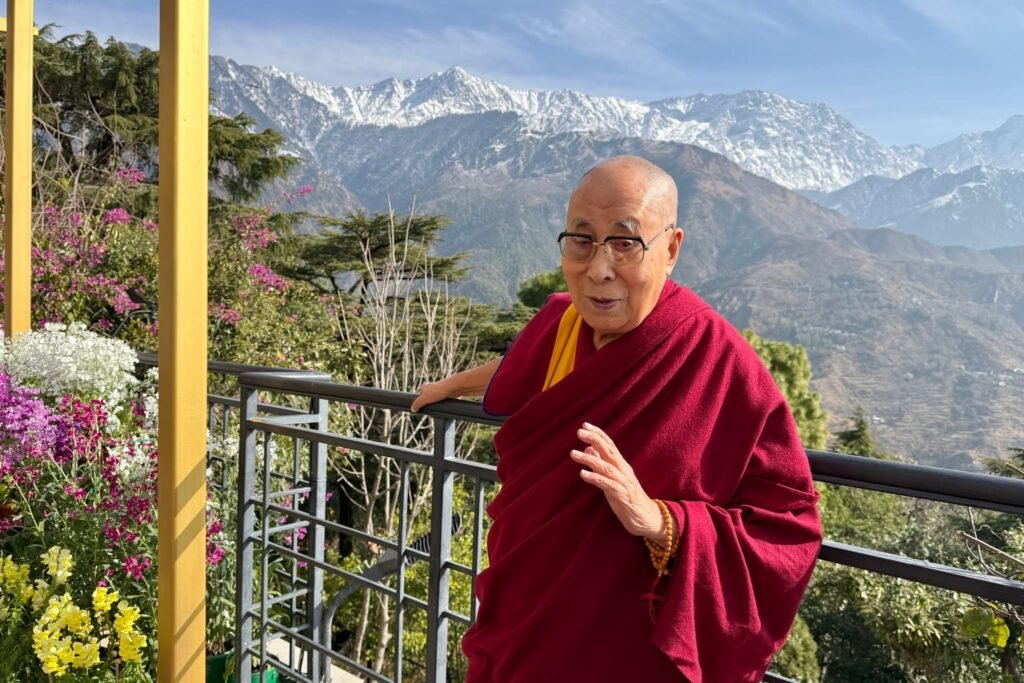
Chief Minister of Assam Dr. Himanta Biswa Sarma joined other Indian leaders, including Arunachal Pradesh Chief Minister Pema Khandu and Union Minister Kiren Rijiju, in wishing the 14th Dalai Lama on his 90th birthday recently.
These seemingly routine greetings carry weight beyond symbolic respect. They arrive at a moment when international and regional observers are asking a critical question: What will happen after the Dalai Lama?
” On His birthday,I offer my warmest wishes to His Holiness, The Dalai Lama.” Sarma wrote on facebook.
” For years , he has preached peace, compassion and unity across the world and inspired millons of people to live a life of truth and simplicity.I pray to God to grant him good health and a long life.” He further wrote.
The succession of the Dalai Lama is not only a deeply spiritual concern for millions of Buddhists but also a complex and highly sensitive geo-strategic matter for India—especially in the Northeast, where regions like Arunachal Pradesh are both spiritually tied to Tibetan Buddhism and geopolitically contested by China.
The Spiritual Leader Beyond Borders
The 14th Dalai Lama has been living in exile in India since 1959 after the failed Tibetan uprising against Chinese rule. Settled in Dharamshala, Himachal Pradesh, he has become a global icon of peace and non-violence, as well as the unchallenged spiritual leader of Tibetan Buddhists worldwide.
In India’s Northeast, particularly in Tawang, West Kameng, and parts of Sikkim, the Dalai Lama’s teachings and presence have provided not only spiritual nourishment but also a sense of cultural anchorage. Many communities in these areas follow the Gelug school of Tibetan Buddhism, to which the Dalai Lama belongs. His regular visits to Tawang have always been met with both reverence and political tension, as China frequently objects to such trips.
China’s Perspective: “South Tibet” and Strategic Claims
China has never accepted India’s sovereignty over Arunachal Pradesh and refers to large portions of it—especially the Tawang region—as “South Tibet”. Beijing considers the Dalai Lama a “separatist” and insists that only the Chinese state has the authority to recognize the next reincarnation.
In 1995, China appointed its own Panchen Lama, rejecting the boy chosen by the Dalai Lama—a move widely condemned by human rights groups. The Chinese state is expected to use a similar approach for the next Dalai Lama, orchestrating the recognition of a child born within China’s borders who can be trained under the Communist Party’s ideological framework.
This would create a dual Dalai Lama scenario: one chosen by the Tibetan Buddhist community in exile (most likely with Indian support), and another appointed by China. This schism will have far-reaching consequences.
Implications for India’s Northeast: A Closer Look
Religious and Cultural Uncertainty:
The Dalai Lama is not just a figurehead—he is the linchpin of faith and identity for millions. A dispute over succession could lead to spiritual confusion among communities in Tawang, Dirang, Bomdila, and other places. Some monasteries might face pressure to shift allegiance or risk being labeled as “anti-China.”
Tactical Psychological Pressure from China:
Beijing has used soft power and propaganda to assert its territorial claims. The installation of a state-backed Dalai Lama could be used to “validate” China’s claim over Arunachal Pradesh. With maps, renaming of towns, and issuing stapled visas to Arunachali citizens, China has already made symbolic moves; a state-chosen Dalai Lama could escalate these efforts.
Security at the LAC (Line of Actual Control):
Post-succession, China might increase troop movements or border infrastructure development under the guise of “protecting sacred Tibetan land.” This will force India to increase vigilance along the sensitive border stretches of Tawang, Upper Siang, and Anjaw districts.
India’s Position and Diplomatic Response
India has historically treaded a cautious path, recognizing the Dalai Lama as a religious leader while avoiding political endorsement of Tibetan independence. However, recent developments suggest a more assertive stance:
The Ministry of External Affairs (MEA) recently reiterated that Arunachal Pradesh is an “inseparable and integral part of India.”
India has also increased high-level visits to border areas and is investing heavily in infrastructure development, including the Sela Tunnel, strategic bridges, and advance landing grounds.
Prime Minister Narendra Modi and senior ministers have openly acknowledged the Dalai Lama’s contribution to peace, a shift from earlier years of diplomatic reticence.
Voices from the Region: Ties That Go Beyond Religion
In interviews conducted by this correspondent in Tawang and West Kameng, local leaders and monks expressed concern over the uncertainty that lies ahead.
“Our people respect only one Dalai Lama, the one we grew up with,” says a monk at the 17th-century Tawang Monastery. “We will not recognize any leader imposed by China.”
Local MLA Tsering Tashi emphasized the need for the central government to stand firm. “We have always defended our identity as Indians and Buddhists. Any foreign attempt to hijack our spiritual leadership must be resisted.”
In Assam, Buddhist communities in Barpathar, Margherita, and Namphake village also view the Dalai Lama with deep respect. The Tai-Phake and other tribes see him as a symbol of shared Buddhist heritage across the eastern Himalayan belt.
The Geopolitical Gameboard: Northeast as a Strategic Pivot
India’s Act East Policy and infrastructure investments in the Northeast aim not only at development but also at strategic deterrence. In this light, the Dalai Lama’s succession could be a test case of soft power versus authoritarian control.
China’s Belt and Road Initiative (BRI) and border disputes with Bhutan and Nepal indicate a larger pattern of expansionism. In this context, Arunachal and Assam could become the frontline of resistance against such ambitions—not through war, but through cultural, spiritual, and democratic resilience.
Future Course: What Should India Do?
Strengthen Monastic Institutions:
Empowering local monasteries in Arunachal with autonomy, funding, and cultural exchange can prevent external ideological penetration.
International Support:
India must collaborate with like-minded countries like the US, Japan, and European nations to support a free and legitimate reincarnation process of the Dalai Lama.
People-to-People Diplomacy:
Promoting Buddhist circuits across Northeast India can reinforce shared values of peace, harmony, and resistance to authoritarian influence.
Youth Engagement:
Local youth must be educated about the spiritual significance and geopolitical risks tied to the succession issue, turning potential vulnerabilities into awareness and preparedness.
As the twilight of the 14th Dalai Lama’s life approaches, the political and spiritual stakes in India’s Northeast are rising. His eventual successor—whether recognized globally or contested—will determine not only the future of Tibetan Buddhism but also the strategic stability of the entire eastern Himalayas.
In this sensitive time, leaders like Pema Khandu, Kiren Rijiju, and Himanta Biswa Sarma will be pivotal in ensuring that Northeast India remains a beacon of spiritual strength and national unity. The path forward will require not just military preparedness but also cultural insight, diplomatic balance, and faith in democratic values.
The Dalai Lama often says, “The real change is within.” For India, the real challenge—and opportunity—lies in standing firm while navigating the storm that may follow his departure.