


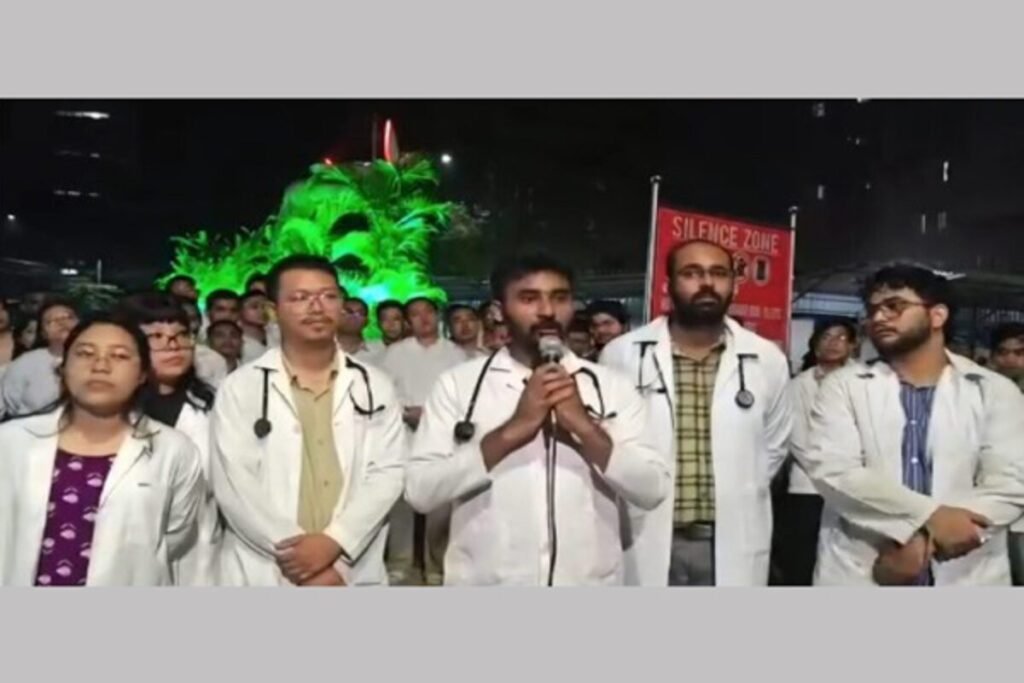
Resident doctors at Agartala Government Medical College and GB Pant Hospital have demanded stronger AGMC resident doctors security arrangements following concerns over workplace safety and professional dignity. The Resident Doctors’ Association staged a sit-in and submitted a five-point memorandum to the college administration. The doctors have sought stronger deployment, including Tripura State Rifles personnel, along with tighter controls on unauthorised recording inside hospital premises. The protest later paused after officials assured the doctors that their concerns would receive attention.
Tripura Prepares for 410 MW Durga Puja Power Demand
AGMC Resident Doctors Security Demands Gain Urgency
The AGMC resident doctors security issue came into sharper focus after an incident involving a senior resident doctor at the Medicine OPD. The episode was followed by the circulation of videos and allegations on social media, according to the Resident Doctors’ Association.
Doctors said the developments raised concerns about their safety, privacy and professional dignity. Consequently, the association decided to approach the college administration with a formal set of demands rather than treating the matter as an isolated dispute.
Resident doctors gathered outside the Principal’s office and staged a sit-in. They also submitted a five-point memorandum outlining the measures they wanted authorities to consider. The demands covered both physical security and the protection of doctors from unauthorised recording and online circulation of disputed material.
The security demand has particular importance in a hospital that operates continuously. Doctors, postgraduate trainees and other healthcare workers may remain on duty during late-night and early-morning hours. Therefore, they have argued that security arrangements must provide reliable protection throughout the day and night.
The association has also linked workplace security with patient care. In its view, doctors need a safe environment to perform clinical duties without avoidable disruption or fear. A stronger security framework could therefore benefit both healthcare workers and patients.
Doctors Seek Stronger Deployment Across Hospital
One of the central demands concerns the deployment of security personnel. The RDA has sought the replacement of SIS security guards with Tripura State Rifles personnel wherever necessary and has called for stronger security arrangements across the hospital premises.
The demand reflects the doctors’ wider concern about whether existing arrangements can adequately respond to security incidents. Rather than focusing only on a single location, the association has asked the administration to strengthen protection across areas used by doctors and other healthcare workers.
Hospital security involves more than personnel at an entrance. It can also include controlled access, surveillance, adequate lighting, patrols and clear procedures for responding to emergencies. Additionally, staff members need confidence that authorities can respond quickly when an incident occurs.
The latest demand also comes after earlier security concerns at the GB Pant Hospital campus. A previous incident involving unauthorised entry into the resident doctors’ hostel had prompted the administration to review security arrangements and introduce additional measures. Reports have referred to fencing, protective grills and increased patrolling among the steps taken after that episode.
That earlier experience has added context to the present demand. Resident doctors now want security improvements to remain a broader institutional priority rather than a temporary response to individual incidents.
However, the association’s request for stronger security must also work alongside the hospital’s responsibility to maintain smooth patient movement. Any upgraded system will need to protect staff while allowing patients and authorised attendants to access essential services.
Privacy and Unauthorised Recording Become Key Issues
The AGMC resident doctors security debate also extends beyond physical protection. The RDA has raised concerns about unauthorised photography and videography inside wards, outpatient departments and other patient-care areas.
The doctors have argued that recording inside clinical spaces can affect the privacy of patients as well as the safety and dignity of healthcare workers. They have therefore sought tighter controls on photography and video recording by media personnel, patients and attendants without proper permission.
The association has also demanded removal of videos related to the recent incident and corrections to material it considers misleading. It has sought preventive measures to stop similar content from being recorded and circulated without consent.
Another part of the memorandum concerns what the RDA described as a one-sided “media trial”. The association has maintained that the concerned doctor should receive an opportunity to present their version before public conclusions or administrative action are taken.
These demands remain the association’s position and do not determine the facts of the underlying incident. Any allegations against individuals should be examined through appropriate procedures, while complaints concerning healthcare professionals should also receive due consideration.
Furthermore, protecting patient privacy remains an important part of hospital management. Clinical areas often contain sensitive personal information, making unauthorised recording a concern that extends beyond the dispute involving the resident doctor.
The administration therefore faces a dual responsibility. It must address legitimate security concerns while also ensuring that any restrictions on recording remain consistent with hospital rules, patient rights and applicable law.
Five-Point Memorandum Seeks Administrative Action
The resident doctors’ memorandum brought several concerns together. Alongside stronger security deployment, the RDA requested action concerning videos circulating online, alleged misinformation and unauthorised recording.
The association also sought legal action against people whom it alleged had made false accusations against the concerned doctor. It called on the Medical Superintendent to lodge an FIR and pursue appropriate proceedings where the allegations were found to have a legal basis.
Such requests require examination by the competent authorities. An allegation alone does not establish wrongdoing, and any legal action must follow evidence and due process.
Meanwhile, the proposed protest put pressure on the administration to respond quickly. The doctors had warned that they could resort to a pen-down strike if their demands were not addressed by October 5. The possibility raised concerns about the impact of industrial action on medical services.
Chief Minister and Health Minister Manik Saha intervened on October 3 and directed senior officials to examine the dispute. He said the matter had been forwarded to the Home Secretary for coordination with the Director General of Police and appropriate action.
That intervention preceded a later meeting between representatives of the doctors and senior administrative and police officials. According to reports, the doctors temporarily suspended their work stoppage after receiving assurances that their concerns would be pursued.
The development indicates that the immediate confrontation has eased, although the underlying security demands remain important. Authorities will now face expectations to convert their assurances into concrete measures.
Earlier Hostel Incident Highlights Security Gaps
The latest demand cannot be viewed entirely separately from earlier concerns at GB Pant Hospital. Reports in early October referred to a July incident in which an unauthorised person allegedly entered the women’s resident doctors’ hostel.
That incident reportedly prompted a review of the hospital’s security arrangements. Concerns included surveillance coverage, campus access points and the protection of residential areas used by doctors. The administration subsequently announced additional fencing, protective grills and stronger patrolling around the hostel area.
The earlier episode highlighted the particular vulnerability of doctors who live within or near hospital premises. Resident doctors often work long shifts, and their accommodation needs security measures comparable to other essential institutional facilities.
Consequently, the current demand for stronger security reflects a broader workplace concern. Doctors are asking authorities to create an environment in which they can move between clinical duties and residential areas without facing avoidable risks.
At the same time, hospital authorities must evaluate security arrangements regularly. A one-time deployment increase may not address structural gaps if surveillance, access control or patrol systems remain inconsistent.
A comprehensive approach could therefore involve coordination between the medical college, hospital administration and law-enforcement agencies. Such coordination would allow authorities to identify vulnerable areas and establish clear responsibilities during emergencies.
Administration Faces Pressure to Deliver Concrete Measures
The AGMC resident doctors security issue now enters a stage where implementation will matter more than assurances. The temporary suspension of the work stoppage gives authorities an opportunity to address the concerns raised by the RDA without disrupting patient services.
The doctors have already placed their demands formally before the administration. The next step will be to determine which measures can be implemented immediately and which require longer-term planning.
Stronger security deployment could provide a visible response. However, effective protection will also depend on access controls, surveillance, patrol schedules, emergency communication and clear reporting procedures.
Moreover, any new system should cover doctors, nurses, interns, postgraduate trainees and other healthcare workers. Patients and authorised attendants also need a safe and orderly environment during treatment.
The dispute has shown how quickly a workplace incident can expand into concerns about professional dignity, privacy and institutional security. Addressing those concerns through transparent procedures could help prevent similar tensions in the future.
For the resident doctors, the immediate priority remains a safe workplace. For the administration, the challenge is to deliver that protection while ensuring that hospital operations continue without interruption.
Conclusion
The AGMC resident doctors security demand has brought workplace safety, privacy and professional dignity into focus at Agartala Government Medical College and GB Pant Hospital. The Resident Doctors’ Association has sought stronger security deployment, including TSR personnel, alongside restrictions on unauthorised recording inside clinical areas.
The protest followed an incident involving a senior resident doctor and the subsequent circulation of videos and allegations online. Although the doctors later paused their work stoppage after receiving assurances from officials, their broader concerns remain relevant.
The administration now has an opportunity to strengthen security through practical measures covering personnel, surveillance, access control and emergency response. A consistent approach could protect healthcare workers while also supporting uninterrupted patient care.
FAQs
Why are AGMC resident doctors demanding stronger security?
The AGMC resident doctors security demand follows concerns about workplace safety, professional dignity and privacy after an incident involving a senior resident doctor at the Medicine OPD.
What security change have the doctors requested?
The Resident Doctors’ Association has sought stronger deployment and called for SIS security guards to be replaced by Tripura State Rifles personnel wherever required.
What other demands did the doctors raise?
The five-point memorandum also sought action concerning online videos, alleged misinformation, unauthorised photography and videography, professional dignity and alleged false accusations.
Did the doctors proceed with a strike?
The doctors had threatened a pen-down strike from October 5 if their demands were not addressed. They later temporarily suspended the work stoppage after receiving assurances from senior administrative and police officials.
What did Chief Minister Manik Saha do?
Manik Saha directed senior officials to examine the dispute and coordinate with the Home Department and police authorities.