


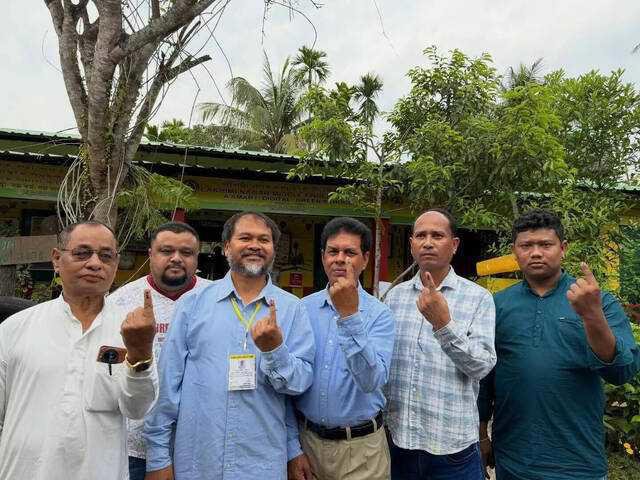
Raijor Dal president and MLA Akhil Gogoi has stirred political debate by claiming that voters in Assam are choosing democracy over what he described as “fascism.” His remarks come amid heightened political activity and intense campaigning, as parties seek to sway public opinion ahead of key electoral developments.
Gogoi’s statement reflects the sharp ideological divide in Assam’s political landscape, where opposition leaders have been vocal in criticizing the ruling Bharatiya Janata Party and its governance approach. The comments have triggered reactions from various political quarters, adding to the ongoing war of narratives in the state.
Read More: Assam Voting 2026: What to Expect, Stakes and Result Updates
Political Context Behind the Remark
Akhil Gogoi’s statement did not emerge in isolation but is rooted in the broader political environment of Assam. Over the past few years, the state has witnessed intense political competition, with opposition parties attempting to challenge the dominance of the BJP.
Gogoi has been a consistent critic of the government led by Chief Minister Himanta Biswa Sarma. He has often raised concerns about issues such as governance, civil liberties, and the functioning of democratic institutions.
According to Gogoi, the current political climate has prompted voters to reflect on the importance of democratic values. He argued that people are increasingly aware of their rights and are making informed choices at the ballot box.
BJP Responds to Allegations
The BJP has strongly rejected Akhil Gogoi’s claims, calling them politically motivated and baseless. Party leaders have defended their governance record, highlighting achievements in areas such as infrastructure development, healthcare, and economic growth.
Supporters of the BJP argue that the party’s policies are aimed at strengthening democracy rather than undermining it. They contend that accusations of “fascism” are exaggerated and intended to create unnecessary fear among voters.
Chief Minister Himanta Biswa Sarma and other leaders have emphasized that the government remains committed to transparency, accountability, and inclusive development. They have urged voters to focus on tangible outcomes rather than rhetoric.
Opposition’s Narrative Gains Momentum
Despite the BJP’s rebuttal, opposition parties have echoed Akhil Gogoi’s sentiments, framing the الانتخابات as a contest between democratic principles and authoritarian tendencies. Leaders from various parties have joined the discourse, criticizing the government on multiple fronts.
The opposition has sought to mobilize voters by highlighting issues such as unemployment, price rise, and alleged misuse of state machinery. They argue that these concerns reflect deeper structural problems that need to be addressed.
Akhil Gogoi, known for his activism and grassroots connect, has played a key role in amplifying this narrative. His statements resonate with sections of the electorate that are seeking change and greater accountability.
Voter Sentiment on the Ground
The claim that voters are choosing democracy over fascism reflects a broader attempt to interpret public sentiment. While it is difficult to generalize, there are indications that voters are actively engaging with political issues and evaluating their options.
In many parts of Assam, voter turnout and participation in political discussions have increased, suggesting a heightened level of awareness. People are weighing factors such as governance performance, leadership, and policy priorities before making decisions.
At the same time, opinions remain divided. While some voters align with the opposition’s critique, others support the BJP’s development agenda. This diversity of perspectives highlights the complexity of the electoral landscape.
Impact on Assam’s Political Discourse
Statements like those made by Akhil Gogoi contribute to shaping the tone and direction of political discourse. They bring ideological debates to the forefront, encouraging voters to think beyond immediate concerns and consider broader principles.
However, such rhetoric can also lead to polarization, as different groups interpret the language in varying ways. Critics argue that the use of terms like “fascism” may oversimplify complex issues and intensify divisions.
Nevertheless, the exchange of ideas and perspectives is an essential aspect of a healthy democracy. It allows voters to hear diverse viewpoints and make informed choices.
Focus on Governance and Accountability
Amid the heated rhetoric, the core issues of governance and accountability remain central to the political debate. Both the ruling party and the opposition are attempting to present their visions for Assam’s future.
The BJP continues to emphasize its track record, citing improvements in infrastructure, law and order, and social welfare schemes. On the other hand, opposition leaders, including Akhil Gogoi, stress the need for greater transparency and responsiveness.
This dynamic creates a competitive environment where parties must continuously engage with voters and address their concerns. It also underscores the importance of elections as a mechanism for accountability.
What Lies Ahead
As Assam moves forward in its electoral journey, the impact of statements like Akhil Gogoi’s will become clearer. Whether voters interpret the الانتخابات as a battle between democracy and fascism or focus on other issues will shape the outcome.
Political analysts believe that while rhetoric plays a role, factors such as grassroots organization, candidate selection, and voter outreach are equally important. The ability of parties to connect with people on the ground will be crucial.
For now, Akhil Gogoi’s remarks have added a new dimension to the political conversation in Assam. They highlight the intensity of the contest and the stakes involved, as parties vie for the support of an increasingly engaged electorate.
Read More: Tipra Motha Exit Certain, BJP Eyes District Council Power in Tripura