


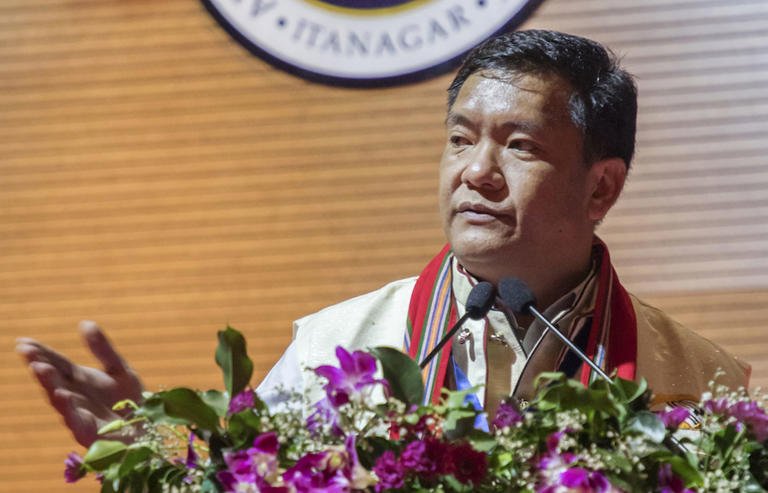
Arunachal Pradesh Chief Minister Pema Khandu has called upon universities across the Northeast to move beyond traditional degree-oriented education and become “problem-solving institutions.” He said higher education institutions must play a more active role in addressing the region’s developmental, social, environmental and strategic challenges.
Khandu made the remarks in Guwahati while speaking about the future of higher education in Northeast India. He stressed that universities should not limit their role to classrooms, examinations and academic degrees. Instead, they should connect research and education with the real problems faced by communities across the region.
The Chief Minister’s remarks come at a time when the Northeast is witnessing rapid changes in infrastructure, technology, education and economic development. He believes universities can become important partners in this transformation by producing research and solutions that directly benefit the region.
Read More: Manipur CM Khemchand Singh Felicitates Commonwealth Games Silver Medallist Rishikanta Singh
Khandu Wants Universities to Focus on Real Problems
Khandu urged universities to understand the challenges that people face in their everyday lives. He said academic institutions should use their knowledge, research capabilities and human resources to find practical solutions.
The Northeast faces several unique challenges. These include difficult geographical conditions, limited connectivity in some areas, environmental concerns and gaps in infrastructure. The region also has a rich cultural and social diversity that requires locally sensitive development strategies.
According to Khandu, universities can help address these issues through focused research. They can also work with governments, industries and local communities to develop solutions that suit the region’s specific needs.
Such an approach could also make higher education more relevant to students. Instead of learning only from textbooks, students could work on projects linked to agriculture, tourism, climate change, healthcare, technology and local entrepreneurship.
Northeast Needs Stronger Academic-Development Link
The Chief Minister’s call reflects the need for a stronger connection between higher education and regional development.
Universities have access to researchers, teachers, students and specialised knowledge. This gives them the ability to study complex problems in depth. However, Khandu’s message suggests that academic research should also reach beyond university campuses.
For example, researchers could study ways to improve agriculture in difficult terrain. They could explore sustainable tourism models that protect the region’s environment. They could also develop technologies that improve connectivity and public services in remote areas.
Universities could further contribute by studying indigenous knowledge and traditional practices. Such research could help preserve cultural heritage while supporting modern development.
Education Must Go Beyond Degrees
Khandu’s emphasis on “problem-solving institutions” challenges the conventional understanding of higher education.
A university traditionally focuses on teaching students and awarding academic qualifications. However, modern universities increasingly contribute to innovation, entrepreneurship, research and public policy.
Khandu wants institutions in the Northeast to adopt a similar approach. He believes universities should prepare students not only to seek employment but also to create solutions and opportunities.
This approach can encourage young people to become entrepreneurs, researchers and innovators. It can also help reduce dependence on conventional government jobs and encourage students to explore new career paths.
Arunachal Pradesh has already taken steps to promote innovation and entrepreneurship. The state has supported initiatives designed to develop a problem-solving mindset among young people and create a stronger ecosystem for startups and innovation.
Research Can Address Regional Challenges
Research can play a major role in solving the Northeast’s developmental challenges. Khandu’s vision places universities at the centre of that process.
The region has enormous potential in areas such as biodiversity, renewable energy, tourism, agriculture and cultural studies. Universities can help identify sustainable ways to use these resources.
Environmental research remains particularly important. The Northeast contains fragile ecosystems and rich biodiversity. Development projects must therefore balance economic growth with environmental protection.
Universities can provide scientific data and policy recommendations to help governments make better decisions. Their research can also support local communities that depend on forests, agriculture and natural resources.
Technology and Innovation Can Drive Change
Khandu’s vision also highlights the growing importance of technology in education and development.
Universities can become centres for technological innovation. They can encourage students to develop solutions using artificial intelligence, digital platforms, data analysis and other emerging technologies.
Such innovation could address practical problems in areas such as healthcare, education, transportation and agriculture.
Arunachal Pradesh has already introduced technology-based initiatives in education. Earlier this year, Khandu inaugurated a Foundational Literacy and Numeracy Centre at Doimukh. The centre combines activity-based learning with digital tools, STEM exposure and local cultural knowledge.
These initiatives reflect a broader focus on practical and experiential learning.
Universities Can Strengthen Youth Opportunities
The Chief Minister’s proposal could also create more opportunities for young people across the Northeast.
Students who work on real-world problems can develop skills that employers increasingly value. These include critical thinking, research, communication, innovation and problem-solving.
Universities can also connect students with industries and government departments. Such partnerships can provide internships, research opportunities and practical experience.
This approach could help students understand the challenges of their own communities. It may also encourage talented young people to remain in the region and contribute to its development.
Collaboration Across the Northeast Is Important
Khandu’s appeal covers universities across the entire Northeast. This reflects the need for greater cooperation among academic institutions in the region.
Universities in different states can collaborate on research projects and share expertise. They can jointly study issues that cross state boundaries, including climate change, biodiversity, connectivity and public health.
Regional collaboration can also strengthen the Northeast’s academic ecosystem. Institutions can share laboratories, research facilities and specialised knowledge.
Such partnerships could help universities take on larger projects and produce research with greater regional impact.
Universities Can Become Partners in Development
Khandu’s call ultimately seeks to change the role of higher education in the Northeast. He wants universities to become active participants in the region’s development rather than functioning only as centres of instruction.
The idea of a problem-solving institution places practical impact at the heart of education. It encourages universities to ask important questions, conduct relevant research and develop solutions that communities can actually use.
The approach also aligns education with the changing needs of society. As the Northeast faces new economic, environmental and technological challenges, universities can provide knowledge and skilled people to address them.
A New Vision for Northeast Higher Education
Pema Khandu’s message has placed the future of higher education at the centre of the Northeast’s development conversation. His call for universities to become problem-solving institutions highlights the need to connect education with real-world challenges.
The Northeast has a young population, rich natural resources and significant cultural diversity. Strong universities can help turn these strengths into long-term opportunities.
By promoting practical research, innovation and collaboration, academic institutions can contribute directly to regional growth. They can also prepare students to become creators of solutions rather than simply recipients of degrees.
Khandu’s vision therefore goes beyond education. It presents universities as important engines of innovation, employment and sustainable development across the Northeast. If academic institutions successfully embrace this role, they could become powerful partners in building a more resilient, innovative and self-reliant region.
Read More: Kuki Inpi Manipur Raises Strong Objection to CM’s Kangpokpi Visit