


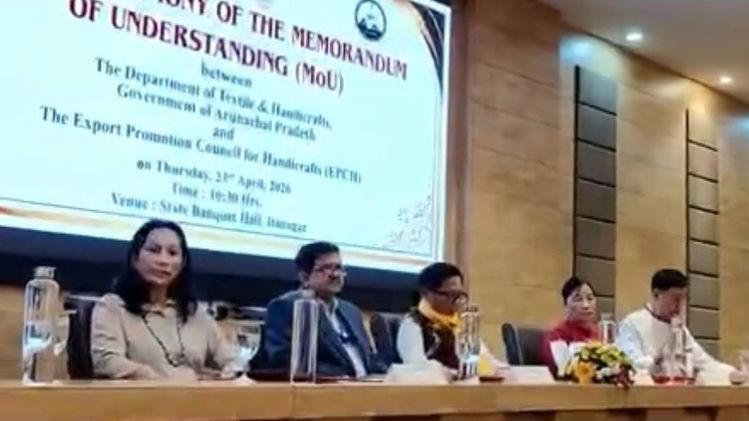
The Arunachal Pradesh government has taken a major step to strengthen its traditional industries. It recently signed a memorandum of understanding with the Export Promotion Council for Handicrafts. This agreement aims to boost the state’s textile and handicrafts sector.
The Arunachal Pradesh EPCH MoU focuses on improving market access, skill development, and global exposure for local artisans. Moreover, the initiative seeks to promote indigenous crafts that reflect the cultural identity of the region. Officials believe this collaboration will help artisans secure better income opportunities while preserving traditional skills.
Read More: Tripura: TTAADC Members to Take Oath on April 27, Tipra Motha Set to Form Council
The state government has been actively promoting local industries in recent years. Therefore, this MoU marks another milestone in its efforts to build a sustainable economic ecosystem for artisans.
Key objectives of the Arunachal Pradesh EPCH MoU
The agreement outlines several important objectives. First, it aims to enhance the quality and competitiveness of handicraft products. To achieve this, EPCH will provide technical support and training to artisans.
Second, the MoU focuses on expanding market linkages. Artisans in Arunachal Pradesh often struggle to reach national and international buyers. However, with EPCH’s network, they will gain access to global exhibitions and trade fairs.
Third, the initiative emphasizes branding and promotion. Local crafts often lack visibility despite their uniqueness. Therefore, the collaboration will help create a strong brand identity for Arunachal products.
Additionally, the MoU includes provisions for design innovation. Experts will work with artisans to modernize traditional designs while maintaining authenticity. This approach ensures that products remain relevant in contemporary markets.
Boost for traditional textiles and indigenous crafts
Arunachal Pradesh is known for its rich textile heritage. Different communities in the state produce distinct patterns and weaving styles. These textiles are not just products but also cultural expressions.
Through the Arunachal Pradesh EPCH MoU, the government aims to revive and promote these traditional crafts. Training programs will focus on improving weaving techniques and introducing new designs. As a result, artisans can produce high-quality items that appeal to modern consumers.
Moreover, the initiative will support other handicraft sectors such as bamboo, cane, and woodwork. These crafts have strong demand potential but often lack proper marketing channels. With EPCH’s support, artisans can showcase their work on larger platforms.
This effort will also encourage younger generations to take up traditional crafts. Many young people have moved away from these professions due to limited income. However, improved opportunities may attract them back to their roots.
Economic impact and employment opportunities
The Arunachal Pradesh EPCH MoU is expected to create significant economic benefits. Handicrafts and textiles have the potential to generate large-scale employment, especially in rural areas.
By improving market access, artisans can increase their earnings. This will lead to better living standards and reduced migration from villages. Furthermore, the initiative supports women artisans, who form a major part of the workforce in this sector.
The collaboration also aligns with the government’s broader goal of promoting self-reliance. By strengthening local industries, the state can reduce dependence on external markets. At the same time, it can position itself as a hub for high-quality handicrafts.
Officials have highlighted that the initiative will also boost tourism. Visitors often seek authentic local products as souvenirs. Therefore, a strong handicrafts sector can enhance the overall tourism experience in Arunachal Pradesh.
Government’s vision for sustainable growth
The Arunachal Pradesh government has emphasized sustainable development in its policies. The handicrafts sector plays a crucial role in this vision. It relies on eco-friendly materials such as bamboo and natural fibers.
Through the EPCH partnership, the state aims to promote environmentally responsible production practices. Training programs will include sustainable sourcing and waste management techniques.
Moreover, the government plans to integrate digital tools into the sector. Artisans will receive guidance on online marketing and e-commerce platforms. This will help them reach customers beyond geographical boundaries.
The Arunachal Pradesh EPCH MoU also reflects the state’s commitment to preserving cultural heritage. By supporting traditional crafts, the government ensures that these skills continue for future generations.
Future roadmap and expectations
Looking ahead, the success of the Arunachal Pradesh EPCH MoU will depend on effective implementation. Authorities plan to organize workshops, exhibitions, and buyer-seller meets. These initiatives will create direct connections between artisans and markets.
Additionally, the government will monitor progress and provide necessary support. Regular evaluations will help identify challenges and improve strategies.
Experts believe that this collaboration can transform the handicrafts sector in Arunachal Pradesh. If executed well, it can serve as a model for other North Eastern states.
In conclusion, the Arunachal Pradesh EPCH MoU represents a promising step towards economic growth and cultural preservation. It not only empowers artisans but also strengthens the state’s identity on a global platform.
Read More: Political turmoil after Kharge’s remarks on PM Modi