


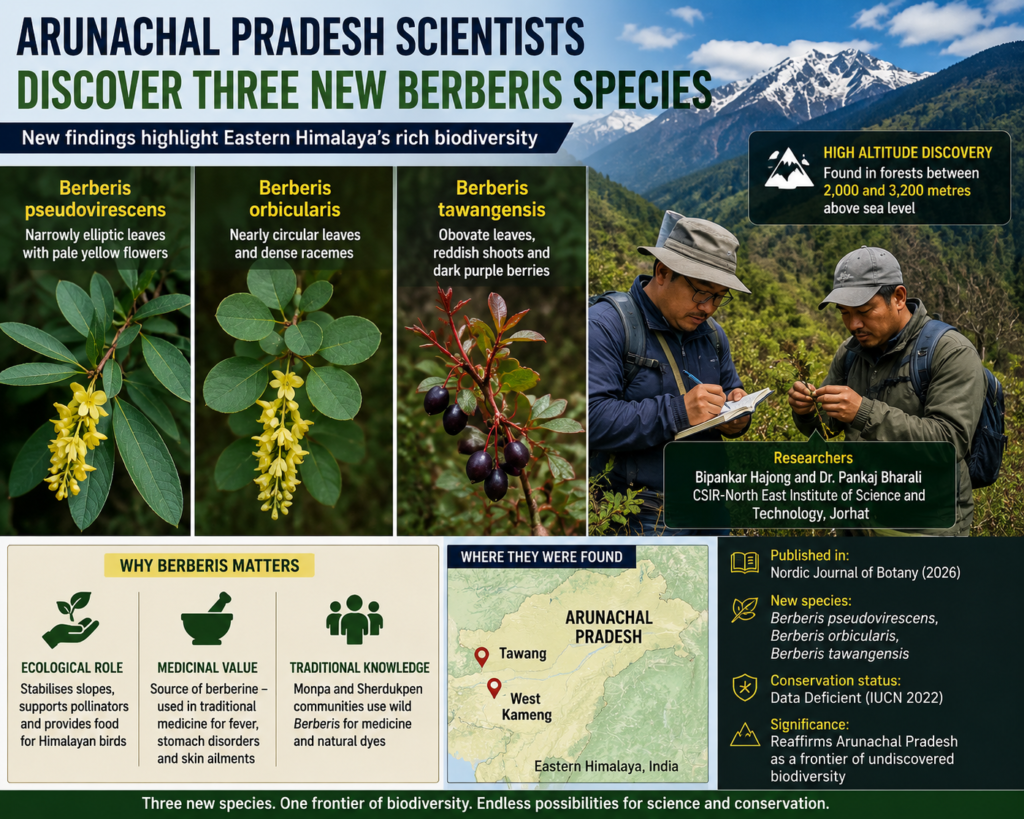
Scientists from the CSIR-North East Institute of Science and Technology (CSIR-NEIST), Jorhat, have discovered three new species of Berberis shrubs in the high-altitude forests of Arunachal Pradesh. The newly identified species — Berberis pseudovirescens, Berberis orbicularis, and Berberis tawangensis — were found during field studies in Tawang and West Kameng districts. Researchers published the findings in the 2026 edition of the Nordic Journal of Botany. The discovery highlights Arunachal Pradesh’s importance as a biodiversity hotspot in the Eastern Himalaya region. Scientists say the plants have ecological, medicinal, and conservation value, while local tribal communities have traditionally used wild Berberis species for medicine and dyes.
Read More: Meghalaya Mawkdok Skywalk Project Nears Completion
Key Facts
- State: Arunachal Pradesh
- New Species Discovered:
- Berberis pseudovirescens
- Berberis orbicularis
- Berberis tawangensis
- Research Institution: CSIR-North East Institute of Science and Technology
- Scientists Involved:
- Bipankar Hajong
- Dr. Pankaj Bharali
- Discovery Locations:
- Tawang
- West Kameng
- Altitude Range: 2,000 to 3,200 metres above sea level
- Published In: Nordic Journal of Botany (2026 edition)
- Conservation Status: Data Deficient under IUCN guidelines
Scientists Discover New Plant Species in Arunachal Pradesh
Researchers from CSIR-North East Institute of Science and Technology have identified three previously unknown Berberis species in the forests of Arunachal Pradesh.
The discovery emerged during extensive botanical surveys conducted in the districts of Tawang and West Kameng.
Scientists Bipankar Hajong and Dr. Pankaj Bharali led the research team that documented the species in temperate broadleaved and mixed conifer forests at elevations between 2,000 and 3,200 metres.
Three New Berberis Species Identified
The newly discovered species include Berberis pseudovirescens, Berberis orbicularis, and Berberis tawangensis.
Researchers named Berberis tawangensis after its type locality in Tawang, where the shrub was found growing on rocky slopes and forest margins.
Meanwhile, scientists collected Berberis pseudovirescens and Berberis orbicularis from moist valleys and scrubland habitats in West Kameng.
The research team confirmed the uniqueness of the plants after detailed comparisons with more than 400 known Berberis species across the world.
Unique Botanical Features Observed
Scientists observed several distinctive physical features in the three species.
Berberis pseudovirescens displays narrowly elliptic leaves, visible leaf veins, and pale yellow flowers. In contrast, Berberis orbicularis features almost circular leaves and dense flower clusters.
Additionally, Berberis tawangensis produces obovate leaves, reddish young shoots, and dark purple berries.
Researchers also studied leaf shape, spine structure, seed morphology, and flower arrangements to confirm the classification of the plants as new species.
The scientists deposited holotype specimens at the CSIR-NEIST herbarium, while they sent duplicate samples to national botanical repositories.
Importance of Berberis Plants
Berberis shrubs, commonly known as barberry plants, play an important ecological role in Himalayan ecosystems.
The shrubs help stabilise mountain slopes and provide food resources for pollinators and Himalayan bird species.
Moreover, Berberis plants possess medicinal value because their roots and stems contain berberine, a natural alkaloid widely used in traditional medicine.
Communities across the Himalayan region have historically used Berberis extracts for treating fever, gastrointestinal disorders, and skin diseases.
Modern scientific studies are also examining berberine for its antimicrobial, anti-inflammatory, and anti-diabetic properties.
Arunachal Pradesh Emerges as Biodiversity Hotspot
According to Dr. Pankaj Bharali, the discovery forms part of a larger scientific review of Berberis diversity in Arunachal Pradesh.
The Eastern Himalayan region continues to gain recognition as a major centre for plant evolution and species diversification.
Researchers believe the mountainous terrain and diverse climate conditions of Arunachal Pradesh support the growth of many rare and undiscovered species.
As a result, scientists continue to conduct botanical explorations in remote forest areas of the state.
Conservation Concerns and Traditional Knowledge
Scientists currently classify all three species as “Data Deficient” under International Union for Conservation of Nature (IUCN) guidelines because researchers still lack sufficient information about their population size and distribution.
However, experts warn that newly discovered species with limited habitats may face future threats from environmental changes and habitat disturbance.
The discovery also highlights the importance of indigenous knowledge systems in Northeast India.
Local Monpa and Sherdukpen communities in Tawang and West Kameng have traditionally used wild Berberis plants for medicinal purposes and natural dyes.
Importance of Arunachal Pradesh in Northeast India
Arunachal Pradesh is one of India’s richest biodiversity regions and forms an important part of the Eastern Himalaya global biodiversity hotspot.
The state’s forests contain numerous rare plants, wildlife species, and medicinal herbs. Therefore, scientific discoveries from Arunachal Pradesh contribute significantly to India’s environmental research, conservation planning, and ecological understanding.
Question and Answer Section
What did scientists discover in Arunachal Pradesh?
Scientists discovered three new species of Berberis shrubs in the forests of Arunachal Pradesh.
Who conducted the research?
Researchers Bipankar Hajong and Dr. Pankaj Bharali from CSIR-North East Institute of Science and Technology conducted the study.
Where were the species found?
The plants were found in Tawang and West Kameng districts.
Why are Berberis plants important?
Berberis species support ecosystems and have medicinal value because they contain berberine compounds used in traditional medicine.
What is the conservation status of the new species?
Scientists currently classify the three species as Data Deficient under IUCN guidelines.
Also Read: Mizoram Plans New Land Revenue Bill 2026