


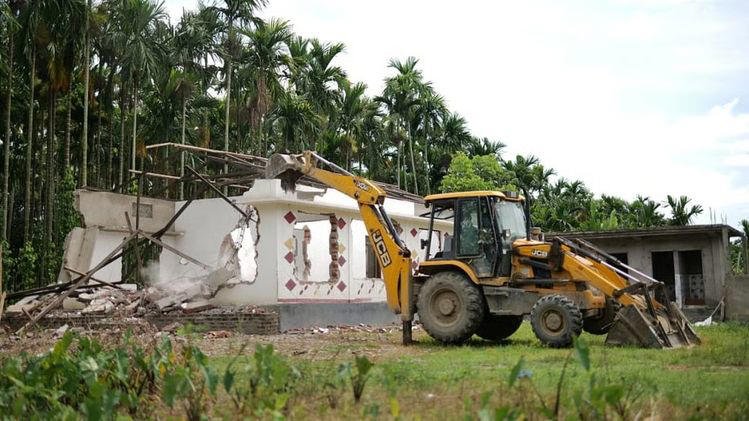
The Assam government has intensified its measures to protect forest land with the launch of the second phase of the Assam eviction drive in the Rangma reserve forest. Officials confirmed that around 26 hectares of encroached land were cleared as part of the operation, which aims to safeguard the state’s biodiversity and check illegal settlements.
The drive, which began earlier this week, witnessed the participation of forest personnel, district administration, and police forces. Authorities said the action was carried out peacefully, though several families were relocated from the reserve forest areas.
Read More: Arunachal Governor Hails Assembly’s 50 Years, Calls for Inclusive Growth
Second phase eviction marks a big step in conservation
The Assam eviction drive in Rangma reserve forest is part of a broader plan by the state government to reclaim forest lands from illegal encroachment. According to officials, the second phase alone resulted in the clearance of 26 hectares, an achievement considered vital for the ecological balance of the region.
The reserve forest, known for its rich flora and fauna, has faced rising encroachments in recent decades. Local sources revealed that settlements, agricultural fields, and small structures had gradually expanded into restricted zones, endangering the ecosystem.
By reclaiming this land, authorities expect to restore the forest’s natural environment while sending a strong signal against unlawful occupation.
Administration ensures law and order during eviction
To ensure a smooth process, the district administration and police deployed adequate personnel. Heavy machinery was used to dismantle makeshift houses and clear agricultural fields. Officials stressed that the eviction was carried out after issuing multiple notices to the occupants, giving them sufficient time to vacate the land.
Eyewitnesses reported that the process was conducted without major resistance. Still, security forces remained alert throughout to prevent untoward incidents. The administration also mentioned that arrangements were being considered for the rehabilitation of affected families in nearby areas, though details are yet to be finalized.
Protecting biodiversity remains a key priority
The Assam eviction drive in Rangma reserve forest is not only about reclaiming land but also about protecting the state’s rich biodiversity. Environmental experts have often warned that unchecked encroachments in forests can lead to soil erosion, habitat loss, and damage to wildlife corridors.
Rangma reserve forest is home to various species of birds, reptiles, and mammals. Conservators argue that restoring the forest land is essential for maintaining ecological balance and ensuring long-term environmental sustainability.
The government has emphasized that forest conservation is a priority, aligning with its larger vision of sustainable development. By reclaiming forest areas, officials aim to curb further degradation and secure green cover for future generations.
Eviction drive sparks mixed reactions among residents
While many environmentalists have welcomed the government’s decision, local residents expressed mixed emotions about the eviction. Some families claimed they had been living on the land for decades and depended on farming for their livelihood. For them, the eviction meant sudden displacement and uncertainty.
On the other hand, several community leaders supported the initiative, highlighting that unchecked encroachment not only harms forests but also reduces resources for future generations. They urged the government to balance conservation efforts with proper rehabilitation measures for affected families.
Assam’s wider policy on forest protection
The Rangma operation is part of a series of eviction drives launched by the state government in recent years. Assam has witnessed increasing instances of forest and wetland encroachments, prompting authorities to take strict action.
Officials stated that similar eviction campaigns are being planned in other vulnerable forest belts across the state. The administration intends to reclaim thousands of hectares of land in a phased manner. This long-term plan aims to strengthen Assam’s position as a state committed to both development and environmental preservation.
Chief Minister Himanta Biswa Sarma has repeatedly stressed that protecting forest reserves is a non-negotiable responsibility of the government. He argued that while developmental projects remain important, they must not come at the cost of the environment.
Looking ahead: balancing conservation and rehabilitation
As the Assam eviction drive progresses, challenges remain in balancing conservation with humanitarian needs. The government has assured that proper rehabilitation will be provided to displaced families. However, critics have urged for more transparent policies and sustainable alternatives, such as skill-based employment programs or affordable housing schemes.
Environmentalists also recommend follow-up measures to ensure that cleared forest areas are not re-encroached in the future. They suggest fencing, reforestation, and regular monitoring to strengthen the results of the eviction drive.
For Assam, the path forward involves walking a fine line—ensuring that forests are preserved while also safeguarding the rights and welfare of vulnerable families.
The second phase of the Assam eviction drive in Rangma reserve forest marks a decisive step in reclaiming forest land and restoring biodiversity. Clearing 26 hectares highlights the government’s commitment to conservation, though it also raises concerns about displacement.
Going forward, inclusive policies that combine environmental protection with community welfare will be key. The Rangma operation serves as a reminder that forest conservation is crucial, not just for Assam but for the wider ecological future of the Northeast.
Read More: Assam DGP Urges Public to Join I-Day Celebrations