


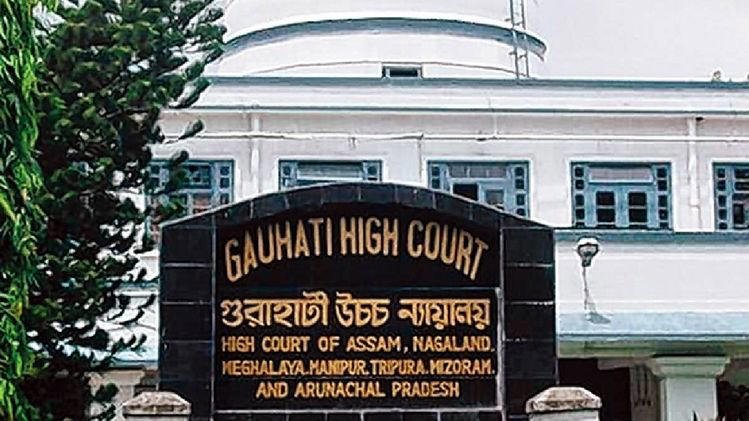
The political and legal battle over the shifting of the Gauhati High Court has reached the highest level. An Assam Congress leader urges Supreme Court to halt Gauhati High Court relocation plan just days before the scheduled foundation stone-laying ceremony. Senior Congress leader and advocate Debabrata Saikia, along with other members of the legal fraternity, has filed a petition seeking an immediate stay on the government’s move to shift the principal seat of the High Court to North Guwahati. The petition argues that the decision is unilateral and violates the rights of litigants and legal professionals.
Read More: Tripura CM Orders Strict Action After Attack on BJP Workers
Assam Congress Leader Urges Supreme Court to Halt Gauhati High Court Relocation for Public Interest
The move to the Supreme Court comes after the state government ignored widespread protests from the local bar association. As the Assam Congress leader urges Supreme Court to halt Gauhati High Court relocation plan, he highlights that moving the court 30 kilometers away to Rangmahal will create a “judicial desert” for the common citizen. Consequently, the petitioner claims that the move prioritizes commercial riverfront development over the accessibility of justice.
Congress leaders argue that the current location in Uzan Bazar is centrally located and serves as a heritage site for the entire Northeast. Furthermore, they believe that the government did not conduct a proper feasibility study regarding the transportation of thousands of lawyers and litigants across the Brahmaputra River every day. The petition seeks to protect the existing judicial ecosystem from being fractured by a sudden relocation.
Lawyers Launch Hunger Strike Against the Move
While the legal battle unfolds in New Delhi, the situation on the ground in Guwahati is equally tense. Most members of the Gauhati High Court Bar Association (GHCBA) began a three-day hunger strike on Thursday, January 8, 2026. Led by GHCBA President Kamal Nayan Choudhury, the lawyers are protesting in front of the historic old High Court building. They have also resolved to boycott the foundation stone ceremony scheduled for January 11.
The scale of opposition is evident from a recent internal referendum. Specifically, 1,164 lawyers voted against the relocation, while only 154 members supported it. Despite this overwhelming rejection, the state cabinet recently approved ₹479 crore for the first phase of the judicial township. Lawyers argue that the government’s insistence on the move, despite the “democratic verdict” of the bar, undermines the dignity of the legal profession.
Logistics and Accessibility Concerns at Rangmahal
The primary grievance of the legal community involves the logistical nightmare of moving to Rangmahal in Amingaon. Currently, the High Court is surrounded by lower courts, administrative buildings, and senior advocates’ chambers. Moving the institution would require lawyers to commute for hours, especially since the existing bridges are often congested.
Key concerns raised in the Supreme Court petition include:
- Distance: The new site is located approximately 30 km from the heart of the city.
- Lack of Infrastructure: Rangmahal currently lacks the essential transport links and public facilities required for a high-traffic judicial zone.
- Impact on Junior Lawyers: Young practitioners and women professionals without private transport will face significant financial and safety hurdles.
- Heritage Destruction: Many fear that the historic High Court building, where eminent judges have served for decades, will be demolished for a commercial convention center.
Government Defends the Judicial City Project
In contrast, the state government maintains that the relocation is essential for the future. Advocate General Devajit Saikia stated that the present court complex lacks sufficient space for judges’ rooms, conference halls, and parking. He argued that the new “Judicial City” would solve these space constraints for the next 50 years. According to the government, the modern complex will feature AI-enabled courtrooms and integrated residential facilities for judicial staff.
Moreover, the government claims that the relocation is part of a broader vision to modernize the Brahmaputra riverfront. They believe that North Guwahati is the only direction in which the city can grow sustainably. However, the petitioning Congress leader argues that development should not come at the cost of displacement and the erosion of judicial independence.
The confrontation between the state government and the legal fraternity has now entered a decisive phase. Since the Assam Congress leader urges Supreme Court to halt Gauhati High Court relocation plan, all eyes are on the apex court’s upcoming hearing. Whether the foundation stone will be laid on January 11 remains uncertain as the legal community remains firm in its opposition. For now, the hunger strikes and boycotts continue to signal a deep divide between the executive and the stakeholders of the justice system.
Read More: Assam Rifles Seize Rs 34 Lakh Worth of Counterfeit Cigarettes in Silchar Raid