


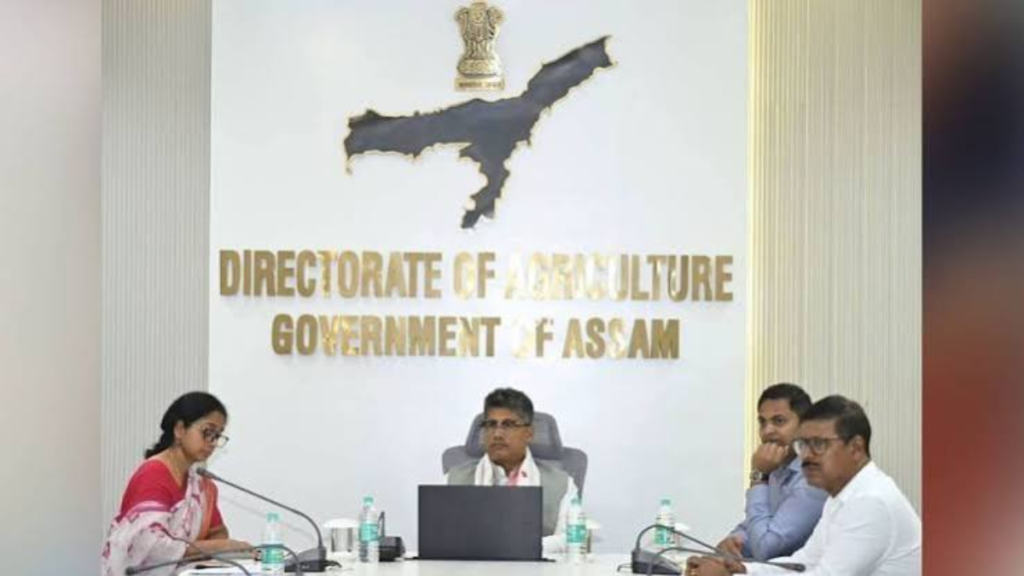
Assam crop diversification is gaining fresh momentum as Agriculture Minister Pijush Hazarika pushes farmers towards high-value cultivation and stronger farmer producer companies. The state government aims to make agriculture more profitable by expanding crop choices and improving market opportunities.
Hazarika has emphasised the need to move beyond dependence on traditional paddy cultivation. He has also encouraged farmers to adopt modern agricultural practices, explore commercial crops and work collectively through farmer-led organisations.
Assam crop diversification moves beyond paddy
The minister has repeatedly said that paddy will remain important to Assam, but it may not always deliver the best returns to farmers. At an October 7 event marking an agreement between the Assam government and the International Food Policy Research Institute (IFPRI), he identified horticulture as a major focus.
The partnership will support research and policy development, focusing on climate resilience, flood adaptation, rice-based farming systems, horticulture, tea, livestock, fisheries and stronger farmer organisations.
The agreement sets a framework for cooperation, with research intended to guide agricultural planning.
High-value crops and multiple cropping
Hazarika has urged farmers to retain paddy cultivation while considering double and triple cropping. The approach could help farmers make better use of available land and earn income from more than one harvest.
At a Guwahati workshop on August 24, he outlined a five-year roadmap focused on high-value crops, horticulture, irrigation, market links and exports. Around 250 progressive farmers discussed business opportunities in agriculture and allied sectors.
He also highlighted makhana, fruits and other horticultural crops. The government plans to promote makhana in mission mode and distribute fruit saplings, broadening crop choices across Assam.
The minister has also stressed the importance of identifying crops that require less land and offer better returns. This approach could help small farmers increase productivity without depending entirely on conventional cultivation.
Moreover, the government wants to develop Assam as a horticulture hub. Greater production of fruits, litchi and other commercial crops could create opportunities for farmers and agricultural businesses.
Assam crop diversification through farmer companies
Farmer Producer Companies can help small cultivators work together instead of negotiating with buyers individually. Members can improve access to inputs, technology, investment and markets.
The Assam Small Farmers’ Agri-Business Consortium says these organisations help small producers strengthen production, plan crop-specific activities and reach markets.
Hazarika’s visit to Junbeel Farmer Producer Company in September offered a practical example of this approach. The company had 520 members and was involved in traditional and value-added food products, including Komal Saul, pithas and cakes.
The minister distributed finger millet seeds to members and visited a women-run hatchery. The group was also planning a millet processing unit with support under the Agriculture Infrastructure Fund.
The example shows how processing and women-led food enterprises can add value beyond cultivation.
Furthermore, farmer companies can help members purchase inputs collectively, improve production standards and explore larger markets. These benefits can reduce some of the difficulties faced by individual small-scale farmers.
However, such organisations need proper management, financial support and regular market connections to remain sustainable.
Irrigation, markets and climate resilience
Crop diversification requires more than encouraging farmers to plant different crops. Reliable irrigation, quality seeds, technical guidance, storage, transport and access to buyers all influence whether a new crop becomes commercially viable.
At the August workshop, Hazarika said around 21 per cent of Assam’s agricultural land had irrigation coverage. He outlined plans to expand it over five years, alongside proposed investments in agriculture and irrigation.
The October partnership with IFPRI also places climate resilience and flood adaptation among its priorities. In a flood-prone state, better research and local data could help identify suitable crops and practices.
Additionally, stronger market connections will remain essential. Farmers need dependable buyers, fair prices and opportunities to process their produce before reaching larger markets.
Assam crop diversification faces an implementation test
The push towards farmer producer companies and high-value crops will depend on effective delivery at the village level. Farmers need timely information, dependable inputs and transparent access to schemes. They also need buyers who can offer fair prices and stable demand.
Not every crop will suit every district. Decisions must account for soil, water, skills and market conditions. Producer companies also need professional support and sound management.
The government’s collaboration with IFPRI could strengthen this process through research, institutional support and better agricultural planning. However, the impact will depend on how effectively these initiatives reach farming communities.
Overall, Hazarika’s approach links Assam crop diversification with collective enterprise, infrastructure and market development. The challenge now is to turn policy priorities into practical opportunities for small farmers.
Consistent support, suitable crop choices and reliable market connections will determine whether Assam can build a more diversified agricultural economy and deliver lasting improvements in farmers’ incomes.