


The Assam government has proposed a site-specific Eco-Sensitive Zone (ESZ) around Kaziranga National Park and Tiger Reserve. The proposal seeks to regulate development around the protected area while addressing the needs of local communities.
The proposed ESZ would generally extend between one and three kilometres from the boundary of Kaziranga. The move has sparked discussion over conservation, development and the impact of environmental restrictions on people living around the park.
The state government has clarified that the proposal does not change the boundary of Kaziranga National Park. The proposed changes concern areas outside the national park.
Government Says Park Boundary Will Remain Unchanged
Assam Agriculture and Irrigation Minister Pijush Hazarika said the proposal aims to address the livelihood and development needs of communities around Kaziranga.
Chief Minister Himanta Biswa Sarma has also stated that the park boundary remains unchanged. The government has argued that the proposed ESZ follows the Supreme Court’s framework for notifying such zones around protected areas.
The government has also rejected descriptions of the proposal as a move to weaken protection around Kaziranga. Officials have said the objective is to create a site-specific framework based on local conditions.
Existing Default 10-Km Framework
The debate centres on the existing default ESZ framework. Where a protected area does not have a notified ESZ, restrictions can apply up to 10 kilometres from its boundary under the applicable framework.
The Assam government has said it is now seeking a specific ESZ for Kaziranga instead of relying on the default arrangement. Minister Pijush Hazarika said the proposal follows the Supreme Court’s directions on ESZs.
The proposed zone would therefore vary according to the location and surrounding landscape rather than applying a uniform 10-kilometre boundary everywhere.
Proposal Covers a Larger Ecological Landscape
The issue has a longer history. In May 2024, the Assam government submitted a proposal to the Ministry of Environment, Forest and Climate Change for an integrated ESZ covering Kaziranga and several surrounding protected areas and reserve forests.
According to records cited before the National Green Tribunal, the proposed integrated zone covered about 3,596 square kilometres. It included protected areas such as Burachapori, Laokhowa, Nambor Doigrung, Nambor, Garampani and East Karbi Anglong wildlife sanctuaries.
The proposal also included several reserve forests around the Kaziranga landscape. The Ministry of Environment, Forest and Climate Change had been examining the state’s proposal.
Development and Livelihood Concerns
The Assam government has highlighted the challenges faced by communities living around Kaziranga. A blanket 10-kilometre zone can affect construction, land use, businesses and infrastructure projects in areas outside the protected park.
Residents in villages around Kaziranga have also discussed the issue. Some villagers told NDTV that a site-specific ESZ could help balance conservation requirements with everyday livelihood and development needs.
Housing, healthcare facilities, roads and local businesses are among the areas that can face additional regulatory requirements when they fall within an ESZ.
Conservation Groups Raise Ecological Concerns
The proposed ESZ has also drawn attention from conservation organisations. Aaranyak has called for an assessment based on the ecological characteristics of different parts of the Kaziranga landscape.
The organisation has argued that the ESZ should consider wildlife movement, ecological sensitivity, hydrology, settlements and land use. It has also supported a variable-width approach based on scientific assessment rather than a predetermined distance.
These concerns highlight the complex relationship between Kaziranga and the surrounding landscape. Wildlife movement often extends beyond the formal boundaries of protected areas.
Proposal Still Requires Further Process
The proposed ESZ has not yet replaced the existing framework through a final notification. The proposal remains part of the regulatory process involving the state government and the central environment ministry.
The final boundaries and regulations will determine how activities around Kaziranga are managed. The process can also involve consideration of ecological factors, local conditions and development requirements.
The National Green Tribunal had earlier recorded that the Assam government’s 2024 proposal for an integrated ESZ had been forwarded to the Ministry of Environment, Forest and Climate Change and was pending consideration.
Balancing Conservation and Local Development
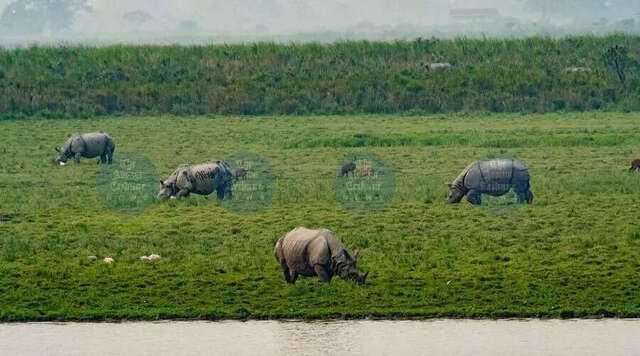
Kaziranga is one of India’s most important protected landscapes and is known for its population of greater one-horned rhinoceroses. The surrounding areas also support communities, agriculture, tourism and other economic activities.
The proposed Eco-Sensitive Zone therefore brings together two important concerns. One is the need to maintain ecological safeguards around the national park. The other is the need to allow communities outside the park to access essential infrastructure and pursue livelihoods.
The final ESZ framework will determine how these interests are balanced. For now, the Assam government’s proposal has opened a wider discussion on how conservation and development can coexist around Kaziranga.