


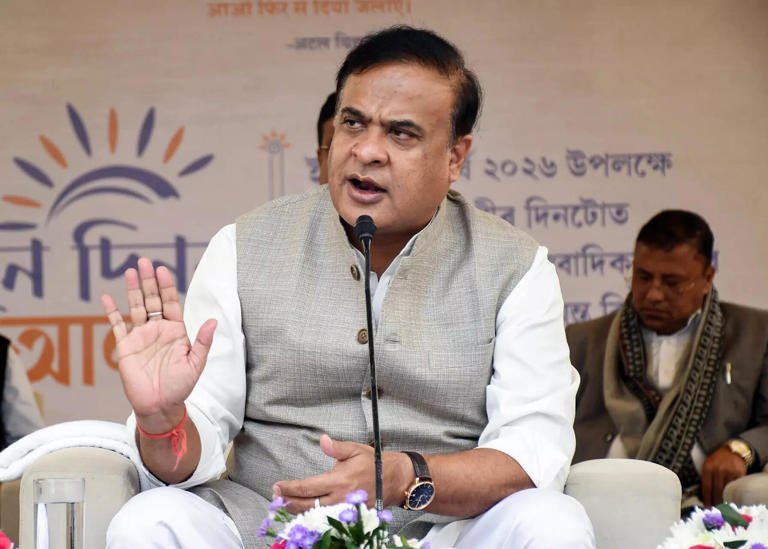
As the countdown to the 2026 Assembly elections begins, the Assam government has launched an aggressive campaign to bolster the rural economy. Specifically, the state is scaling up its self-employment initiatives for women to transform millions of housewives into “Nari-preneurs.” Chief Minister Himanta Biswa Sarma has made it clear that financial independence for women is not just a social goal but a cornerstone of the state’s upcoming electoral strategy.
Read More: NIA Probes Serial Explosions in Manipur’s Bishnupur District
Massive Seed Capital Distribution Under MMUA
On Tuesday, the Chief Minister visited Bokakhat to lead a massive distribution ceremony. He handed over entrepreneurship cheques worth ₹10,000 each to more than 27,000 women. These funds fall under the flagship Mukhya Mantri Mahila Udyamita Abhiyaan (MMUA). This scheme represents one of the most ambitious self-employment initiatives for women in India’s history.
The government originally set a target to support 32 lakh women. However, because of the overwhelming response, the administration has recently hiked this target to 40 lakh beneficiaries. “We are moving closer to our dream of creating 40 lakh Lakhpati Baideos (millionaire sisters),” the CM wrote on social media. Currently, over 15 lakh women have already received their initial seed capital, and the remaining funds will be disbursed within the next 20 days.
Transforming SHGs into Economic Powerhouses
The core of these self-employment initiatives for women lies in the Self-Help Group (SHG) network. Assam currently boasts nearly four lakh SHGs that have significantly altered the socio-economic fabric of the state. The MMUA scheme works in three distinct phases:
- Seed Capital: An initial grant of ₹10,000 to start a small business.
- Subsidized Loans: Successful entrepreneurs can then access a ₹25,000 loan at low interest rates.
- Expansion Support: A third installment of up to ₹50,000 is available for those who demonstrate business growth.
By providing this structured financial ladder, the government ensures that these self-employment initiatives for women lead to long-term sustainability rather than one-time relief. Already, official data shows that over eight lakh women in Assam have achieved “Lakhpati” status, earning more than ₹1 lakh annually through diverse ventures like dairy farming, tailoring, and handicrafts.
Key Highlights of the Empowerment Drive:
- Financial Inclusion: Women are becoming familiar with banking systems and digital transactions through direct benefit transfers.
- Sector Diversification: The initiatives encourage businesses in agriculture, animal husbandry, handlooms, and even small-scale manufacturing.
- Inclusive Outreach: Even in opposition strongholds like Dhubri, the government is aggressively distributing cheques to prove its “Nation First” commitment.
- Strategic Timing: The acceleration of these schemes coincides with the election season, targeting a decisive female vote bank.
Political Significance and National Influence
The success of self-employment initiatives for women in Assam has not gone unnoticed outside the state. Chief Minister Sarma recently noted that the MMUA model was adopted by the Bihar government for its own “Mukhyamantri Mahila Rojgar Yojana.” He attributed the NDA’s massive mandate in various regions to these welfare-driven outreach programs.
Furthermore, the government is coupling these entrepreneurship grants with other welfare schemes. For example, the Orunodoi 3.0 scheme recently expanded to cover 40 lakh women with monthly financial assistance. Additionally, the Nijut Moina scheme supports the education of nearly three lakh female students. Collectively, these programs create a powerful narrative of total empowerment that resonates deeply in both rural and urban areas.
Future Outlook: A Self-Reliant Assam
By positioning women as the primary economic drivers, the state government is looking to move Assam from a “consumer state” to a “contributor state.” The Chief Minister believes that when 40 lakh women become self-reliant, the state’s Gross State Domestic Product (GSDP) will see a major boost.
As the February deadline for major disbursements approaches, the intensity of these self-employment initiatives for women will likely increase. The government plans to provide an additional ₹8,000 to Orunodoi beneficiaries on February 20, just ahead of the Bhogali Bihu celebrations. This “double-engine” approach of combining welfare with entrepreneurship is expected to be a major talking point in the 2026 polls.
Conclusion: Empowering the ‘Nari Shakti’
Ultimately, the self-employment initiatives for women in Assam are about more than just numbers; they are about dignity. Through the MMUA and related missions, the state is providing women with the capital they need to realize their dreams. As Minister Ashok Singhal noted, the end of the “bandh culture” and the rise of the “entrepreneurship culture” mark a new era for Assam. With millions of women now holding the reins of their household finances, the “Amazon of the East” is paving the way for a more inclusive and prosperous future.
Read More: Chabimura Eco-Tourism Makeover: Tripura’s Hidden Gem Goes Global