


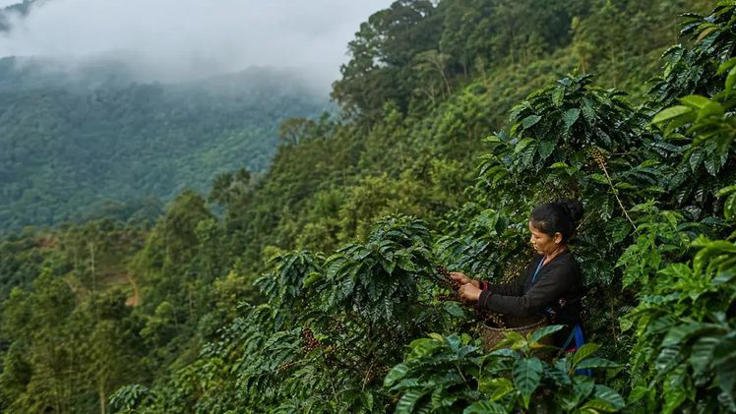
North Eastern Council (NEC) Secretary Satinder Kumar Bhalla has stressed the need for better infrastructure, value addition and stronger market connections to make coffee cultivation commercially viable in Nagaland.
Bhalla made these remarks during a visit to Touphema village, around 34 km from Kohima. He reviewed coffee plantations and supporting infrastructure developed under the Coffee Utilisation of Surplus Potential (USP) Project.
During the visit, he inspected plantation sites and the Hi-Tech Coffee Washing Station. He also interacted with coffee growers and members of the Touphema Cluster to understand their challenges and development needs.
Bhalla said coffee development must go beyond planting trees. Instead, he called for an integrated approach that connects cultivation, processing, quality control and marketing.
NEC Secretary Calls for Stronger Coffee Infrastructure
Bhalla highlighted the importance of road connectivity, modern processing machinery and efficient post-harvest facilities. According to him, these improvements can help farmers reduce production challenges and improve the quality of their produce.
Moreover, he said growers need access to quality assurance systems, value-added products and reliable market and export connections. Such facilities can help local producers move beyond raw coffee sales and earn better returns.
The NEC secretary also stressed that the Coffee USP Project should function as an integrated livelihood and economic development programme. In other words, the initiative must support the entire coffee value chain rather than focus only on plantation activities.
He called for stronger coordination among the Centre, Nagaland government, Coffee Board, local administration, farmers, technical institutions and private companies. Through this cooperation, the project aims to improve productivity and create sustainable income opportunities.
Coffee USP Project Aims to Improve Farmers’ Income
The Coffee USP Project focuses on developing coffee cultivation and related infrastructure in Nagaland. It seeks to strengthen the entire value chain, from plantation management to processing and market access.
Furthermore, Bhalla said coordinated efforts could help farmers earn more from coffee production. He encouraged the state government and Coffee Board to work with central agricultural institutions to identify suitable intercrops and complementary agricultural activities.
Crop diversification could improve land productivity while providing farmers with additional income sources. At the same time, it may reduce dependence on a single crop and strengthen the economic sustainability of coffee cultivation.
The NEC secretary also highlighted the need to connect production with commercial opportunities. Better processing, packaging and marketing facilities could help Nagaland coffee reach wider markets.
Farmers Seek Mechanisation and Water Facilities
During discussions, Touphema Village Council chairman Pfuduolhou Kense highlighted the high labour costs involved in weeding and harvesting. He requested support for brush cutters and harvesting equipment to reduce manual labour and improve productivity.
In addition, Kense raised concerns about water shortages affecting plantations and post-harvest processing. He sought water-harvesting structures, storage tanks and irrigation facilities to address these challenges.
Responding to the requests, Bhalla assured farmers that authorities would examine the possibilities of introducing water-harvesting systems, mechanisation, modern technologies and suitable equipment.
He also encouraged the local administration to engage industrial houses, investors and exporters. These partnerships, he said, could support mechanisation and automation in the coffee sector.
Nagaland Coffee Cultivation Dates Back to 1981
Nagaland’s coffee cultivation initiatives began in 1981. However, the sector has yet to achieve its full economic potential.
Development Commissioner Y Kikheto Sema identified limited awareness, inadequate market connections and other constraints as factors affecting the industry’s growth.
Therefore, he encouraged farmers to adopt a diversified approach to cultivation. He also suggested growing black pepper and other suitable crops alongside coffee wherever technically feasible.
Such practices could provide additional income opportunities while improving the use of agricultural land. In the long term, diversification may also help farming communities manage market and production risks.
Touphema and Ghotovi Develop Coffee Clusters
Nagaland is developing coffee through cluster-based value-chain projects. Touphema in Kohima district focuses on Arabica coffee, while Ghotovi in Niuland district focuses on Robusta.
Alongside these projects, the state has launched the ‘Coffees of Nagaland’ mission to develop an origin-based specialty coffee brand for wider markets.
The initiative aims to improve the identity and market reach of coffee produced in the state. Through stronger branding and quality standards, local growers could connect with buyers seeking specialty coffee.
However, branding alone cannot ensure commercial success. Farmers will also need reliable processing facilities, suitable transportation and stable market connections.
Young Grower Brings Specialised Coffee Expertise
Bhalla appreciated young coffee grower Vibei Kense, who travelled to Vietnam and obtained specialised certification in coffee.
He said such initiatives could help build local expertise and strengthen Nagaland’s coffee ecosystem. In particular, skilled local professionals can support improvements in cultivation, processing, quality control and product development.
The NEC secretary also encouraged young people and community elders to work together to create sustainable livelihood opportunities.
Their participation could help bring modern techniques into farming while preserving community involvement in local economic development.
Nagaland Seeks to Build a Sustainable Coffee Economy
The visit highlighted the need to address challenges across Nagaland’s coffee value chain. Farmers require better roads, processing facilities, water access, mechanisation and stronger market connections to improve commercial returns.
Meanwhile, the state’s focus on Arabica and Robusta cultivation, cluster-based development and specialty branding forms part of its broader effort to expand the sector.
Bhalla’s observations underline the importance of connecting agricultural production with processing, investment and market access. As a result, the success of coffee cultivation will depend not only on plantation expansion but also on the ability to create a sustainable business model.
With coordinated support from government agencies, farmers and private partners, Nagaland’s coffee sector aims to create more reliable income opportunities for rural communities.