


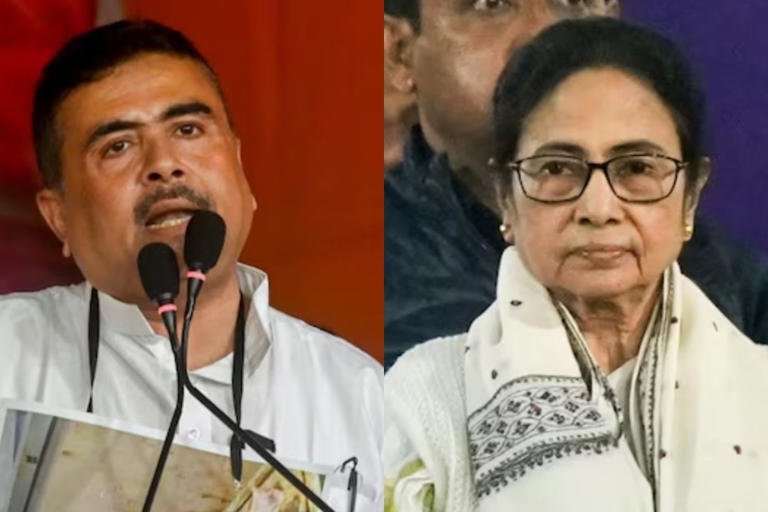
The political spotlight has once again shifted to Bhabanipur as the constituency emerges as the stage for a renewed rivalry between West Bengal Chief Minister Mamata Banerjee and senior BJP leader Suvendu Adhikari. The Bhabanipur Mamata Suvendu rematch is gaining momentum, with grassroots workers shaping the narrative through slogans that reflect the high-stakes contest.
Read More: Meghalaya BJP MLA AL Hek Raises Concerns Over FCRA Amendment Bill
Bhabanipur Becomes Political Epicentre
Bhabanipur, a key constituency in Kolkata, has once again become the focal point of Bengal politics. Known for its political significance, the seat carries symbolic weight, especially for Mamata Banerjee.
The renewed contest has turned the constituency into a battleground where both sides are mobilising their cadres extensively. Campaign activities have intensified, with rallies, door-to-door outreach, and public meetings dominating the landscape.
The Bhabanipur Mamata Suvendu rematch is not just about a seat; it represents a larger political narrative in West Bengal.
Foot Soldiers Drive Campaign Narrative
At the heart of this contest are the party workers, whose slogans and grassroots mobilisation are shaping public perception. Supporters from both sides have been actively engaging with voters, using catchy and emotionally charged slogans.
These slogans reflect the contrasting narratives of the two camps. While one side emphasizes continuity and governance, the other focuses on change and accountability.
The Bhabanipur Mamata Suvendu rematch has thus become a contest not only of leaders but also of narratives crafted at the ground level.
Mamata Banerjee’s Political Stakes
For Mamata Banerjee, Bhabanipur holds immense importance. The constituency has been a stronghold for her in the past, symbolizing her connection with the people.
Her campaign focuses on highlighting the achievements of her government, including welfare schemes and development initiatives. She has been actively engaging with voters, emphasizing her commitment to the state’s progress.
The Bhabanipur Mamata Suvendu rematch is crucial for reinforcing her political position and maintaining her influence.
Suvendu Adhikari’s Challenge
Suvendu Adhikari, on the other hand, represents the BJP’s challenge to the ruling party. Having previously defeated Mamata Banerjee in a high-profile contest, he brings significant political weight to the campaign.
His strategy revolves around questioning the government’s performance and presenting an alternative vision. Adhikari has been actively addressing rallies and mobilizing support among party workers.
The Bhabanipur Mamata Suvendu rematch provides him with an opportunity to strengthen the BJP’s presence in the region.
Revival of a High-Profile Rivalry
The renewed contest between Mamata Banerjee and Suvendu Adhikari revives one of the most closely watched rivalries in Indian politics. Their previous electoral battle had captured national attention.
This time, the stakes remain equally high, with both leaders aiming to assert their dominance. The rivalry adds a dramatic dimension to the election, drawing widespread interest.
The Bhabanipur Mamata Suvendu rematch is therefore more than a local contest; it is a clash of political heavyweights.
Campaign Strategies on Both Sides
Both parties have adopted distinct campaign strategies to appeal to voters. The Trinamool Congress is focusing on its track record and grassroots connection.
Meanwhile, the BJP is emphasizing issues such as governance, corruption, and development. The party is also leveraging its organizational strength to reach voters effectively.
The Bhabanipur Mamata Suvendu rematch highlights the diversity of campaign approaches in modern elections.
Public Response and Voter Sentiment
Voters in Bhabanipur are closely following the developments. The high-profile nature of the contest has generated significant interest among the electorate.
Public sentiment appears to be shaped by both local issues and broader political narratives. Voters are evaluating the candidates based on their performance, promises, and credibility.
The Bhabanipur Mamata Suvendu rematch is expected to witness high voter turnout, reflecting the intensity of the contest.
Role of Grassroots Mobilisation
Grassroots mobilisation plays a crucial role in determining electoral outcomes. Party workers are actively engaging with voters, organizing events, and spreading campaign messages.
Their efforts are particularly important in a closely contested seat like Bhabanipur. Effective mobilisation can influence voter perception and turnout.
The Bhabanipur Mamata Suvendu rematch underscores the importance of strong organisational networks.
Political Implications Beyond Bhabanipur
The outcome of this contest could have wider implications for West Bengal politics. A victory for Mamata Banerjee would reinforce her leadership, while a strong performance by Suvendu Adhikari could boost the BJP’s prospects.
The Bhabanipur Mamata Suvendu rematch is thus being closely watched by political observers and analysts.
It also reflects the broader contest between regional and national political forces in the state.
Conclusion
The Bhabanipur constituency has once again become the stage for a high-stakes political battle between Mamata Banerjee and Suvendu Adhikari. With grassroots workers driving the narrative and both leaders actively campaigning, the Bhabanipur Mamata Suvendu rematch promises to be a closely watched contest.
As the campaign intensifies, the focus will remain on voter sentiment and turnout. The outcome will not only determine the fate of the constituency but also shape the political landscape of West Bengal.
In this clash of narratives and leadership, Bhabanipur stands at the centre of a defining moment in Bengal politics.
Read More: Meghalaya Approves Provident Fund Scheme for Private Education Staff