


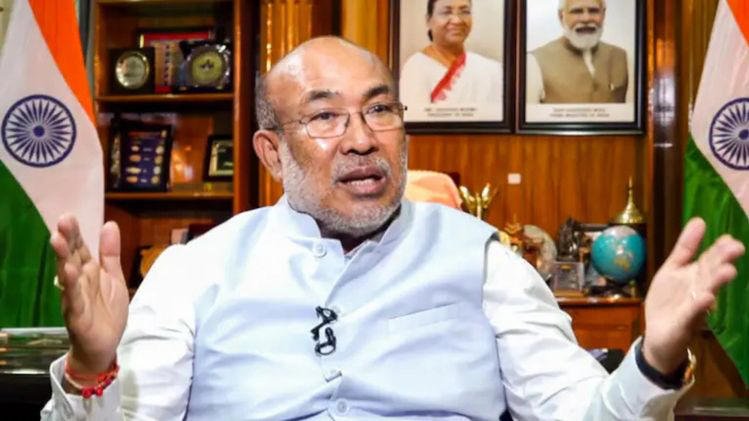
Manipur Chief Minister N Biren Singh has revealed that his resignation in 2023 was not voluntary but triggered by immense political pressure. During an interaction with local media, he claimed that mounting unrest and internal party conflict pushed him to take the drastic step, although he eventually stayed on after intervention from the central leadership.
Singh admitted he had written his resignation letter and reached the Raj Bhavan in Imphal. However, he said he tore it up after realising that the Bharatiya Janata Party (BJP) leadership still supported him. He asserted that the decision to step down came under compulsion, driven by escalating ethnic violence and an emotional breakdown.
Read More: Air India to resume full international services by October 1
Ethnic Violence Created Governance Challenges
The Kuki-Meitei conflict has left Manipur on edge since May 2023. Singh acknowledged that the situation spiralled out of control and shook the administrative machinery. According to him, the government struggled to respond due to intense polarisation and public anger.
The violence resulted in over 200 deaths and the displacement of thousands. The administration faced accusations of bias, especially from Kuki groups, who felt targeted. Singh noted that despite efforts to restore peace, including the deployment of central forces, stability remained elusive.
“The government became a target for both communities. Some believed we didn’t do enough, while others accused us of favouritism,” he explained.
Pressure from Party and Public
Biren Singh indicated that dissent within the party added to the crisis. He pointed to conflicting demands from MLAs, civil society groups, and community leaders. Several party members had publicly criticised his leadership, while others demanded that the central government impose President’s Rule.
The chief minister confessed that the emotional toll of the situation affected his decision-making. At one point, he felt completely isolated, especially when the pressure peaked in July 2023. His resignation letter, now a historic symbol of that period, was reportedly written in his vehicle outside the governor’s residence.
“I wasn’t sure if I could continue, but I was also concerned about the message it would send,” Singh said, adding that the central leadership’s support eventually convinced him to carry on.
Central Leadership Stood Firm
After his initial attempt to resign, senior BJP leaders including Union Home Minister Amit Shah reached out to Singh. They urged him to stay, assuring him of support and coordination in handling the crisis. This outreach proved crucial in reversing his decision.
Sources close to the party stated that Singh’s leadership was still valued, especially as an experienced regional leader with a strong mass base. His resignation, if accepted, would have deepened instability in an already volatile state.
The central government also feared that a leadership vacuum could worsen ethnic tensions. Therefore, it directed the state administration to take a more inclusive approach, ensuring that voices from both communities were heard.
Road Ahead Remains Uncertain
While Biren Singh stayed on, the challenges remain far from over. Clashes between communities have reduced, but mutual distrust lingers. Singh mentioned that normalcy will take time and that healing must happen at the grassroots level.
To restore public confidence, the government has taken steps such as rebuilding destroyed homes, relocating displaced families, and conducting outreach programs. Yet, political observers believe that Singh’s authority has weakened.
Critics argue that his continuation is symbolic rather than functional. Several administrative decisions now require clearance from the centre. Moreover, there is still no political dialogue between the warring communities, which many believe is essential for lasting peace.
Calls for Peace and Dialogue
Singh used his platform to urge both the Kuki and Meitei communities to come together. He said peace talks and mutual understanding are the only viable paths forward. “Without cooperation, we will only prolong the suffering,” he emphasised.
He also appealed to youth groups and civil organisations to stop spreading hate on social media, which often inflames tensions. The state has already imposed internet shutdowns several times to curb misinformation, although critics argue that these measures hinder transparency.
Opposition Reacts to CM’s Admission
Opposition leaders were quick to react to Singh’s statement. Congress MLA K Meghachandra claimed that the chief minister’s confession proved his failure in handling the crisis. “If he had to be forced into resigning, it shows he lacks confidence and control,” he said.
Civil society groups echoed similar views, suggesting that Manipur needs fresh leadership that can bridge the ethnic divide. Some have called for a national-level dialogue on the future of governance in the state.
Biren Singh’s statement about being forced to resign has added a new dimension to Manipur’s ongoing crisis. It sheds light on the intense political and emotional stress at the highest level of state leadership. While he continues as chief minister, the future remains uncertain unless the government can build trust across fractured communities and deliver a sustained roadmap for peace.
Read More: Assam hill districts protests over Article 244(A): Powerful backlash erupted