


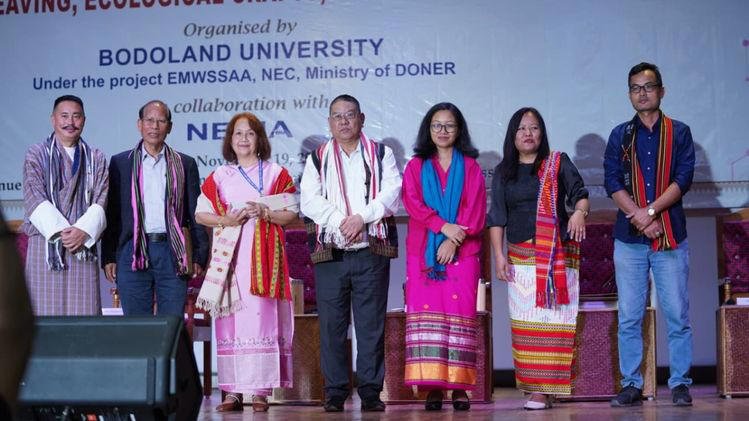
Bodoland indigenous heritage seminar discussions took centre stage on November 20 as Bodoland University organised a national seminar that highlighted the urgent need to document and preserve the Northeast’s diverse cultural traditions. The event, held under the EMWSSAA project of the NEC, Ministry of DoNER, brought together scholars, researchers, and cultural practitioners from India and abroad. Moreover, the gathering created a collaborative space for experts to share insights on safeguarding oral histories, arts, weaving traditions, ecological crafts, food cultures, and languages.
Read More: CM Manik Saha Urges Tribal Voters to Support BJP Ahead of ADC Election
Bodoland Indigenous Heritage Seminar Opens with Strong Call for Preservation
The Bodoland indigenous heritage seminar began with a welcome address by Dr. Zothanchhingi Khiangte, Principal Investigator of the EMWSSAA project and Coordinator of the Centre for Women Studies. She highlighted the urgency of preserving cultural memory, especially in regions where modernisation and rapid lifestyle changes threaten traditional knowledge systems. Her opening remarks set the tone for a day of meaningful discussions centred on identity, continuity, and the role of research in cultural survival.
Scholars noted that the Northeast possesses extraordinary cultural richness. Its communities carry centuries-old traditions reflected in weaving patterns, oral narratives, artistic expressions, and food practices. However, many of these traditions remain undocumented. Therefore, researchers stressed that failure to record these elements could lead to irreversible cultural loss.
The inauguration session also highlighted the value of collaboration between universities, cultural organisations, and community practitioners. Such collaboration ensures that academic research connects with lived experiences. Additionally, it helps translate scholarly work into practical cultural preservation initiatives.
Sessions Explore Languages, Arts, and Ecological Knowledge
During the Bodoland indigenous heritage seminar, multiple thematic sessions explored the region’s cultural diversity. One major theme focused on languages. Scholars pointed out that the Northeast is home to several endangered languages that face the risk of fading out. They emphasised that language carries memory, philosophy, and worldview. Hence, documenting vocabulary, grammar, and oral narratives becomes essential.
Another session highlighted indigenous arts and weaving traditions. Cultural practitioners presented intricate textile patterns and demonstrated how designs express community values. Experts noted that traditional weaving has survived through intergenerational transmission. However, modern clothing trends, reduced market support, and limited training platforms have created challenges for young artisans. Therefore, the seminar stressed the need to promote traditional crafts through education and market linkages.
Ecological crafts also drew strong attention. Participants discussed how communities use natural materials in sustainable ways. From bamboo products to handmade household items, ecological crafts reflect deep knowledge of local ecosystems. Scholars argued that such practices offer solutions to modern sustainability challenges. Furthermore, preserving ecological craft traditions helps protect biodiversity while strengthening rural livelihoods.
Food Traditions and Oral Histories Highlighted at the Event
Food heritage formed a vibrant part of the Bodoland indigenous heritage seminar. Presenters spoke about traditional food systems that rely on seasonal ingredients, forest produce, and community farming. They discussed how food carries cultural meaning, health values, and ecological balance. Many participants noted that industrialisation and mass-produced goods have changed food habits. As a result, documenting indigenous food traditions becomes crucial for both cultural and nutritional reasons.
Oral histories also played a central role in the discussions. Researchers shared stories preserved through songs, folktales, chants, and community rituals. They explained that oral storytelling is one of the oldest ways communities pass down wisdom. However, as younger generations migrate to urban areas, oral traditions face disruption. The seminar therefore encouraged the creation of digital archives, community recordings, and school-based cultural programmes to safeguard these narratives.
Collaboration Underlines the Path Forward
The Bodoland indigenous heritage seminar underscored the importance of joint efforts between academic bodies and cultural organisations. The event was organised under the EMWSSAA project of the NEC, Ministry of DoNER, in collaboration with NEIHA. This partnership enabled a broad exchange of ideas, resources, and methodologies that can support long-term cultural research.
Speakers emphasised that preservation must go beyond documentation. Cultural practices need active participation from communities. Universities must engage with local groups through workshops, field studies, and training programmes. Additionally, researchers should highlight community voices rather than rely solely on external perspectives.
The seminar encouraged young scholars to pursue research on indigenous arts, languages, and ecological knowledge. Their involvement ensures continuity and provides fresh academic energy. Many participants also recommended more funding for cultural research and better institutional support.
Bodoland Indigenous Heritage Seminar Reinforces Need for Action
The Bodoland indigenous heritage seminar concluded with a strong message: preserving the Northeast’s cultural heritage requires dedication, collaboration, and urgency. As participants reflected on the discussions, they agreed that cultural traditions shape identity and community cohesion. Losing them would mean losing a part of history and collective memory.
With its emphasis on documentation and cultural empowerment, the seminar marked a meaningful step toward protecting the region’s unique heritage. The Bodoland indigenous heritage seminar therefore stands as a reminder that safeguarding culture is not only an academic responsibility but a shared duty across communities, institutions, and future generations.
Read More: Team India Reaches Guwahati for 2nd Test