


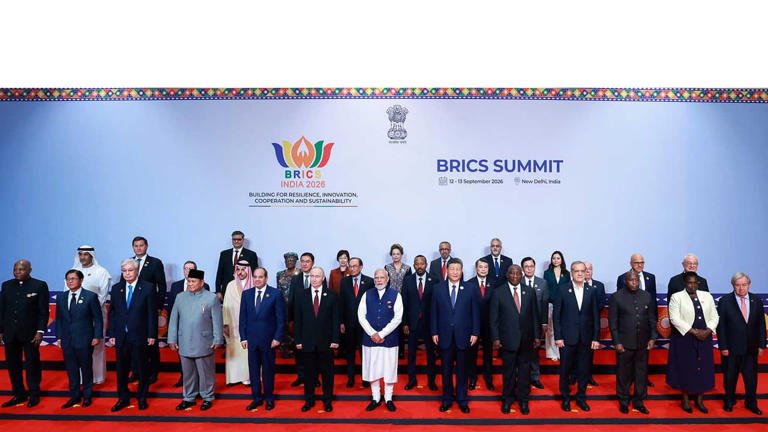
The BRICS Summit 2026 in New Delhi has been described as a “major success” by the Ministry of External Affairs (MEA), with India’s year-long chairship producing more than 50 concrete outcomes across different areas of cooperation.
The 18th BRICS Summit concluded in New Delhi on September 13. India hosted the summit as the BRICS chair for 2026. The gathering brought together leaders and representatives from the expanded BRICS grouping and focused on strengthening cooperation among emerging and developing economies.
MEA Secretary (Economic Relations) Sudhakar Dalela said the outcomes reflected practical and development-oriented cooperation among BRICS members. He also highlighted the consensus reached on the New Delhi Declaration.
Read More: Chief Minister Rekha Gupta Announces Hostels for 10,000 Students in Delhi
India’s People-Centric BRICS Chairship
India assumed the BRICS chairship in January 2026. The country placed “Building for Resilience, Innovation, Cooperation and Sustainability” at the centre of its agenda.
Prime Minister Narendra Modi said India followed a people-centric and “Humanity First” approach during its chairship. More than 350 meetings and high-level engagements took place across nearly 30 cities during the year.
These meetings covered areas such as trade, finance, health, agriculture, technology, energy, climate action and cultural exchanges.
The chairship also sought to take BRICS cooperation beyond government-level discussions. India organised youth, women, scientific, cultural and sports programmes to increase people-to-people engagement among member countries.
New Delhi Declaration Adopted
One of the major outcomes of the summit was the adoption of the New Delhi Declaration.
The declaration reflected areas of broad agreement among BRICS members on international cooperation and global governance. MEA said the consensus resulted from consultations held at different levels throughout India’s year-long chairship.
Dalela said BRICS members maintained their position on the need to reform the United Nations. Members also discussed the need for global governance institutions to become more representative, inclusive and responsive to present-day realities.
The declaration provided a common framework for future cooperation among BRICS members.
Trade and Economic Cooperation
Economic and financial cooperation remained a major part of India’s BRICS agenda.
India worked with member countries on measures aimed at strengthening trade, improving supply-chain resilience and supporting small businesses. Earlier ministerial meetings produced initiatives covering MSMEs, trade finance, services and global value chains.
The BRICS Trade Ministers’ Meeting in Jaipur adopted the Jaipur Consensus and Guiding Principles for MSME Credit. The framework seeks to address the trade-finance gap and improve small businesses’ access to international markets.
The broader BRICS economic agenda also included discussions on local-currency trade, cross-border payments and investment cooperation.
Technology and Innovation Take Centre Stage
Technology and innovation formed another important part of India’s BRICS chairship.
The grouping advanced cooperation in areas such as artificial intelligence, digital technologies, startups and scientific research. India also proposed initiatives aimed at strengthening the startup ecosystem among BRICS countries.
The BRICS Industry Ministers adopted a framework for cooperation on small and medium enterprises. They also advanced cooperation in the photovoltaic industry and supported the development of a BRICS Startup Innovation Fund and BRICS Incubator Network.
These initiatives aim to encourage innovation and provide greater opportunities for entrepreneurs across BRICS countries.
Energy Cooperation Strengthened
Energy also featured prominently during India’s chairship.
The BRICS Energy Ministers adopted a joint communiqué covering energy security, sustainability, resilient infrastructure and technological cooperation.
One major initiative was the launch of the BRICS Digital Centre of Excellence for Smart Grids and Energy Storage. The platform will support knowledge sharing, capacity building and cooperation on modern power systems.
BRICS countries also adopted guiding principles for smart grids and energy storage. Discussions covered hydrogen, renewable energy, energy efficiency, digitalisation and other emerging technologies.
Agriculture and Food Security
Agriculture remained another important area of BRICS cooperation.
India’s chairship placed attention on food security, sustainable agriculture and cooperation among developing economies. Discussions focused on improving agricultural resilience and sharing knowledge and technology.
The agricultural track also explored ways to strengthen cooperation between member countries. Such cooperation can support food security while helping countries respond to climate and supply-chain challenges.
The focus on agriculture reflects the wider BRICS effort to connect international cooperation with development priorities.
Health Cooperation Expanded
Health formed another key pillar of the BRICS agenda.
Member countries discussed cooperation in areas such as public health, medical research and healthcare technologies. India also promoted greater collaboration on health-related challenges affecting developing countries.
The chairship encouraged knowledge sharing and cooperation between health institutions in BRICS countries.
The health agenda formed part of the wider effort to create practical cooperation that can produce benefits for ordinary people.
Youth and Women’s Participation
India also placed strong emphasis on youth and women during its BRICS chairship.
The country hosted the BRICS Youth Summit and Youth Council in Gandhinagar. The Young Scientists Forum took place in Bengaluru, while the Young Diplomats Forum was organised in New Delhi.
Women’s participation also received attention through the BRICS Women’s Working Group and the BRICS Women’s Business Alliance.
The BRICS Women’s Business Alliance presented its report to leaders at the summit. India also supported a digital repository of best practices on women’s empowerment.
Cultural and People-to-People Exchanges
The 2026 chairship also expanded cultural engagement.
India organised a BRICS cultural festival in Bhopal and planned a film festival in Goa. A theatre festival in Delhi and the BRICS Bazaar in New Delhi added further cultural elements.
Sports also became part of the people-to-people agenda. BRICS members held traditional and indigenous sports demonstrations and established a working group on sports technology.
These activities aimed to increase interaction among people from BRICS countries beyond formal diplomatic engagements.
Broad Participation at New Delhi Summit
The scale of participation also stood out during the summit.
According to External Affairs Minister S. Jaishankar, the summit brought together 32 delegations, including representatives from all 11 BRICS member countries, 10 partner countries, four regional organisations and seven international organisations.
The participation reflected the wider expansion of BRICS since its formation. The grouping now includes countries from Asia, Africa, the Middle East and Latin America.
The 2026 summit also came as BRICS marked two decades since the grouping began as BRIC.
India’s BRICS Chairship Comes to an End
The completion of the New Delhi Summit marks the conclusion of India’s 2026 BRICS chairship.
The MEA has highlighted more than 50 concrete outcomes across economic, financial, technological, health, agricultural, energy and people-to-people tracks. The New Delhi Declaration also established a common framework for continued cooperation.
The summit showed the wide range of areas in which BRICS members are seeking practical cooperation. At the same time, the grouping includes countries with different economic systems, national priorities and foreign-policy positions. Maintaining consensus will therefore remain important as members work to implement the outcomes.
For India, the year-long chairship has produced a broad set of initiatives and agreements. The BRICS Summit 2026 has now concluded with the New Delhi Declaration and more than 50 reported outcomes forming the central results of the year’s engagement.
Read More: Chief Minister Rekha Gupta Announces Hostels for 10,000 Students in Delhi