


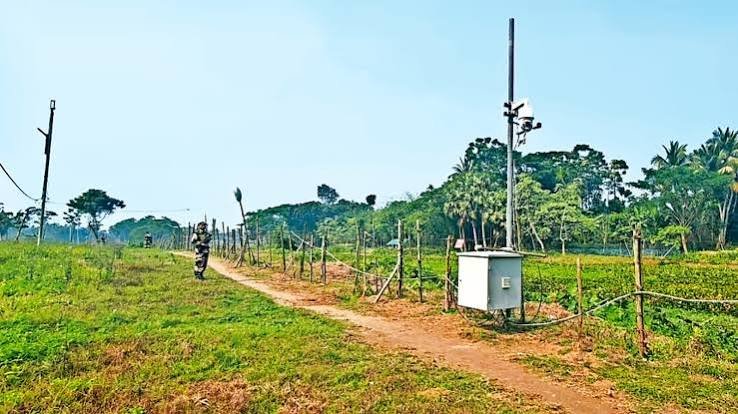
The Border Security Force has intensified India Bangladesh border security through closer surveillance, faster fencing work and stronger coordination with other agencies. Recent reviews have focused on unfenced stretches, border infrastructure and measures to detect breaches.
However, available official information does not confirm a newly activated nationwide “emergency border protocol” along the entire India-Bangladesh boundary. Instead, the BSF has continued to strengthen its existing security framework through technology, patrols and infrastructure.
The latest developments come as authorities accelerate fencing projects in sensitive areas. At the same time, BSF leadership has called for closer coordination against smuggling, illegal migration and other cross-border crimes.
Tripura Prepares for 410 MW Durga Puja Power Demand
India Bangladesh Border Security Gets Stronger Technology Support
India Bangladesh border security is increasingly relying on technology alongside conventional fencing and patrols. The Centre has been introducing systems designed to detect activity near vulnerable stretches and provide faster alerts to border personnel.
In July 2026, Union Home Minister Amit Shah inspected a radio-based fence-breach detection system at the Jhumagachh Border Outpost in Siliguri. The system can alert personnel through a pre-recorded message when someone tampers with the border fence.
The Home Minister also reviewed other surveillance technologies during the visit. These included infrared alarm systems and a smart gate-management system. Such equipment can help authorities monitor difficult stretches and regulate movement around sensitive border areas.
Furthermore, the government laid the foundation for a four-kilometre border fence in West Bengal at a cost of ₹30 crore. The project forms part of a wider effort to strengthen physical barriers along vulnerable sections of the international boundary.
These measures indicate a shift toward layered border management. Instead of relying solely on physical fencing, authorities are combining barriers, electronic detection, surveillance and coordinated patrols.
Fencing Work Accelerates Along Sensitive Stretches
Physical fencing remains one of the most important components of India Bangladesh border security. The international boundary extends for about 4,096 kilometres through West Bengal, Assam, Meghalaya, Tripura and Mizoram.
Several sections remain difficult to fence because of rivers, forests, settlements and challenging terrain. Consequently, authorities have focused on acquiring land and developing alternative surveillance arrangements where conventional fencing faces obstacles.
West Bengal has recently recorded significant progress in providing land for new border fencing. According to a report published on October 1, the state government had handed over 1,177.1 acres to the BSF for fencing in sensitive areas by September. Another 93.1 acres remained to be transferred from the land acquired with central funding.
The land transfer covers several districts along the Bangladesh frontier. Murshidabad accounted for the largest share, followed by North 24 Parganas and Malda. Cooch Behar also remained an important area because some land required for the project was still pending.
Meanwhile, the BSF leadership has been pushing for faster completion of fencing. A September review by BSF Director General Praveen Kumar examined pending land acquisition, fence construction and trans-border smuggling. The review also called for faster work on marked unfenced areas.
The developments show that border preparedness is being strengthened through long-term infrastructure rather than a single emergency measure.
BSF Strengthens Patrols and Inter-Agency Coordination
India Bangladesh border security also depends on regular patrols and coordination between security agencies. Physical barriers cannot cover every geographic challenge, making intelligence sharing and coordinated responses important.
The BSF and Bangladesh’s Border Guard Bangladesh held their 57th Director General-level Border Coordination Conference in New Delhi from June 8 to 11, 2026. Both sides reviewed border-security concerns and discussed measures to improve cooperation.
During the conference, the two forces agreed to strengthen coordinated patrols, improve vigilance and enhance real-time information sharing. They also agreed to intensify joint efforts against trans-border criminal networks.
Such coordination remains important because incidents along the frontier can involve multiple agencies and affect bilateral relations. Regular communication can therefore help security forces respond to incidents while reducing the possibility of misunderstandings.
On the Indian side, the BSF also works with state administrations and other enforcement agencies. The September leadership review specifically stressed greater synergy with law-enforcement agencies and civil authorities to address trans-border crimes and smuggling.
The approach therefore combines border infrastructure with operational coordination. Authorities are seeking faster detection, better information flow and stronger responses across areas where security challenges overlap.
Northeast Border States Remain a Major Security Focus
India Bangladesh border security has particular importance for the Northeast because four states share portions of the international boundary. Tripura, Meghalaya, Assam and Mizoram all face different geographical and operational challenges along their respective stretches.
Tripura has a particularly long border with Bangladesh, while Meghalaya’s frontier includes hilly and forested areas. Assam and Mizoram also face terrain and river-related challenges that can complicate conventional fencing.
The border-security strategy therefore needs to account for local conditions. A system that works effectively in an open agricultural area may not provide the same coverage in a riverine or forested stretch.
Technology can help fill some of these gaps. The systems reviewed by the Union Home Minister in West Bengal demonstrate how electronic detection can supplement physical barriers. Radio-based breach alerts, infrared systems and controlled access points can provide additional layers of monitoring.
At the same time, recent enforcement operations show continued attention to cross-border smuggling. In September, the Directorate of Revenue Intelligence said it had recovered around 12 kilograms of foreign-origin gold worth approximately ₹17 crore through operations conducted with BSF support along the Bangladesh route.
These operations highlight why authorities continue to strengthen surveillance around border fences and vulnerable areas. However, such enforcement activity should not automatically be interpreted as evidence of a nationwide emergency. The available official material points instead to sustained and enhanced border vigilance.
Conclusion
India Bangladesh border security is entering a stronger phase of infrastructure development, surveillance and inter-agency coordination. The BSF is accelerating fencing work while expanding the use of technology to detect breaches and monitor vulnerable areas.
However, current official sources do not establish that the BSF has activated a new nationwide emergency protocol along all India-Bangladesh fencing lines. The evidence instead shows an ongoing security upgrade supported by new fencing, electronic detection systems, patrols and coordination with other agencies.
The next phase will likely focus on completing pending fencing projects and improving coverage in difficult terrain. Meanwhile, continued communication between the BSF and BGB will remain important for maintaining stability along the shared frontier.
FAQs
What is the latest focus of India Bangladesh border security?
The focus includes faster fencing, electronic surveillance, patrols, intelligence sharing and stronger action against cross-border criminal networks.
Has the BSF confirmed a nationwide emergency border protocol?
Available official sources do not confirm a newly activated nationwide emergency protocol. They show strengthened and continuing border-security measures instead.
How long is the India-Bangladesh border?
The India-Bangladesh international boundary extends for about 4,096 kilometres across five Indian states.
What new technology is being used along the border?
Recent measures include radio-based fence-breach detection, infrared alarm systems and smart gate-management technology.
Are India and Bangladesh coordinating on border security?
Yes. The BSF and BGB agreed in June 2026 to strengthen coordinated patrols, improve real-time information sharing and intensify cooperation against trans-border criminal networks.