


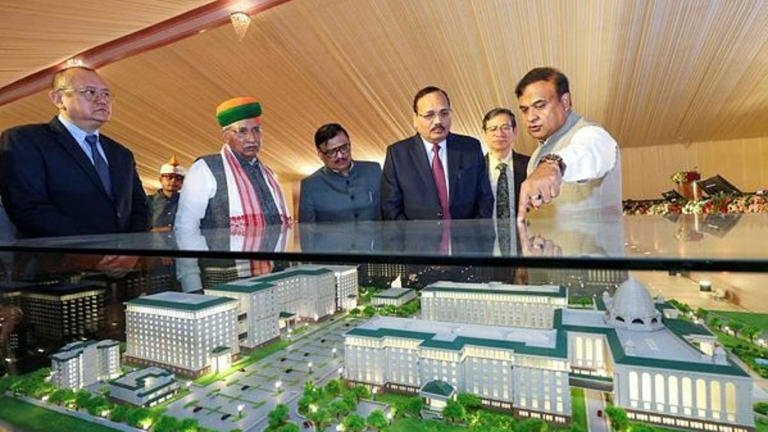
On January 11, 2026, the Chief Justice of India (CJI), Justice Surya Kant, marked a historic but controversial milestone in Assam’s legal history. He laid the foundation stone for a massive integrated judicial complex in North Guwahati. Located at Rangmahal, this “judicial city” aims to modernize the delivery of justice in the Northeast. However, the event took place amidst a high-profile boycott and hunger strike by the Gauhati High Court Bar Association (GHCBA).
Read More: Pema Khandu Celebrates Indigenous Identity at Sarok Festival
A Vision for the Integrated Judicial Complex in North Guwahati
The proposed project is a state-of-the-art judicial township spread across 148 bighas (approximately 49 acres). The Assam government has earmarked a total budget of ₹1,700 crore for the project, with ₹479 crore allocated for the initial phase.
This integrated judicial complex in North Guwahati will house:
- The Gauhati High Court: Moving from its historic seat in Uzan Bazar.
- District Courts: Consolidating the Kamrup and Kamrup Metropolitan district judiciaries.
- Advocate Facilities: Including 300 chambers and a 2,000-seater Bar library.
- Modern Amenities: Interconnected buildings, disaster-resilient designs, and parking for over 1,300 vehicles.
Addressing the Bar Association Boycott
The Gauhati High Court Bar Association strongly opposes the relocation. They argue that moving the court from the “heart of the city” to the northern bank of the Brahmaputra will cause extreme inconvenience. Lawyers launched a series of symbolic hunger strikes leading up to the ceremony, citing a lack of consultation and concerns over accessibility for litigants.
Addressing these concerns, CJI Surya Kant expressed surprise at the resistance. He stated that the integrated judicial complex in North Guwahati is designed for the future. “Personal or vested interests cannot be valid grounds for opposing infrastructure for the next generation,” the CJI remarked. He emphasized that the legal profession must adapt to accommodate the thousands of young lawyers entering the system.
Strategic Connectivity and Development
Chief Minister Himanta Biswa Sarma also addressed the accessibility issue during the ceremony. He noted that the new bridge over the Brahmaputra, set to open in February 2026, will significantly reduce travel time. He argued that the integrated judicial complex in North Guwahati will become the center of a new, decongested “central zone” for the city.
The state government plans to use the current High Court land for the Brahmaputra riverfront development project. While the Bar Association considers legal action to stall the shift, the government remains committed to its 24-month timeline for the first phase.
Why Integration Matters
The CJI highlighted that the “integrated” nature of the complex is its greatest strength. By bringing the High Court, district courts, and mediation centers under one roof, the system removes physical barriers for litigants. This move aligns Assam’s infrastructure with international standards, ensuring that justice remains efficient and accessible for decades to come.
Read More: Howrah-Anand Vihar Amrit Bharat Weekly Express: New Stoppages in Bihar Announced