


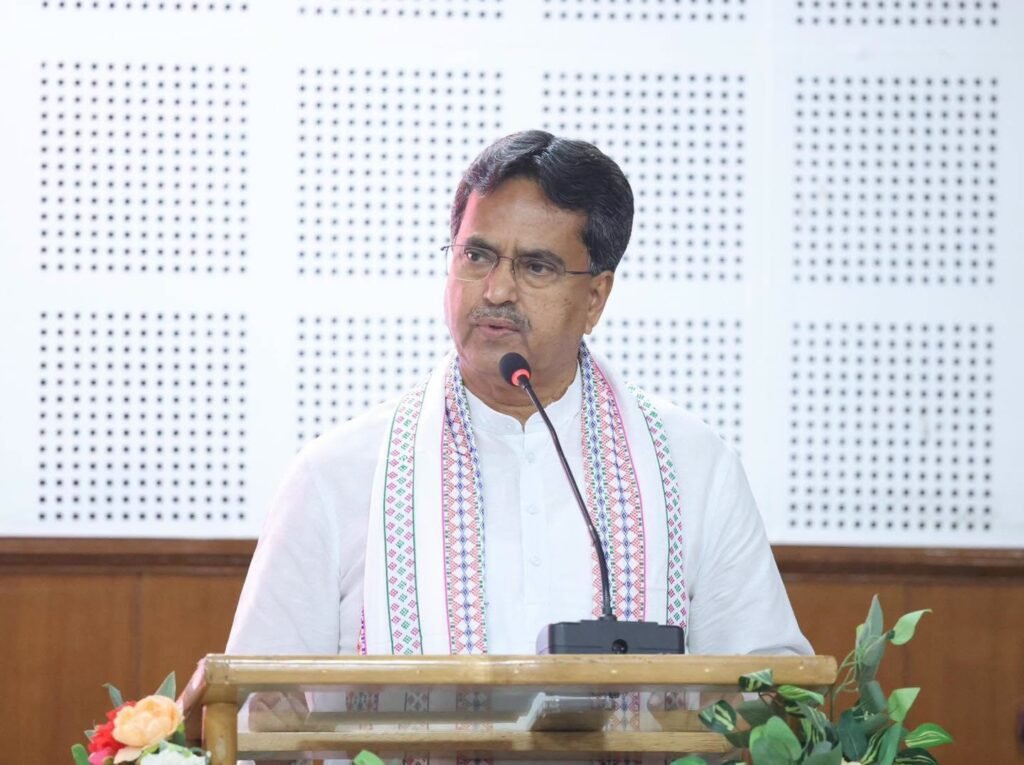
Chief Minister Manik Saha has announced a Tripura urban infrastructure masterplan aimed at modernising civic facilities across Nagar Panchayats and Municipal Council areas. The announcement comes about two months before elections to the state’s 21 urban local bodies.
Saha outlined the plan while inaugurating a newly constructed two-storey ward office at Pratapgarh under the Agartala Municipal Corporation. The ward office cost ₹97.43 lakh.
The government says the broader objective is to improve civic services and extend development beyond Agartala. Meanwhile, officials have highlighted ongoing investments in drinking water, roads, drainage, housing and other urban facilities.
Tripura Prepares for 410 MW Durga Puja Power Demand
Tripura Urban Infrastructure Masterplan Extends Beyond Agartala
The Tripura urban infrastructure masterplan seeks to create modern civic infrastructure across Nagar Panchayat and Municipal Council areas. Saha said the state has prepared the plan along the lines of the development work being undertaken through the Smart City Mission in Agartala.
The announcement marks an attempt to broaden the state’s urban-development focus. Agartala has received significant investment through Smart City programmes, while other urban centres require improvements in basic civic facilities and infrastructure.
According to the Chief Minister, the government’s development approach aims to ensure that public services reach all sections of society. He also said development programmes would operate without political discrimination.
However, detailed project-wise information for all 21 urban local bodies has not yet been publicly outlined. The government has not provided a complete list of proposed projects, individual financial allocations or implementation timelines for every civic body.
That distinction is important because the announcement represents a broad development framework rather than a fully detailed project schedule. The implementation phase will determine how the proposed modernisation reaches smaller municipalities and Nagar Panchayats.
Agartala Projects Provide Foundation for Wider Urban Push
The Tripura urban infrastructure masterplan builds on several projects already implemented in Agartala. Saha pointed to the Smart City Mission as an example of the government’s urban-development work in the state capital.
According to figures cited by the Chief Minister, 65 projects worth ₹581 crore have been implemented across Agartala under the Smart City Mission. These projects have contributed to improvements in civic infrastructure and urban services.
Water supply has also remained a major focus. Under AMRUT 2.0, the government has implemented safe drinking-water projects worth ₹112 crore, with around 16,000 families receiving access to the improved water infrastructure, according to Saha.
The government has also constructed 48 flats for economically weaker sections, while work on two additional flats remains underway. These projects form part of the broader effort to connect urban development with housing and basic services.
Meanwhile, Saha highlighted road construction and repairs, drainage improvements, pucca housing and healthcare expansion among the areas receiving attention. The government has also indicated that additional projects will be undertaken under AMRUT 3.0.
Together, these initiatives provide the existing foundation for the wider urban-development strategy. The next challenge will be extending similar improvements to civic bodies outside Agartala.
Civic Services and Infrastructure Become Key Priorities
The Tripura urban infrastructure masterplan comes as the government faces growing expectations for better municipal services. Urban residents increasingly depend on reliable water supply, drainage, roads, waste management, lighting and accessible administrative services.
Saha has argued that urban development should improve people’s quality of life rather than focus only on constructing physical structures. Recent government statements have similarly highlighted drainage modernisation, alternative roads, solar lighting and the conservation of parks and water bodies.
Such priorities are particularly relevant as Tripura’s urban areas expand. Better drainage can reduce problems during heavy rainfall, while improved roads can support mobility and reduce pressure on congested routes.
At the same time, municipal bodies require stronger local infrastructure to deliver services efficiently. Ward offices can play an important role by bringing administrative services closer to residents and improving communication between citizens and civic authorities.
The newly inaugurated Pratapgarh ward office illustrates this approach. The two-storey facility was constructed at a cost of ₹97.43 lakh and is intended to strengthen local-level civic administration within the Agartala Municipal Corporation.
The wider plan could therefore combine large infrastructure projects with smaller administrative improvements. Both levels will matter if the government wants to create more consistent civic services across the state.
21 Urban Local Bodies Enter Election Preparation
The announcement of the Tripura urban infrastructure masterplan comes at a politically important time. Elections to 21 urban local bodies are expected in the coming months, with the state already beginning preparations for the civic polls.
The 21 bodies include Agartala Municipal Corporation along with Municipal Councils and Nagar Panchayats across Tripura. Political parties have started organisational preparations, including discussions on candidates, reservations and election strategy.
Development and good governance are expected to feature prominently in the campaign. The BJP has already identified development and governance as key themes for the upcoming urban local body elections.
Against this backdrop, the government’s infrastructure announcement is likely to receive considerable attention during the civic-election period. However, the timing alone does not establish that the plan is an electoral measure. The government has presented the initiative as part of its broader development programme.
The more significant test will come through implementation. Residents will likely assess whether promised infrastructure reaches individual towns and whether improvements translate into better daily services.
Furthermore, the success of the plan will depend on coordination between the state government, Urban Development Department, municipal authorities and other agencies. Infrastructure projects require land, funding, technical planning and long-term maintenance.
Modernisation Must Reach Smaller Civic Areas
The Tripura urban infrastructure masterplan could have its greatest impact if it addresses differences between Agartala and smaller urban centres. Existing development has been particularly visible in the capital, while other municipalities and Nagar Panchayats require sustained investment.
The state’s ongoing Tripura Urban and Tourism Development Project already includes infrastructure work in several urban local bodies. The 2025-26 budget document identified water supply, roads, drainage and other infrastructure works across 12 ULB areas, including Khowai, Mohanpur, Ranir Bazar, Bishramganj, Melagarh, Belonia, Dharmanagar, Kailashahar and Kumarghat.
That existing programme provides context for the latest master-plan announcement. The new framework could potentially create a more coordinated approach to urban infrastructure across the state.
At the same time, planning will need to account for local conditions. A drainage solution suitable for Agartala may not work in the same way in a smaller town. Similarly, road requirements, water demand and waste-management systems can differ significantly between municipalities.
The government will therefore need detailed local planning alongside the broader state-level vision. Clear project timelines, funding arrangements and measurable service targets would also help residents evaluate progress.
Sustainable development will remain another important consideration. Tripura’s urban planning efforts increasingly include water-body conservation, green spaces and climate-sensitive infrastructure. These elements can help cities grow while preserving their environmental assets.
Conclusion
The Tripura urban infrastructure masterplan represents a broad attempt to extend modern civic infrastructure beyond Agartala to Nagar Panchayats and Municipal Council areas across the state. Chief Minister Manik Saha has linked the initiative to the government’s wider objective of improving public services and ensuring more inclusive development.
Agartala’s existing Smart City projects, AMRUT 2.0 investments and new ward facilities provide examples of the infrastructure model the government wants to expand. However, detailed plans for individual urban local bodies remain to be outlined publicly.
With elections to 21 urban local bodies approaching, implementation will remain closely watched. Ultimately, the success of the plan will depend on whether promised investments produce measurable improvements in water supply, roads, drainage, sanitation, housing and everyday civic services across Tripura.
FAQs
What is the Tripura urban infrastructure masterplan?
The Tripura urban infrastructure masterplan is a government plan to develop modern civic infrastructure across Nagar Panchayat and Municipal Council areas in the state.
Who announced the urban infrastructure plan?
Chief Minister Manik Saha announced the plan while inaugurating a newly constructed two-storey ward office at Pratapgarh under the Agartala Municipal Corporation.
How much has been invested under Agartala’s Smart City Mission?
According to Saha, 65 Smart City Mission projects worth ₹581 crore have been implemented across Agartala.
How many families have received safe drinking water under AMRUT 2.0?
The Chief Minister said around 16,000 families have received safe drinking water through AMRUT 2.0 projects worth ₹112 crore in Agartala.
Why is the master plan significant before the ULB elections?
The plan comes about two months before elections to 21 urban local bodies. Therefore, its implementation and the government’s civic-development record are likely to receive significant public attention during the election period.