


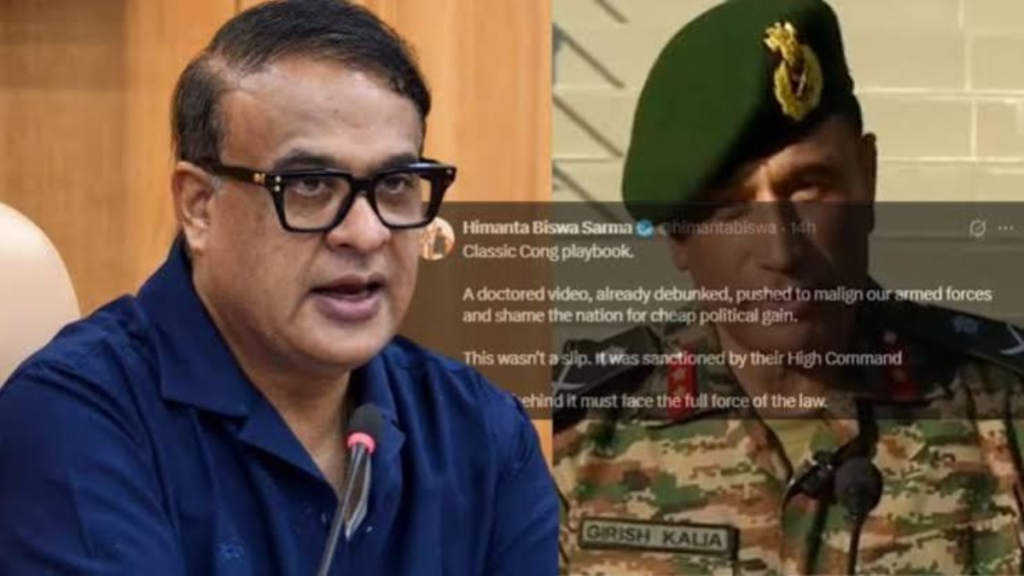
An alleged doctored Army video has triggered a political controversy after Assam Chief Minister Himanta Biswa Sarma demanded legal action against those responsible for circulating the clip. Sarma accused the Congress leadership of using fabricated military statements to damage the reputation of the Indian armed forces.
The controversy intensified after the Indian Army rejected claims attributed to Lieutenant General Girish Kalia, a senior officer associated with the Army’s Spear Corps. The military said the viral footage had been digitally manipulated and contained fabricated remarks about the situation along the India-China border.
Doctored Army Video Sparks Political Row
On October 26, Sarma criticised the Congress over the circulation of the video in a post on X. He described the alleged incident as a “Classic Cong playbook” and accused the party of attempting to malign the armed forces for political gain.
The Assam chief minister alleged that the circulation of the doctored Army video was not an isolated mistake. He further claimed that the party’s senior leadership had sanctioned the content.
Sarma called for those responsible to face legal consequences. However, his allegations about the Congress leadership’s involvement remain political claims and should not be treated as established findings.
The controversy has drawn attention to the growing risks associated with manipulated digital content, particularly when it involves national security and senior military officials.
Army Debunks Doctored Army Video Claims
The Indian Army’s fact-checking handle rejected the viral clip and identified it as digitally altered content. According to reports, the video used artificial intelligence-generated lip-syncing and voice cloning to attribute fabricated remarks to Lieutenant General Kalia.
The clip alleged that China had occupied areas in Arunachal Pradesh, including Asaphila, Longju and Taksing Circle. It also questioned the deployment of Indian security personnel and claimed that soldiers had been denied essential supplies.
Additionally, the video circulated claims about the alleged arrest of 25 soldiers and uncertainty over their whereabouts. These assertions raised concerns online because they appeared to suggest serious failures in India’s border security arrangements.
However, the Army said the officer had not made the statements attributed to him. Its fact-check described the content as fabricated military disinformation.
Original Footage Reveals Video Manipulation
The Army traced the footage to an earlier press briefing held in Kupwara, Jammu and Kashmir, on October 27, 2023. At that time, Kalia was serving as General Officer Commanding of the 28 Infantry Division.
The original briefing concerned counter-terrorism operations and infiltration attempts along the Line of Control. It did not contain the claims about Chinese control over parts of Arunachal Pradesh that appeared in the viral clip.
According to the Army’s clarification, the manipulated video repurposed archival footage to make it appear that the officer had disclosed sensitive information about the border situation.
This distinction matters because authentic military footage can lend credibility to false claims when editors alter a speaker’s words or imitate their voice. As a result, viewers may struggle to distinguish genuine statements from fabricated material.
The Army urged social media users to verify information before sharing videos concerning national security.
Doctored Army Video Fuels Congress-BJP Tensions
The doctored Army video controversy has added another issue to the continuing political confrontation between the BJP and Congress. Both parties have frequently accused each other of using misleading digital content to influence public opinion.
Congress leader Ritu Choudhary shared the claims concerning Kalia and the border situation on social media, according to published reports. The Army subsequently rejected the assertions attributed to the officer.
Union minister Kiren Rijiju also criticised the Congress and demanded an apology over the circulation of the video. Meanwhile, the Indian Youth Congress questioned Rijiju’s decision to share the clip while describing it as fake.
These exchanges highlight a broader dispute over responsibility for spreading misleading content online. However, the available reports do not establish that the Congress high command authorised the alleged manipulation, as Sarma claimed.
Any legal action would need to establish the relevant facts, including who created the video, how it was circulated and whether specific laws were violated.
Legal Accountability and Digital Verification
The doctored Army video row underscores the importance of responsible communication when military affairs become part of political debate. False claims about territorial control, troop deployments or military operations can create unnecessary public anxiety.
Moreover, artificial intelligence tools now allow people to imitate voices and manipulate existing footage with increasing realism. This makes verification by official agencies and independent news organisations especially important.
Social media users can reduce the spread of misinformation by checking original recordings, consulting official fact-checks and comparing claims with reliable news reports before sharing them.
The demand for legal action has placed accountability at the centre of the latest political dispute. However, allegations against individuals or political organisations require evidence and due process.
As the controversy develops, the central questions remain who created and circulated the fabricated footage, and whether investigators will establish grounds for prosecution. The Army’s clarification has disputed the video’s claims, but responsibility for its circulation must be assessed on evidence rather than political accusations.
Tripura CM Manik Saha Criticises Congress Chief Mallikarjun Kharge Over PM Modi’s Father Remarks