


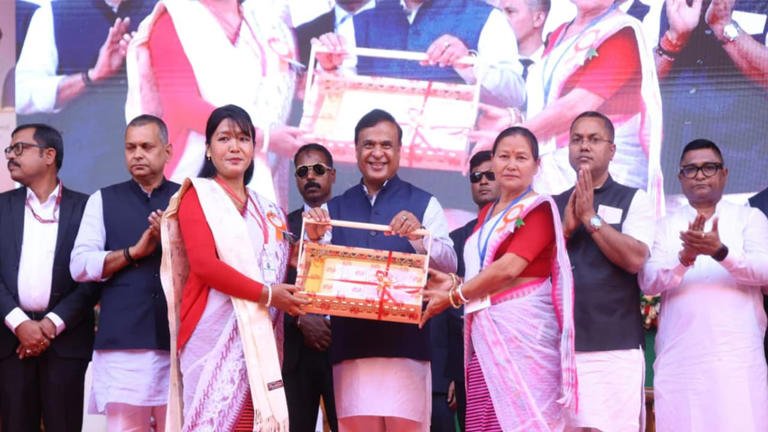
Assam is currently witnessing a historic shift in its rural economic structure. Recently, Chief Minister Dr. Himanta Biswa Sarma intensified the rollout of a flagship initiative. This program aims to turn millions of women into independent business owners. The Assam women entrepreneurship mission, officially known as the Mukhya Mantri Mahila Udyamita Abhiyan (MMUA), represents a massive investment. By providing direct financial support, the government aims to create a new class of rural entrepreneurs.
Read More: Tripura’s Path to Prosperity: A Humanitarian Governance Model
Distribution of Seed Capital Across Assam
The mission reached a significant milestone this week. In multiple ceremonies held in districts like Sribhumi and Cachar, the Chief Minister personally distributed cheques. Thousands of beneficiaries received their funds during these events. Specifically, each eligible woman receives an initial seed capital of ₹10,000. This amount serves as a “grant-in-aid” to help them start micro-enterprises.
As of January 2026, the Assam women entrepreneurship mission has already covered over 19 lakh women. These beneficiaries span across 80 Legislative Assembly Constituencies. During a recent event in Karimganj, the Chief Minister revealed the total budget. He stated that the project would eventually cost ₹3,200 crore. Consequently, the goal is to touch the lives of 40 lakh women who belong to Self-Help Groups (SHGs).
The “Lakhpati Baideo” Vision
A central pillar of the Assam women entrepreneurship mission is the creation of “Lakhpati Baideos.” These are women who earn a minimum annual income of ₹1 lakh. The government believes that financial independence for women benefits the entire family. Therefore, the mission follows a structured path to success.
- Phased Support: The ₹10,000 seed fund is only the first step. If beneficiaries use the money effectively, they qualify for more help. They can later receive amounts of ₹25,000 and ₹50,000.
- Collective Investment: CM Sarma suggested that women can pool their individual grants. By doing so, they can create a larger corpus. This allows them to start bigger ventures like poultry farms or weaving centers.
- Economic Impact: The government expects a massive boost to the state’s wealth. If 40 lakh women earn ₹1 lakh annually, it will add ₹40,000 crore to Assam’s economy every year.
Eligibility and Sustainable Growth
The state has attached certain social criteria to ensure long-term success. For instance, beneficiaries must follow a “Sankalp Patra.” This document includes rules regarding family size and education. Specifically, daughters must attend school for a family to remain eligible. Thus, economic growth goes hand-in-hand with social progress.
Furthermore, the administration will conduct house-to-house evaluations after six months. This monitoring process ensures that people use the funds for genuine business activities. For example, women can choose from various models like fruit cultivation or bamboo crafts. These diverse options allow them to leverage local resources effectively.
Toward an Atmanirbhar Assam
The Assam women entrepreneurship mission is more than just a welfare scheme. Instead, it is a strategic economic intervention. The state is moving away from a “subsidy-only” mindset. In its place, the government is fostering a culture of risk-taking at the grassroots level.
As the Chief Minister noted in Dhemaji, the rural economy strengthens when women contribute. Since the second and third phases are already in motion, Assam is setting a national benchmark. The rise of “Nari-preneurs” is paving the way for a self-reliant and vibrant Assam. This vision aligns perfectly with the goal of a developed India by 2047.
Read More: Howrah-Anand Vihar Amrit Bharat Weekly Express: New Stoppages in Bihar Announced