


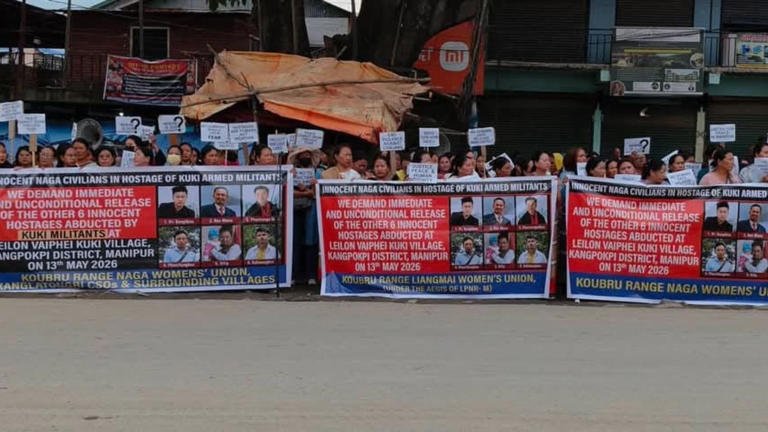
The continuing impact of Manipur’s hostage crisis has started affecting transportation networks and supply movement, creating concern among businesses, transport operators, and local communities. One of the visible consequences has been the growing number of stranded trucks and increasing pressure on supply chains across affected areas.
As movement disruptions and uncertainty continue, transporters have reported delays in cargo movement while concerns over the availability of essential goods have started emerging. The situation has also drawn attention to the broader economic and logistical effects that security-related disruptions can create.
Observers noted that transport interruptions often produce consequences beyond immediate security concerns and can affect daily life across communities.
Read More: Former JD(U) Leader Nimaichand Luwang Joins BJP in Manipur
Transport Movement Faces Disruptions
The hostage crisis and related uncertainty have created challenges for the movement of commercial vehicles in parts of Manipur.
Reports of stranded trucks have raised concerns among transport operators who depend on uninterrupted routes to deliver goods and maintain schedules.
When vehicle movement slows, supply chains experience pressure across multiple sectors. Consequently, delays begin affecting delivery timelines and operational planning.
Transporters also face uncertainty regarding route accessibility and cargo movement.
Commercial transport remains important for ensuring regular supply of goods to local markets. Therefore, disruptions often create concerns among traders and consumers.
Industry stakeholders stated that restoring confidence in transport routes remains necessary to improve normal movement.
Supply Chains Show Signs of Pressure
Supply movement disruptions have started creating concerns regarding shrinking availability of goods in affected areas.
Markets and businesses often rely on continuous inflow of products through road transportation. However, interruptions in vehicle movement can gradually affect stock levels and distribution systems.
Observers noted that reduced supply activity may increase logistical challenges and create uncertainty for businesses.
Supply chains depend on timely movement and predictable transport conditions. Therefore, extended delays can influence operational efficiency.
Businesses connected to wholesale and retail networks continue monitoring conditions closely.
At the same time, stakeholders are encouraging measures that ensure smoother movement of essential goods.
Economic Activity Faces Secondary Effects
Apart from transport disruptions, the situation has also influenced economic activity in areas dependent on road connectivity.
Commercial operations often slow when transportation becomes uncertain. As a result, local businesses and service providers may experience operational pressure.
Small traders and logistics operators generally remain among the most affected groups during prolonged movement disruptions.
Economic activity depends heavily on stable transport systems. Therefore, interruptions frequently create wider ripple effects.
Observers highlighted that transport-related challenges can influence both local markets and regional business operations.
Many stakeholders continue to emphasise the need for stability to restore economic confidence.
Communities Express Concern Over Essential Supplies
Residents in affected areas have also expressed concern regarding the continuity of supplies and access to daily necessities.
Road transportation supports movement of food items, consumer goods, and other essential products. Consequently, prolonged delays often create anxiety among communities.
Although supply networks continue operating in several areas, concerns remain regarding future availability if disruptions continue.
Community members have called for measures that support uninterrupted transport while maintaining public safety.
Observers stressed that maintaining supply chains remains important during periods of uncertainty.
Authorities and stakeholders continue monitoring developments and assessing requirements.
Transport Sector Seeks Stability and Predictability
Transport operators and logistics stakeholders have highlighted the importance of restoring stable conditions for smoother movement.
Vehicle operators depend on clear routes and predictable schedules to maintain regular deliveries.
Industry representatives noted that reducing uncertainty can improve confidence and encourage resumption of normal transport activity.
They also emphasised the need to maintain uninterrupted movement of commercial vehicles wherever possible.
Stable transport systems support economic activity and reduce operational risks.
Therefore, restoring normal mobility remains important for businesses and communities alike.
Broader Impact Extends Beyond Immediate Crisis
The situation in Manipur reflects how security-related disruptions can extend into transport and supply systems.
Although the immediate concern remains the humanitarian and social dimensions of the hostage crisis, secondary effects have become increasingly visible.
Stranded trucks and shrinking supplies demonstrate how interconnected transport and economic systems are.
Experts often point out that disruptions in one area can create broader consequences across markets and public services.
Maintaining movement and reducing logistical pressure remain important for supporting normal life.
Stakeholders continue to stress that coordinated efforts and improved conditions can help restore supply confidence.
Attention Turns to Restoring Normal Movement
As developments continue, attention has shifted toward ensuring uninterrupted transport and stabilising supply channels.
Businesses, transport operators, and communities remain focused on restoring confidence and maintaining regular movement of goods.
Authorities are expected to continue monitoring conditions and encouraging measures that support essential supply networks.
The impact of stranded trucks and shrinking supplies has highlighted the importance of stable transportation systems during periods of uncertainty.
While the broader situation evolves, stakeholders continue to emphasise the need for solutions that support mobility, public welfare, and economic continuity.
The fallout from Manipur’s hostage crisis shows how disruptions can move beyond immediate events and affect transportation, trade, and everyday life across affected regions.
Read More: Public Hearing on Rs 1,800 Crore Meghalaya Limestone Mining Project Called Off Amid Protests