


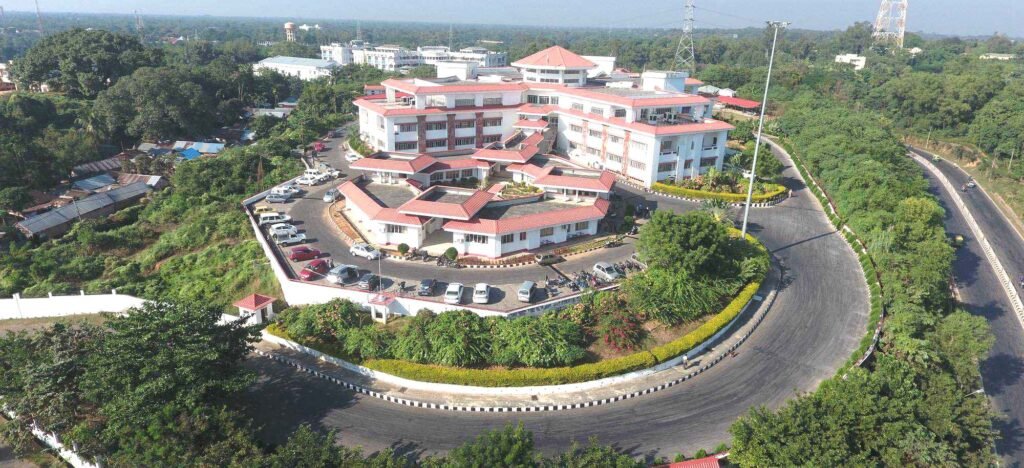
Agartala, August 18, 2025: The much-debated case of 10,323 retrenched teachers in Tripura reached a crucial stage today as the High Court’s single bench, headed by Justice Sabyasachi Datta Purkayastha, concluded the final hearing. The matter, which has drawn attention across the state for years, now awaits the court’s judgment.
Advocates Amrit Lal Saha, Aveek Saha, and T.K. Naike presented arguments on behalf of petitioners Subhas Sinha (undergraduate teacher), Santanu Bhattacharjee (graduate teacher), and Bidhan Das (postgraduate teacher). The petitioners had approached the court after being granted “liberty” by the Supreme Court. Representing the state government were Advocate General Shaktimay Chakraborty and government counsel Dipankar Sharma.
The hearing, which began at 11:20 AM, saw detailed arguments from the petitioners’ side. Advocate Amrit Lal Saha argued that the government’s decision to downgrade the status of 10,323 teachers to ad hoc employees in December 2017 and their mass termination on March 31, 2020, had no backing from any judicial order of the High Court or Supreme Court in the Tanmay Nath case. He highlighted that the retrenchment orders were “omnibus” in nature, issued collectively instead of serving individual termination notices as required by law.
Saha further pointed out that the government failed to provide approval from the Law Department before moving to the Supreme Court, a requirement under the Rules of Executive Business (REB).
Drawing from constitutional provisions, he cited Article 311 (2) and Constituent Assembly debates, including B.R. Ambedkar’s remarks, to argue that no government employee can be dismissed without prior notice, except under specific exceptions not applicable in this case. He also referred to Paragraph 127 of the original judgment delivered by then Chief Justice Deepak Kumar Gupta and Justice Swapan Chandra Das, which had clearly stated that the ruling would have a “prospective effect” — meaning only 60-62 teachers whose recruitment was directly challenged could be terminated, not all 10,323.
The petitioners’ counsel also clarified that the recruitment of these teachers had been made under the Recruitment Rules of 1970, with amendments in 2001 and 2007. He asserted that the appointments were never based on the alleged 2003 policy, which the government and opposing litigants had cited earlier. This, he argued, rendered the case “void ab initio.”
On the other hand, the state’s legal representatives struggled to establish that the retrenchment orders were directly tied to the Supreme Court’s directives in the Tanmay Nath case.
According to court sources, Justice Purkayastha gave patient hearing to both parties, intervening occasionally to raise queries and observations. The much-awaited final judgment will be pronounced at a later date, to be listed in the court’s cause list.
The outcome of this case is expected to have significant implications, not only for the retrenched teachers but also for Tripura’s education sector and government recruitment policies.