


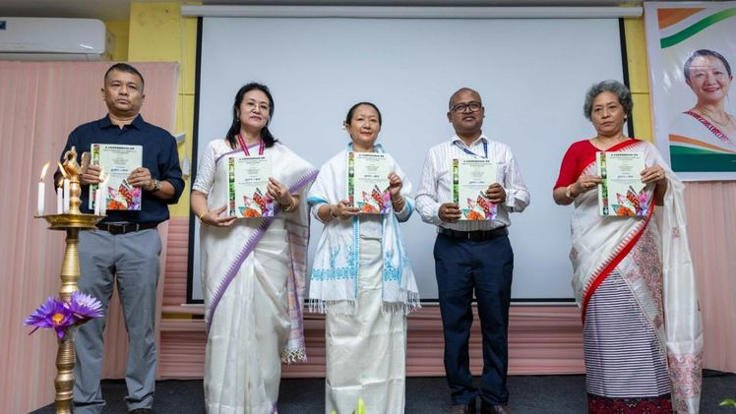
NITI Aayog member Dr Joram Aniya has called for greater scientific support to preserve indigenous knowledge systems across Northeast India. She stressed that modern research must help sustain traditional practices and make them relevant for future generations.
Aniya made the remarks during a Societal Development Lecture on Indigenous Knowledge Systems and Viksit Bharat 2047. The Institute of Bioresources and Sustainable Development (IBSD) organised the programme at its campus in Takyel, Imphal West, on Monday.
She said indigenous knowledge should not remain limited to cultural heritage. Instead, researchers must study, document and validate traditional practices through modern scientific methods.
The NITI Aayog member also highlighted the importance of biodiversity, traditional agriculture, medicinal plants and sustainable resource management.
Traditional Knowledge Faces Challenges as Younger Generations Move Away
Aniya expressed concern over the gradual disappearance of traditional knowledge systems.
She said communities have developed a deep understanding of nature through generations of observation and experience. However, changing lifestyles and migration for education and employment have weakened the transfer of this knowledge.
Traditional communities often relied on natural indicators to determine agricultural cycles. They observed flowering plants, fruiting patterns and changes in weather to identify suitable periods for sowing crops.
Such practices reflect generations of interaction with the environment.
Aniya stressed that scientists must document this knowledge before communities lose access to it.
She also called for stronger cooperation between researchers and indigenous communities. Their combined knowledge can help develop solutions that address modern challenges without abandoning valuable traditional practices.
Apatani Farming System of Ziro Highlights Sustainable Agriculture
Aniya cited the Apatani agricultural system in Ziro, Arunachal Pradesh, as an example of how traditional knowledge supports sustainable farming.
The Apatani community combines paddy cultivation with fish farming. Farmers also grow crops such as millet along the bunds that separate agricultural fields.
This integrated system connects agriculture, water management and biodiversity.
The practice demonstrates how communities can use available natural resources while maintaining ecological balance.
Aniya also highlighted the contribution of Apatani women in maintaining the traditional agricultural landscape.
However, she warned that the system faces challenges as younger people increasingly leave villages for education and employment.
The labour-intensive maintenance of field bunds also creates difficulties for farming communities.
She called for scientific and technological interventions to address these problems while protecting the traditional system.
Biotechnology Can Support Traditional Farming Practices
Aniya suggested that biotechnology and modern research could help strengthen traditional agricultural systems.
Scientists could explore methods to reduce soil erosion, improve water conservation and protect soil health.
Such interventions could help farmers maintain traditional practices while addressing emerging environmental challenges.
She emphasised that researchers should support existing systems rather than replace them.
The objective, she said, should be to combine traditional wisdom with scientific innovation.
This approach could also help preserve agricultural biodiversity and strengthen sustainable livelihoods in rural communities.
The discussion highlighted the need for research institutions to develop solutions that consider local conditions, cultural practices and environmental needs.
Indigenous Conservation Practices Offer Lessons for Biodiversity Protection
Aniya also highlighted traditional community-based systems for managing forests, wildlife and natural resources.
Several communities follow customary rules to regulate hunting and protect local ecosystems.
These practices can provide useful lessons for biodiversity conservation.
She said researchers should examine such systems through scientific methods instead of dismissing them as folklore.
Modern research can help establish evidence for traditional practices and identify ways to improve their application.
At the same time, scientists must respect the knowledge that communities have preserved across generations.
The integration of indigenous knowledge and scientific research could support conservation efforts throughout Northeast India.
IBSD Highlights Conservation of Northeast’s Bioresources
BRIC-IBSD Director (Additional Charge) Dr Nanaocha Sharma highlighted the institute’s work in conserving and sustainably using bioresources across the Northeast.
He stressed the importance of connecting traditional knowledge with modern scientific research.
Sharma also announced that the institute had filed applications for Geographical Indication (GI) tags for two varieties of black rice from Manipur.
GI recognition can help identify products with a specific geographical origin and protect their regional identity.
The initiative also reflects efforts to promote the region’s agricultural heritage and bioresource potential.
Compendium on Northeast Medicinal Plants Released
The programme also featured the release of a publication titled A Compendium on Medicinal Plants of the Family Zingiberaceae from North-East India (Volume-I).
The book documents medicinal plants belonging to the ginger family found across Northeast India.
The publication aims to strengthen scientific understanding of the region’s plant resources.
It also contributes to wider efforts to document traditional knowledge associated with medicinal plants.
Researchers and institutions can use such documentation to support further studies on biodiversity and sustainable bioresource management.
Indigenous Knowledge Linked to Viksit Bharat 2047
Aniya connected the preservation of indigenous knowledge with the broader vision of Viksit Bharat 2047.
She called on scientists and research institutions to explore how traditional practices can contribute to India’s long-term development goals.
The lecture highlighted the importance of combining scientific innovation with community knowledge.
Northeast India possesses rich biodiversity and diverse cultural traditions. Its indigenous communities have developed practices related to agriculture, medicinal plants and natural resource management over generations.
Scientific validation and proper documentation can help preserve these practices while creating opportunities for future research.
Aniya’s message underlined the need to ensure that development does not disconnect future generations from their cultural and ecological heritage.
The programme concluded with discussions on the role of science, technology and research institutions in protecting indigenous knowledge and supporting sustainable development across the Northeast.