


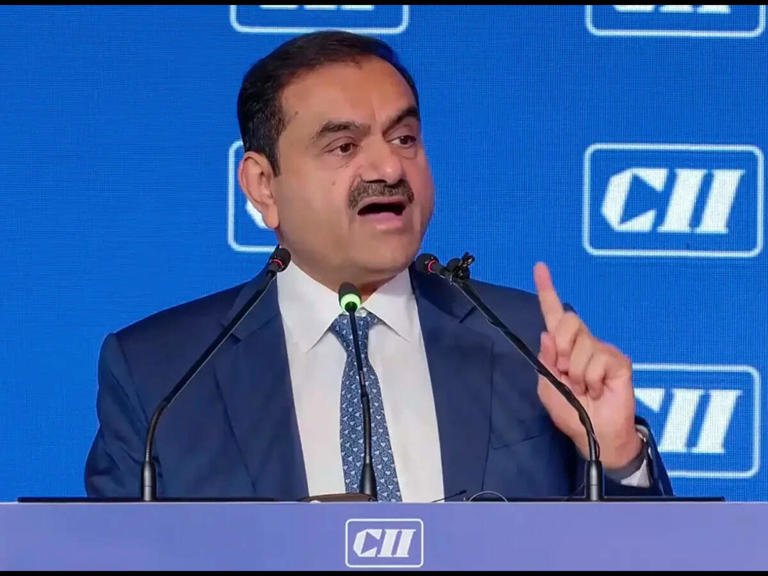
Industrialist Gautam Adani has called for India to build, power, and own artificial intelligence (AI) infrastructure within the country, stressing the importance of technological self-reliance and long-term digital sovereignty.
Speaking at a business and technology-focused event, Adani said India must create strong domestic AI infrastructure to remain globally competitive in the rapidly evolving technology sector.
According to him, artificial intelligence will shape the future of economies, industries, governance, and national security. He argued that India cannot depend entirely on foreign-controlled infrastructure for such a critical technological shift.
Read More: Charan Boro Takes Oath In Bodo In Assam NDA Government
Adani also highlighted the importance of data centres, semiconductor capabilities, energy systems, and digital networks in supporting AI-driven growth.
The remarks come at a time when India is increasingly focusing on AI, semiconductor manufacturing, and digital transformation as key pillars of economic development.
Adani stresses importance of AI infrastructure
Gautam Adani said AI infrastructure should become a national priority for India in the coming years.
According to him, the future of artificial intelligence depends not only on software and algorithms but also on physical infrastructure such as data centres, energy systems, cloud networks, and computing power.
He stated that countries capable of controlling and powering their own AI ecosystems would gain significant economic and strategic advantages.
Adani also warned against excessive dependence on external infrastructure providers and foreign technology systems.
The industrialist argued that India should create a complete domestic ecosystem capable of supporting AI innovation and deployment at scale.
Experts believe AI infrastructure will become increasingly important as industries adopt automation, machine learning, and data-driven technologies.
Call for technological self-reliance
Adani linked AI infrastructure development with India’s broader goal of technological self-reliance.
He said India must avoid becoming dependent on external powers for critical digital technologies and computing infrastructure.
According to him, owning domestic AI systems would strengthen economic security, innovation capacity, and national resilience.
The businessman also highlighted the growing global competition in emerging technologies such as AI, semiconductors, cloud computing, and advanced manufacturing.
India has already launched several initiatives aimed at encouraging domestic electronics and semiconductor production.
Political analysts believe technology self-reliance has become a major strategic priority for India because of changing geopolitical and economic conditions.
Data centres and energy seen as crucial
Gautam Adani emphasised the importance of data centres and energy infrastructure in supporting AI growth.
Artificial intelligence systems require massive computing power and continuous energy supply for training and operation.
According to Adani, India must build reliable and large-scale digital infrastructure capable of supporting future technological demands.
He also stressed the need for sustainable and affordable energy solutions to power data centres and AI networks.
The Adani Group has already expanded investments in sectors such as renewable energy, digital infrastructure, logistics, and data centres.
Experts noted that energy availability and computing infrastructure are becoming critical factors in global AI competition.
India emerging as digital powerhouse
Adani said India already possesses major strengths in software services, digital innovation, and information technology.
He highlighted the country’s large talent pool, startup ecosystem, and growing digital economy as important advantages.
According to him, India now has the opportunity to move beyond software outsourcing and become a major global technology power.
The industrialist also praised India’s digital public infrastructure and rapid adoption of technology across sectors.
Government initiatives such as Digital India and startup promotion have accelerated technology adoption in recent years.
Political observers believe India’s digital transformation has significantly increased investor interest in technology and infrastructure sectors.
AI expected to reshape industries
Gautam Adani said artificial intelligence would transform nearly every major industry in the future.
He noted that sectors such as healthcare, transportation, manufacturing, agriculture, finance, logistics, and education are already witnessing AI-driven changes.
According to him, companies and countries that fail to invest in AI infrastructure may struggle to remain competitive.
Adani also stressed the importance of preparing India’s workforce for technological transformation.
The industrialist called for greater investment in research, skill development, and advanced technical education.
Experts believe AI adoption could create both economic opportunities and employment challenges as automation expands globally.
Semiconductor ecosystem gains importance
During his remarks, Adani also highlighted the strategic importance of semiconductor manufacturing.
Semiconductors remain essential for AI systems, electronics, telecommunications, automobiles, and digital devices.
India has recently intensified efforts to establish a domestic semiconductor ecosystem through policy incentives and industrial partnerships.
Adani stated that semiconductor capabilities would become crucial for supporting AI infrastructure and technological independence.
Experts noted that global supply chain disruptions and geopolitical tensions have increased the importance of domestic semiconductor production.
India now aims to position itself as a major electronics and semiconductor manufacturing destination.
Government prioritising AI and technology
The Centre has increasingly focused on AI, digital infrastructure, and technology manufacturing under Prime Minister Narendra Modi’s leadership.
Union Minister Ashwini Vaishnaw recently described AI and semiconductors as key drivers of India’s future transformation.
The government has launched programmes linked to digital innovation, startup growth, semiconductor incentives, and advanced manufacturing.
Officials believe technology sectors can significantly contribute to economic growth and employment generation.
Political analysts said Adani’s remarks align with the broader national emphasis on self-reliance and technological advancement.
Private sector role highlighted
Adani stressed that both the government and private sector must work together to build India’s AI infrastructure.
According to him, large-scale investments and long-term planning will remain necessary for technological leadership.
The industrialist said Indian companies should invest aggressively in digital infrastructure, research facilities, and innovation ecosystems.
He also highlighted the role of startups and entrepreneurs in developing AI applications and services.
Experts believe collaboration between industry, academia, and government institutions will be essential for building a competitive AI ecosystem.
India’s startup ecosystem has already witnessed rapid growth in sectors linked to fintech, healthtech, logistics, and artificial intelligence.
Global AI race intensifying
The industrialist noted that countries around the world are rapidly investing in AI infrastructure and advanced technologies.
The United States, China, and several European nations have already launched major initiatives linked to AI development and semiconductor manufacturing.
Adani warned that India must move quickly to remain competitive in the global technology race.
He stated that AI would influence future economic power, industrial competitiveness, and geopolitical influence.
Experts believe the competition for technological leadership may become one of the defining global trends of the coming decades.
India therefore faces increasing pressure to strengthen its domestic capabilities in AI and digital infrastructure.
Vision for future India
Concluding his remarks, Gautam Adani expressed confidence in India’s ability to emerge as a major technology and innovation hub.
He said the country possesses the talent, market size, and entrepreneurial energy needed for large-scale technological transformation.
According to him, India should aim not only to use AI but also to own and control the infrastructure powering it.
The industrialist argued that building domestic AI capabilities would strengthen economic resilience and long-term national growth.
As India accelerates investments in digital technology and infrastructure, discussions surrounding AI sovereignty, semiconductor manufacturing, and data infrastructure are expected to become increasingly important in shaping the country’s future economic strategy.
Read More: AI, Semiconductors And Railways To Drive India: Vaishnaw