


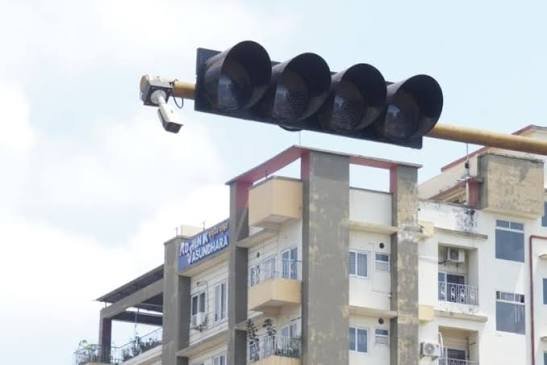
The Guwahati Smart City CCTV Rollout is expanding the use of intelligent surveillance and traffic-monitoring technology across the city. Guwahati Smart City Limited has developed an integrated surveillance framework that combines CCTV feeds, automatic number plate recognition and AI-based video analytics.
The system aims to strengthen traffic enforcement, improve public safety and provide authorities with real-time information from important locations. However, current official information does not confirm that hundreds of newly activated AI enforcement cameras have simultaneously gone live across bypass junctions. Instead, the city is continuing to develop and integrate its wider smart surveillance and traffic-management infrastructure.
PM Modi Turns 76: Himanta Credits Him for Assam’s Growth and Development
Guwahati Smart City CCTV Rollout Expands Intelligent Surveillance
The Guwahati Smart City CCTV Rollout forms part of a broader Intelligent Surveillance System designed by Guwahati Smart City Limited. The project brings different types of camera feeds together through a central Intelligent Command and Control Centre and associated data infrastructure.
According to the official project description, the surveillance system includes fixed bullet cameras, Pan-Tilt-Zoom cameras and Automatic Number Plate Recognition cameras. The system also incorporates emergency call boxes, public announcement systems, environmental sensors and visual message displays.
Furthermore, the project uses AI and machine-learning-based video analytics to process information captured by cameras. This technology can support authorities in identifying traffic situations, monitoring crowded locations and improving responses to incidents.
The official project information lists 1,750 bullet cameras and 250 PTZ cameras as components of the intelligent surveillance system. Therefore, the scale of the planned network is substantial, although these figures should not be interpreted as proof that all cameras are currently operational.
The system also connects surveillance with broader city-management functions. Consequently, authorities can potentially use information from traffic, environmental and security systems together rather than treating each technology as an isolated platform.
AI Technology Supports Traffic Enforcement
The city’s smart traffic infrastructure already incorporates technologies designed specifically for automated enforcement. Guwahati’s Integrated Traffic Management System covers 94 traffic junctions, while 20 junctions were inaugurated during the initial phase.
The National Institute of Urban Affairs’ Integrated Command and Control Centre platform describes Guwahati’s traffic enforcement system as using Automatic Number Plate Recognition and Red-Light Violation Detection. The system can support automatic challan generation for violations including red-light offences, helmet violations, triple riding, seat-belt violations, mobile-phone use while driving and speeding.
Moreover, the system connects camera-based information with the e-challan process. ANPR cameras capture vehicle registration numbers, while other cameras identify specific traffic violations. The information can then move through the enforcement system for appropriate action.
This approach represents an important shift from conventional traffic monitoring. Instead of relying entirely on personnel positioned at individual junctions, authorities can use cameras and centralised monitoring to observe multiple locations.
However, technology does not automatically eliminate traffic-management challenges. A 2025 report on the city’s ITMS noted that the project had faced implementation problems, including incomplete installations and non-functional equipment at some locations.
Therefore, the effectiveness of the Guwahati Smart City CCTV Rollout will depend not only on the number of cameras installed but also on their operational reliability, network connectivity, maintenance and integration with enforcement teams.
Key Junctions Remain Central to Monitoring
Traffic junctions remain an important part of Guwahati’s surveillance architecture. The official ITMS framework identifies 94 junctions for integrated traffic management, while the city’s command-and-control infrastructure supports real-time monitoring of traffic conditions.
The system is intended to help authorities understand traffic conditions and respond more efficiently to congestion and violations. Additionally, the integration of CCTV with geographic information systems can help officials identify camera locations, traffic signals and other urban infrastructure through a common digital platform.
The broader surveillance project also aims to improve situational awareness. Officials can receive information from cameras and other sensors at the command centre and take action according to established operating procedures.
Furthermore, the technology can support urban planning by generating information about traffic patterns and frequently congested areas. This data could help authorities identify locations where changes to road design, signalling or traffic management may be necessary.
However, camera deployment alone cannot resolve structural traffic problems. Road geometry, junction design, pedestrian movement and vehicle volumes also influence congestion. Consequently, smart surveillance works most effectively when authorities combine technological monitoring with physical improvements and active traffic management.
The city’s experience also demonstrates the importance of maintaining installed equipment. Cameras that lose connectivity or become non-functional cannot contribute effectively to automated enforcement. Therefore, maintenance and system reliability remain important alongside expansion.
Command Centre Connects Traffic and Public Safety
The Guwahati Smart City CCTV Rollout is designed around centralised monitoring rather than independent camera networks. The Integrated Command and Control Centre can bring together information from surveillance cameras, traffic systems, environmental sensors and other smart-city components.
The official GSCL framework describes the command centre as a platform for unified operations and data-driven decision-making. It also identifies enhanced traffic enforcement, public safety, emergency response and situational awareness among the expected benefits.
Moreover, the city’s GIS platform allows CCTV locations and traffic-related infrastructure to be represented through a common geographic system. This can help officials understand incidents in relation to roads, junctions and other urban assets.
The surveillance system also has a wider public-safety purpose. GSCL says intelligent monitoring can assist with preventive policing, incident detection and timely response. Therefore, traffic enforcement represents only one part of the overall technology programme.
At the same time, increased camera-based monitoring makes responsible data management important. Systems handling vehicle information and continuous video feeds require appropriate safeguards, controlled access and reliable operational procedures.
Guwahati’s smart-city infrastructure is consequently moving toward a more integrated model in which traffic management, surveillance and urban administration share technological resources. The success of that model will depend on how effectively authorities maintain the equipment and translate real-time information into practical action.
Conclusion
The Guwahati Smart City CCTV Rollout reflects the city’s continuing shift toward technology-supported traffic enforcement and integrated surveillance. AI-based video analytics, ANPR technology, traffic monitoring and centralised command systems form important parts of this infrastructure.
However, available official information does not establish that hundreds of newly installed AI enforcement cameras have all become operational specifically at bypass junctions. Instead, Guwahati is continuing to develop a large-scale surveillance and traffic-management network involving numerous cameras and smart-city systems.
Therefore, the effectiveness of the rollout will ultimately depend on operational coverage, reliable equipment, strong connectivity, effective enforcement and appropriate maintenance. As these systems expand, they could provide authorities with better real-time information while supporting safer and more coordinated traffic management across Guwahati.
FAQs
What is the Guwahati Smart City CCTV Rollout?
The Guwahati Smart City CCTV Rollout refers to the development and integration of large-scale CCTV, traffic-monitoring and intelligent surveillance infrastructure across Guwahati.
Does the system use AI technology?
Yes. Guwahati Smart City Limited says its Intelligent Surveillance System will use AI and machine-learning-based video analytics to process camera feeds and support surveillance and enforcement functions.
How many traffic junctions are covered by the ITMS?
The official Guwahati Smart City ITMS information identifies 94 traffic junctions for implementation, with 20 junctions inaugurated during the initial phase.
Can the cameras detect traffic violations?
Yes. Guwahati’s integrated traffic system uses technologies including ANPR and Red-Light Violation Detection. The system can support enforcement for violations such as red-light offences, helmet violations, triple riding, seat-belt violations and speeding.
Are hundreds of new AI cameras confirmed to be active at bypass junctions?
The available official information confirms a large planned surveillance network but does not independently confirm that hundreds of newly activated AI enforcement cameras are simultaneously operational specifically across bypass junctions. The city’s surveillance and traffic systems remain part of an ongoing smart-city technology programme.