


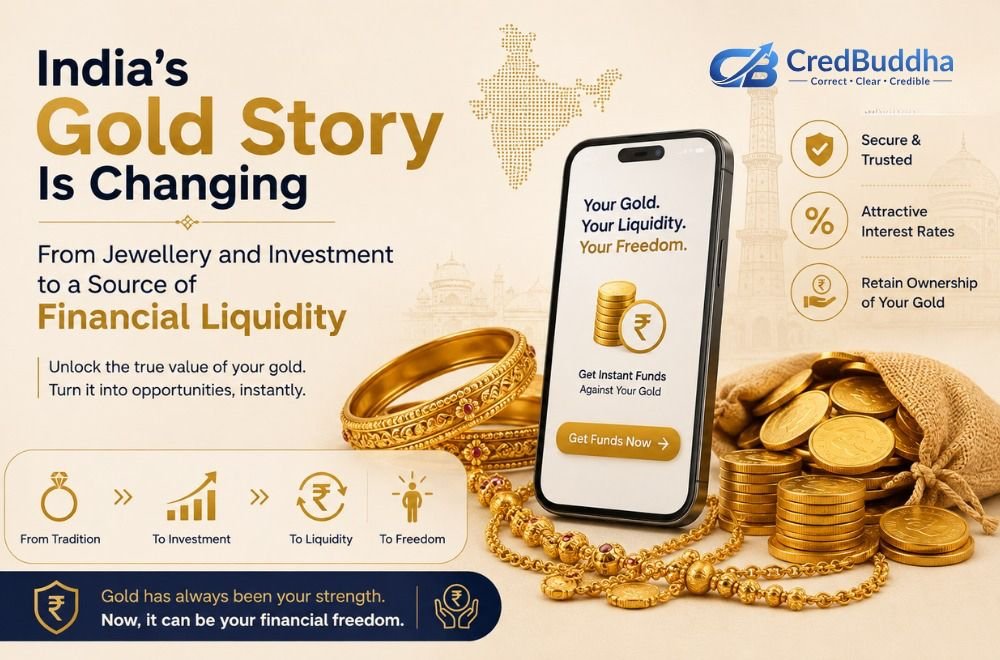
India’s relationship with gold is changing as gold prices are getting high, changing investment habits and growing demand for gold-backed borrowing make household gold an increasingly important source of financial liquidity. CredBuddha is a financial comparison platform that helps users compare loan and financial products and is not a lender.
India’s demand for gold dropped 6% year over year to 131 tonnes in Q2 2026, while spending increased 35% to ₹1.979 trillion, showing how rising gold prices are changing consumer buying habits. This article analyzes the shift from gold ownership to gold monetization, the expansion of gold loans and the factors that borrowers should take into account when using gold as collateral.
Gold’s Expanding Role in Indian Households
With gold prices rising in 2026 supported by global unpredictability and strong investor demand, the value of existing household gold has increased significantly. Gold now serves three overlapping roles: cultural wealth, an investment asset and a potential source of liquidity.
Investment demand has grown markedly. World Gold Council data indicates Q1 2026 bar and coin demand reached 62 tonnes, while gold ETF demand reached record levels. Concurrently, gold-backed borrowing has emerged as a major credit segment, becoming the second-largest retail lending segment after housing according to the World Gold Council’s Q2 2026 India analysis.
Understanding Gold Loans as Financial Liquidity
A gold loan provides an alternative between keeping gold at home and selling it. In a gold-backed loan, physical gold is pledged as collateral and the lender provides funds based on its assessed value, applicable loan-to-value (LTV) limits and the borrower’s eligibility. Ownership remains subject to the loan agreement and repayment obligations.
The market gold rate is not the same as the loan amount. Lenders consider the gold’s purity, net weight, valuation methodology and applicable LTV limits when determining how much can be sanctioned. The same jewellery may qualify for different loan amounts depending on purity and the lender’s terms. Stones and other non-gold components are excluded from valuation.
Why Borrow Against Gold Rather Than Sell?
Rising gold prices can make borrowing against jewellery a practical alternative to selling it. Selling jewellery means giving up ownership permanently, while a gold loan allows the owner to access funds and reclaim the pledged gold after repaying the loan. For short-term financial needs, a gold loan may therefore help meet immediate expenses without permanently parting with jewellery that may be difficult or expensive to replace.
A gold loan, however, is still a debt obligation with interest, processing fees, periods of repayment and other expenses. Default carries significant risk, as pledged gold may be auctioned to recover outstanding dues, subject to the lender’s terms and applicable regulatory procedures.
Gold Loan vs Personal Loan: Key Differences
The main distinction is collateral. A gold loan is secured against pledged gold, while a personal loan depends on income, credit history and lender eligibility. Someone with eligible gold but limited unsecured credit history may consider a gold loan. Interest rates, fees, documentation and repayment terms vary across lenders and borrower profiles, making comparison essential before borrowing.
What Borrowers Should Check
Before pledging gold, borrowers should confirm the interest rate calculation method, review processing and penal charges, examine tenure and repayment structure, understand the LTV limit applied, clarify prepayment and foreclosure terms and confirm the lender’s assessment of gold purity and net weight. These factors together determine the total repayment obligation and the consequences of missing payments.
A higher gold rate can increase collateral value and potential loan amount, but the final loan amount remains subject to LTV limits and lender assessment. Borrowers should avoid taking on more debt simply because gold prices are higher without considering their actual repayment capacity.
Technology and Digital Comparison Tools
Technology is enabling borrowers to discover and assess gold loans more easily. Digital processes reduce branch visits through online eligibility checks and documentation, though physical gold valuation may still require lender assessment. EMI calculators and comparison tools help borrowers understand repayment costs and evaluate gold loans against personal loans before borrowing.
CredBuddha helps users compare financial products and understand borrowing options; CredBuddha is not a lender and does not itself provide gold loans. Its role is to support informed comparison by bringing together information that can help users assess loan eligibility, costs and repayment considerations. For someone comparing a gold loan vs personal loan, tools such as EMI calculators can help evaluate how a proposed loan may affect monthly cash flow.
Conclusion
Gold’s role in Indian household finance has broadened with rising prices and expanding gold-backed credit making it a potential source of financial liquidity. The choice between holding, selling or borrowing against gold depends on the borrower’s financial need, repayment capacity and loan eligibility. A gold loan can provide funds without selling the asset, but it still involves interest costs, repayment obligations and default risks. CredBuddha helps borrowers compare financial products, costs and eligibility to make more informed borrowing decisions.
For more information, visit our website – CredBuddha. You can also explore our Gold rate page and learn how you can use your gold to meet your financial needs.