


India added 1.31 lakh new business registrations between January and April 2026 alone. That count spans across structures like Private Limited Companies, LLPs, One Person Companies, and more, per Ministry of Corporate Affairs data. As more first-time founders move from an idea to a registered business, two steps are becoming essential.
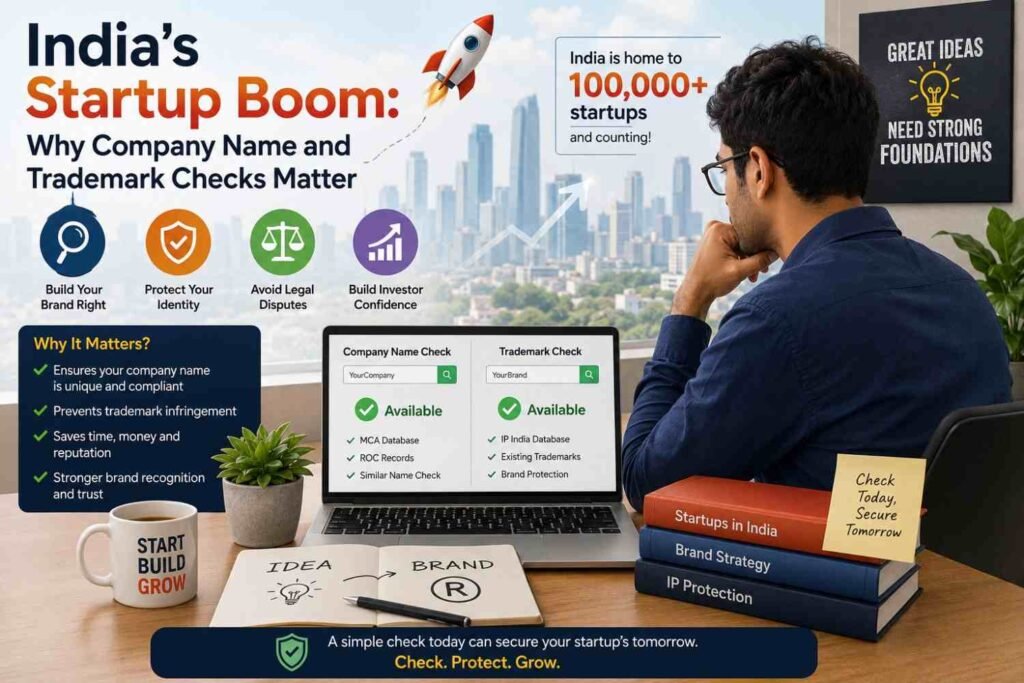
There’s the company name check during incorporation, and a trademark search before filing to actually protect the brand. Both matter, and understanding what each one does helps founders enter the process better prepared.
What a Company Name Check Covers
Founders registering a business through the MCA go through a company name check as part of incorporation. This confirms that no other registered company on the corporate database already has an identical or too-similar name. This step is a required part of getting a company legally registered. It also saves everyone the confusion and admin headache that two companies sharing a name would otherwise cause.
It’s worth being clear about scope, though. ROC name approval confirms there’s no conflicting company name on the register. It doesn’t extend to trademark rights on its own, which is exactly why a separate trademark search plays such an important role alongside it.
Why Trademark Search Matters
A trademark search is what protects a brand name or logo specifically. Before filing Form TM-A with the Trade Marks Registry, a proper search runs the mark against India’s national trademark database, looking for anything identical or deceptively similar that’s already registered or pending. Catching that early is what keeps a Section 11 objection from showing up further down the line. Founders who complete this step early tend to avoid the delays and complications that come with contested applications.
Government filing fees also carry a meaningful concession for smaller applicants. Individuals, MSMEs, and DPIIT-recognised startups pay ₹4,500 per class for online filing. This is half the ₹9,000 rate for companies and partnerships. A valid Udyam registration certificate must be available at the time of filing.
A Local Example: Tripura’s Startup Push
Tripura offers a useful illustration of how this plays out on the ground. Tripura rolled out a new platform for this in mid-August 2026. It’s called T-RISE, short for the Tripura Registry and Integration for Startup Ecosystem, and it’s a single-window digital platform that connects founders, mentors, investors, and government departments in one place. Under the state’s startup policy, 140 registrations have already been approved and 70 startups formally recognised, with the Tri-Seed Fund disbursing more than ₹2.72 crore in early-stage support so far. As platforms like this help more first-time founders with registration, both a company name check and a trademark search are becoming important steps. Founders are increasingly encouraged to complete these checks from the start.
What This Means for Founders Nationally
A few patterns show up consistently as founder awareness on this grows:
● More founders are learning that a company name check and a trademark search serve two distinct, complementary purposes rather than one covering the other.
● MSME and startup fee concessions make formal trademark filing more accessible than many founders assume.
● Regional startup platforms are increasingly building both steps into the onboarding process for new founders.
● A registered trademark functions as a depreciable intangible asset, which matters for founders looking to raise early-stage capital or eventually license their brand.
Outlook
India’s incorporation numbers keep climbing through 2026. State-level platforms are also helping founders formalise their businesses faster. As a result, both a company name check and a trademark search are becoming standard parts of registering a business properly. Together, they help founders build a legally registered company and a protected brand.