


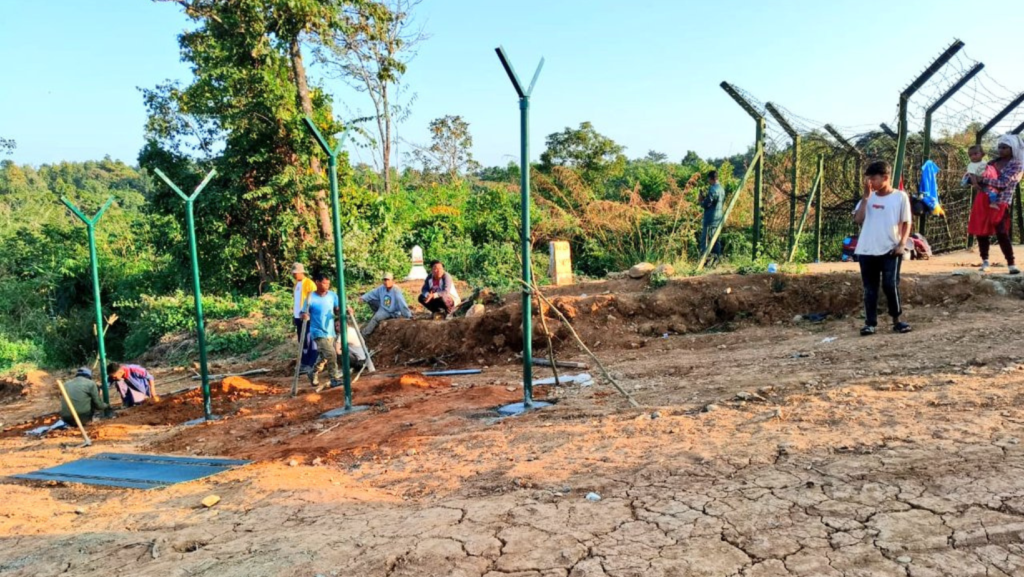
The construction of fencing along the Indo-Myanmar border is progressing steadily under strict security supervision, reflecting ongoing efforts to strengthen border management and improve surveillance in sensitive frontier regions. Authorities stated that the project is being executed in phases to ensure operational efficiency and minimal disruption to local communities. Moreover, security agencies are closely monitoring the work to maintain safety and coordination in the border areas. The development highlights the government’s focus on enhancing border infrastructure and national security preparedness.
Traditional Sports Festival Draws Thousands of Spectators to Majuli Island in Assam
Assam Rifles Engages With Civil Society Organisations in Tamenglong to Bolster Border Peace
Phase-Wise Construction Under Strict Monitoring
Indo-Myanmar border fencing works progress steadily under tight security supervision, with implementation carried out in a phased manner across multiple strategic locations. Consequently, engineering teams and security personnel are working in close coordination to ensure smooth execution.
The fencing project is designed to enhance surveillance capabilities and regulate cross-border movement more effectively. Moreover, the construction process involves challenging terrain, requiring specialized infrastructure planning. Therefore, careful monitoring and logistical coordination are essential for timely completion.
Officials emphasized that maintaining security during construction is a top priority. Furthermore, deployment of security forces ensures that work proceeds without disruptions. As a result, the project is advancing steadily despite geographical and operational challenges.
Meanwhile, periodic reviews are being conducted to assess progress and address site-specific issues. Consequently, adjustments are made to maintain construction timelines.
Strengthening Border Security Infrastructure
Indo-Myanmar border fencing works progress steadily under tight security supervision as part of broader efforts to strengthen national border security. Moreover, secure borders are essential for managing legal movement and preventing unauthorized activities. Therefore, infrastructure development in frontier areas has become a key priority.
Authorities highlighted that improved fencing and surveillance systems will enhance monitoring capabilities. Consequently, security forces are expected to respond more effectively to potential threats. Such measures contribute to regional stability and safety.
Furthermore, modern fencing infrastructure is being integrated with surveillance technologies in select areas. As a result, real-time monitoring and rapid response systems may improve operational efficiency.
Meanwhile, coordination among multiple security agencies is being reinforced. Similarly, inter-agency communication systems are being strengthened.
Addressing Terrain and Operational Challenges
The Indo-Myanmar border fencing works progress steadily under tight security supervision despite difficult terrain and logistical constraints. Moreover, the region’s hilly landscape and dense forests present significant engineering challenges. Therefore, specialized construction techniques are being employed.
Officials stated that access to remote areas requires careful planning and resource management. Consequently, transportation of materials and equipment is being managed in a structured manner. Such efforts help maintain steady progress.
Furthermore, environmental and geographical considerations are being taken into account during construction. As a result, the project is being executed with attention to both efficiency and sustainability.
Meanwhile, field teams are receiving continuous support to overcome site-level challenges. Similarly, contingency planning is being used to handle unforeseen delays.
Enhancing Long-Term Border Management
The project reflects a broader strategy to improve long-term border management and security preparedness. Moreover, structured border infrastructure is essential for maintaining order and supporting lawful cross-border interaction. Therefore, fencing initiatives are being prioritized in sensitive regions.
Officials stated that improved border control infrastructure will contribute to better regulation of movement and enhanced security outcomes. Consequently, long-term monitoring systems are expected to become more effective. Such initiatives support national security objectives.
Furthermore, future integration with digital surveillance tools and monitoring systems is being explored. As a result, border management capabilities may continue to improve.
Meanwhile, authorities are evaluating additional infrastructure upgrades in other border areas. Similarly, strategic planning efforts are ongoing.
Conclusion
Indo-Myanmar border fencing works progress steadily under tight security supervision, marking a significant step in strengthening border infrastructure and surveillance capabilities. Moreover, the phased approach and coordinated execution reflect careful planning and operational discipline.
The project underscores the importance of robust border management systems in ensuring national security and regional stability. Therefore, it represents a key development in frontier infrastructure enhancement.
As Indo-Myanmar border fencing works progress steadily under tight security supervision, the initiative highlights the ongoing efforts to reinforce border security and improve long-term monitoring mechanisms.
FAQs
1. What project is currently underway on the Indo-Myanmar border?
Fencing construction along the border.
2. Why is the project being closely supervised?
To ensure security and smooth execution in sensitive border areas.
3. What challenges does the project face?
Difficult terrain, remote locations, and logistical constraints.
4. What is the objective of border fencing?
To strengthen surveillance and regulate cross-border movement.
5. What is the broader significance of the project?
It enhances national security and border management infrastructure.