


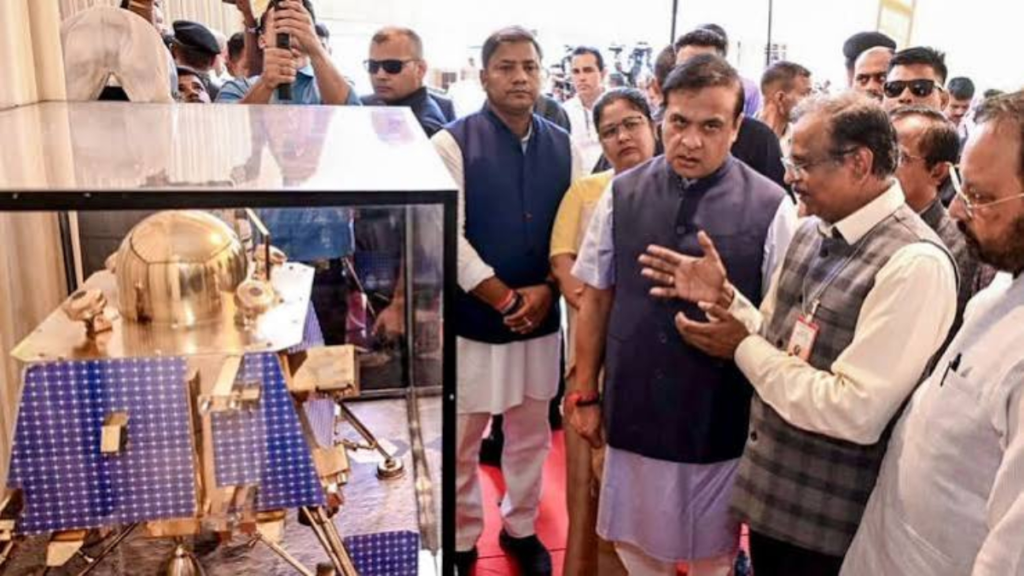
ISRO radar centre at Chandrapur is set to open a new chapter in Assam’s scientific and technology landscape. Chief Minister Himanta Biswa Sarma laid the foundation stone for the Indian Space Research Organisation’s ISTRAC Advanced Radar Research Facility on September 21.
The facility is being developed under Project NETRA, which aims to strengthen India’s Space Situational Awareness capabilities. It will use advanced radar systems and optical telescopes to monitor satellites and other objects in space, helping protect India’s space assets.
ISRO radar centre takes shape at Chandrapur
The ISRO radar centre is being established by the Space Research Organisation’s Telemetry, Tracking and Command Network, or ISTRAC, at Chandrapur near Guwahati. The project is described as the first facility of its kind in the Northeast for space surveillance.
The Assam government has provided land for the project at the former Chandrapur thermal power station site. ISRO’s 2025–26 annual report says a 67-acre site had been identified for the NETRA radar at Chandrapur. The land transfer was completed in November 2025.
Sarma said the project would expand Assam’s role in India’s space ecosystem. He also said the state’s association with space science was only beginning. Meanwhile, ISRO Chairman V Narayanan said the facility would be a world-class centre.
Project NETRA will track space objects
The ISRO radar centre forms part of Project NETRA, ISRO’s programme for tracking and analysing space objects. Such capabilities are important as the number of satellites and other objects in orbit continues to grow.
The facility will support monitoring of satellites, space debris and other objects. As a result, data from the system can contribute to better awareness of objects that may pose risks to operational spacecraft.
The project will also include optical telescopes and advanced radar systems. Therefore, the Chandrapur facility is expected to support research linked to space and atmospheric phenomena, in addition to its space-surveillance role.
First cloud radar planned by February
A key early component of the ISRO radar centre will be a cloud research radar. Sarma said the first radar is expected to be installed by February next year.
ISRO Chairman V Narayanan separately said a cloud radar would be commissioned before the end of February. He also said two more important radars would be commissioned within another one and a half years.
The cloud radar could support scientific studies of atmospheric conditions. This may have wider relevance for research on weather and related phenomena in Assam and the Northeast.
Space research opportunities for Assam
The ISRO radar centre is also expected to strengthen the region’s scientific research ecosystem. Officials said the project could create opportunities in research, innovation, skill development and collaboration involving universities, students and research institutions.
Sarma also referred to a proposed Small Space Centre being developed with IIT to provide a platform for students and encourage scientific interest across colleges. Additionally, he highlighted the ASSAMSAT project, which he said was progressing and could help map weather, rainfall, forests and other factors for resource planning.
These initiatives point to a broader effort to connect space technology with education and applications on the ground. However, the long-term impact will depend on how effectively institutions and researchers use the infrastructure.
Chandrapur could expand Assam’s space role
The new ISRO radar centre places Chandrapur within India’s growing space infrastructure network. Its immediate role will focus on radar research, space-object tracking and related scientific work.
Sarma said the facility could become an important centre for space research and development in the coming years. He also said Assam could emerge as a significant name in space research.
For the Northeast, the project offers a new base for advanced scientific infrastructure. Overall, the Chandrapur facility combines space surveillance with atmospheric research and educational opportunities. Its development will now determine how quickly Assam can build a wider ecosystem around space science and technology.
Naga Peace Talks Re-evaluation: Nagaland Reviews Dialogue Strategy With Centre