


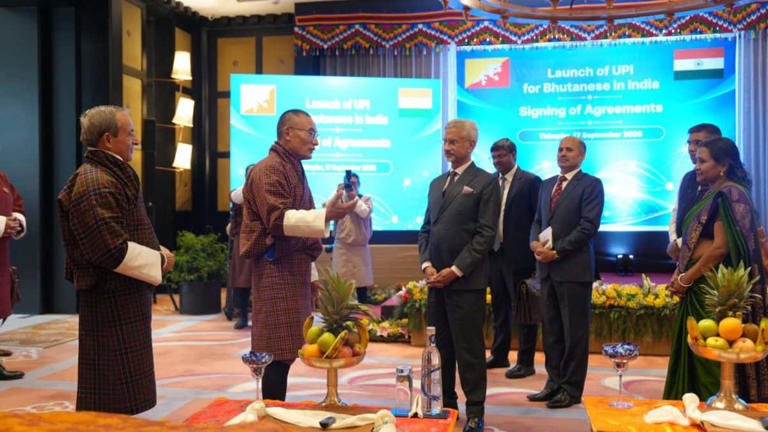
External Affairs Minister S Jaishankar and Bhutan Prime Minister Tshering Tobgay launched the second phase of international Unified Payments Interface (UPI) on September 17. The new phase allows Bhutanese citizens visiting India to make digital payments using Bhutanese mobile applications.
Bhutan’s Foreign Minister D. N. Dhungyel also joined the launch. The development completes two-way UPI-based digital payment connectivity between India and Bhutan.
Jaishankar announced the development during his official visit to Bhutan. He said the new facility adds another dimension to the close partnership between the two countries.
The initiative will make digital payments easier for Bhutanese visitors travelling to India. It also expands the use of digital payment infrastructure across the India-Bhutan border.
Two-Way Digital Payment Connectivity
The launch completes a process that began with the introduction of UPI-based payments in Bhutan. India launched BHIM-UPI in Bhutan in July 2021.
The first phase allowed Indian travellers to make digital payments in Bhutan. Bhutan became the first country outside India to adopt UPI standards for QR-code deployment and the first country in India’s immediate neighbourhood to accept mobile-based payments through the BHIM app.
The second phase now extends the facility in the opposite direction. Bhutanese visitors can use their local mobile applications to make payments in India by using UPI-enabled systems.
The Bhutanese government confirmed that the new facility has now become operational. It described the launch as an important development in the financial and digital cooperation between the two countries.
Easier Payments for Bhutanese Travellers
The new UPI facility can benefit Bhutanese tourists, students and business travellers visiting India. They can use supported Bhutanese mobile applications to make payments without relying entirely on cash.
The facility can simplify everyday transactions during visits to India. Travellers can use digital payments at participating merchants that accept UPI.
The system also builds on the existing financial links between the two countries. India and Bhutan have already established cooperation through RuPay cards and BHIM-UPI.
The expansion of UPI now provides another layer of interoperability for cross-border payments. It can make transactions more convenient for people who regularly travel between the two countries.
India-Bhutan Digital Cooperation Expands
The UPI launch forms part of wider cooperation between India and Bhutan in digital technology and fintech.
The two countries have steadily expanded their partnership beyond traditional areas such as hydropower, trade and development assistance. Digital payments have become an important area of cooperation.
India’s Ministry of Electronics and Information Technology said in February 2026 that UPI was operational in more than eight countries. The list included Bhutan, Nepal, Singapore, the UAE, Sri Lanka, France, Mauritius and Qatar.
The latest development with Bhutan further strengthens India’s cross-border digital payment network.
Jaishankar Highlights India-Bhutan Partnership
Jaishankar’s visit to Bhutan took place from September 16 to 18 at the invitation of Bhutanese Foreign Minister D. N. Dhungyel.
During the visit, Jaishankar met Bhutan’s King Jigme Khesar Namgyel Wangchuck and Prime Minister Tshering Tobgay. He also held discussions with Dhungyel on bilateral cooperation and regional and international issues of mutual interest.
The two sides reviewed cooperation across several sectors. These included trade, connectivity, energy, technology, education and development.
The Bhutanese government said the discussions reflected continued progress in the special India-Bhutan partnership. Both sides also welcomed developments in cross-border connectivity.
Scholarship Cooperation Also Expanded
The UPI launch formed part of a wider set of initiatives announced during Jaishankar’s visit.
Jaishankar and Tobgay witnessed the exchange of a Memorandum of Understanding on extending the Nehru Wangchuck Scholarship Scheme. The programme supports higher education opportunities for Bhutanese students at Indian institutions.
Jaishankar described the move as another step in cooperation in education and capacity building.
Education remains an important part of India-Bhutan people-to-people relations. Bhutanese students have long travelled to India for higher education and professional training.
The extended scholarship arrangement can provide additional opportunities for Bhutanese students to study in Indian institutions.
India Supports Bhutan’s E-Mobility Push
During the visit, Jaishankar also handed over 54 Made-in-India electric vehicles to Bhutan Prime Minister Tshering Tobgay.
The vehicles form part of India’s support for Bhutan’s efforts to promote electric mobility and sustainable transport. Bhutanese broadcaster BBS reported that the vehicles will serve government officials and form part of assistance under Bhutan’s 13th Five Year Plan.
India and Bhutan have also discussed cooperation in other areas of emerging technology and sustainability.
The initiatives announced during the visit show the broadening scope of bilateral cooperation. Digital payments, education, electric mobility and infrastructure now complement long-standing cooperation in energy and development.
UPI Builds on Earlier Financial Cooperation
India and Bhutan have already developed a strong foundation for digital financial connectivity.
In 2019, the two countries launched the first phase of the RuPay card project. The second phase followed in 2020 and allowed Bhutanese RuPay cardholders to use the network in India.
The launch of BHIM-UPI in Bhutan followed in 2021. It enabled Indian travellers to make mobile-based payments in Bhutan.
The latest UPI phase brings the payment system in the other direction. Bhutanese visitors can now use supported local applications for payments in India.
This progression has gradually created a more connected digital payment environment between the two neighbours.
Part of Wider India-Bhutan Cooperation
The UPI initiative also comes as India and Bhutan work to strengthen physical and economic connectivity.
The two governments recently welcomed the operationalisation of a new Land Customs Station at Samrang in Assam. They also noted progress on proposed cross-border rail links between Gelephu and Kokrajhar and between Samtse and Banarhat.
Improved physical connectivity and digital payment facilities can complement each other. Easier movement across borders can increase the importance of convenient payment systems for travellers, businesses and other visitors.
The UPI facility therefore forms part of a broader effort to make India-Bhutan exchanges more efficient.
A New Step in Digital Partnership
The launch of Phase-II of international UPI gives Bhutanese visitors another digital payment option while travelling in India. It also completes the two-way UPI connectivity that both countries have been developing.
For India, the initiative expands the international reach of its digital payment infrastructure. For Bhutan, it provides citizens with access to a familiar digital payment mechanism when they travel across the border.
The development also reflects the expanding scope of India-Bhutan cooperation. Alongside UPI, the two countries are working together on education, connectivity, energy, sustainability and technology.
As Jaishankar’s visit concludes, the launch of UPI Phase-II stands as one of the key developments in the latest round of India-Bhutan engagement. The new facility is expected to make cross-border digital payments more accessible for Bhutanese citizens visiting India while strengthening the financial links between the two neighbouring countries.