


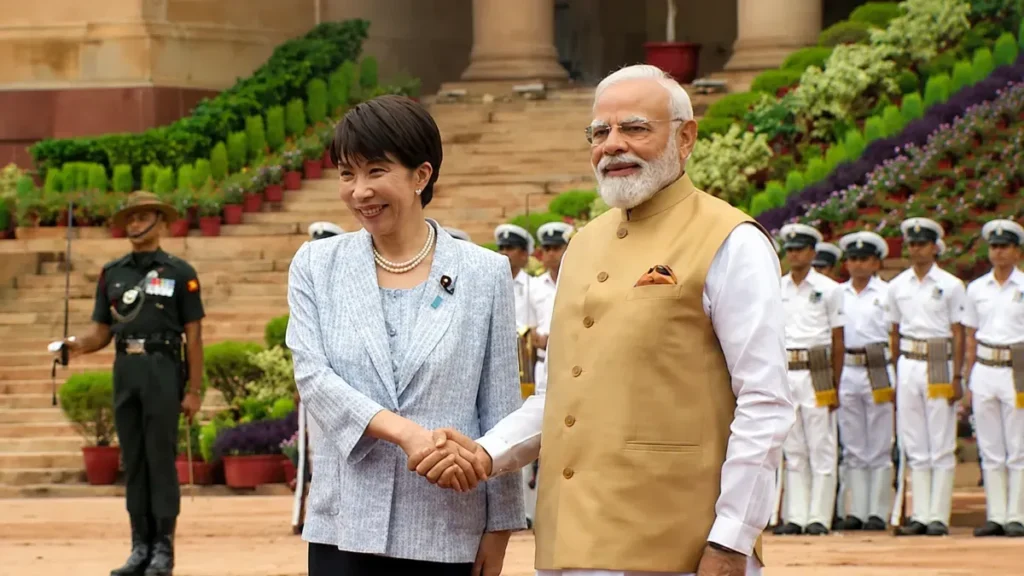
The Japan summit itinerary change has attracted attention after Japanese Prime Minister Sanae Takaichi’s planned visit to Guwahati did not take place following the relocation of the 16th India–Japan Annual Summit to New Delhi. The revised schedule meant Assam no longer hosted the high-level bilateral engagement that had been anticipated. Political leaders and regional observers also noted similarities with the cancellation of the planned India–Japan summit in Guwahati in 2019, when the visit of then Japanese Prime Minister Shinzo Abe was called off because of the security situation.
James Sangma Takes Rajya Sabha Oath
Revised Schedule Moves Summit to New Delhi
The Japan summit itinerary change followed the decision to relocate the annual summit from Guwahati to New Delhi. Consequently, Prime Minister Sanae Takaichi travelled directly to the national capital instead of visiting Assam. Officials stated that logistical and scheduling considerations influenced the revised programme while ensuring the bilateral summit proceeded as planned.
Meanwhile, both governments continued preparations for the high-level meeting in New Delhi. They also reaffirmed their commitment to strengthening cooperation in trade, infrastructure, technology, defence, and regional connectivity. Furthermore, officials emphasized that the venue change did not alter the broader objectives of the bilateral partnership.
The revised itinerary prompted discussion across Assam regarding the missed hosting opportunity.
Comparisons Drawn With 2019
The Japan summit itinerary change revived memories of the cancelled India–Japan summit planned for Guwahati in 2019. Political commentators and regional leaders observed that, for the second time in seven years, Assam was unable to host a Japanese prime minister during a scheduled bilateral summit. However, they also acknowledged that the circumstances surrounding the two decisions were different. In 2019, the visit was cancelled because of the prevailing security situation, whereas the latest relocation was linked to logistical and scheduling constraints.
Furthermore, analysts noted that Guwahati had been expected to showcase the Northeast’s growing strategic and economic importance through the summit.
Regional Reactions Continue
The Japan summit itinerary change generated disappointment among several political leaders, business representatives, and regional stakeholders in Assam. They argued that hosting the summit could have enhanced the Northeast’s international visibility and strengthened opportunities for investment promotion. In addition, many observers highlighted Assam’s importance within India’s Act East Policy and regional connectivity initiatives.
Meanwhile, officials reiterated that India and Japan remain committed to expanding bilateral cooperation through ongoing projects and future diplomatic engagements. They also emphasized that development partnerships across the Northeast continue despite the venue change.
The discussions have remained focused on the broader implications of the relocation.
Bilateral Partnership Moves Forward
The Japan summit itinerary change demonstrates how diplomatic schedules may evolve while broader strategic partnerships continue to advance. Therefore, both countries remain engaged in strengthening cooperation across multiple sectors through high-level dialogue and ongoing projects.
Moreover, India and Japan continue expanding collaboration in infrastructure, investment, economic security, clean energy, and defence. Officials have stated that sustained engagement between the two countries will remain central to their long-term strategic partnership regardless of summit venues.
Conclusion
The Japan summit itinerary change marked a significant alteration to the planned diplomatic programme after the India–Japan Annual Summit moved from Guwahati to New Delhi. The revised schedule meant Prime Minister Sanae Takaichi did not visit Assam, prompting comparisons with the cancelled 2019 summit and generating regional debate. Nevertheless, both governments proceeded with the summit in New Delhi and reaffirmed their commitment to strengthening bilateral cooperation across strategic and economic sectors.
FAQs
1. Why did Prime Minister Sanae Takaichi not visit Guwahati?
The summit venue shifted from Guwahati to New Delhi because of logistical and scheduling considerations.
2. Where was the India–Japan Annual Summit ultimately held?
The summit took place in New Delhi.
3. What is the Japan summit itinerary change?
The Japan summit itinerary change refers to the revision of the Japanese Prime Minister’s travel schedule after the India–Japan Annual Summit was relocated from Guwahati to New Delhi.
4. Why did observers compare the decision with 2019?
Both instances resulted in Guwahati not hosting a planned India–Japan summit, although the reasons differed.
5. Did the relocation affect India–Japan cooperation?
Officials stated that bilateral cooperation continues through ongoing strategic and economic initiatives.
6. Which sectors remain central to the partnership?
Infrastructure, investment, technology, clean energy, defence, and economic security continue to be major areas of cooperation.