


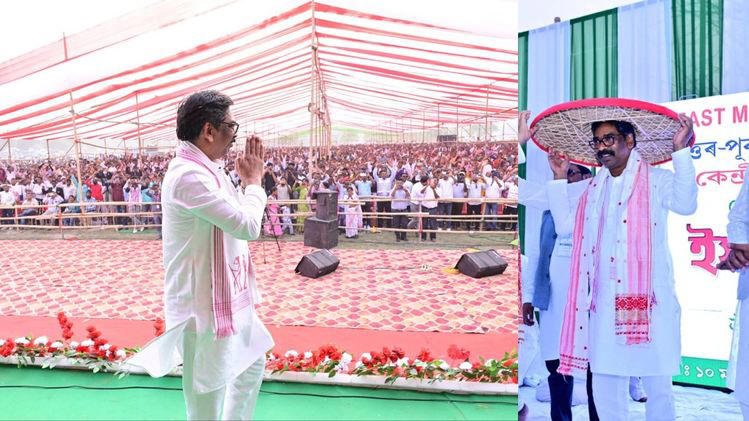
The JMM Assam elections seats announcement has added a new dimension to the political landscape ahead of the 2026 Assembly polls. The Jharkhand Mukti Morcha (JMM) has decided to contest 31 seats in Assam, signaling its intent to expand beyond its traditional stronghold in Jharkhand.
Party leaders confirmed that the move aims to tap into the tribal vote base in Assam. Therefore, JMM’s entry is expected to influence electoral dynamics, especially in constituencies with significant indigenous populations.
Read More: SC Clears Path for Tripura Village Polls After 10-Year Delay
Focus on Tribal Vote Bank
The JMM has built its political identity around the rights and welfare of tribal communities. In Assam, the party sees an opportunity to connect with similar groups who share socio-economic concerns.
Leaders stated that issues such as land rights, livelihood opportunities, and cultural preservation will form the core of their campaign. Moreover, they aim to position themselves as a strong voice for indigenous communities.
As a result, the party hopes to attract voters who seek greater representation and focused policies. This strategy aligns with JMM’s long-standing emphasis on tribal empowerment.
Expansion Beyond Jharkhand
The decision to contest 31 seats reflects JMM’s broader strategy to expand its presence outside Jharkhand. Over the years, regional parties have explored opportunities in neighboring states to increase their influence.
Assam, with its diverse demographic composition, offers a suitable platform for such expansion. Therefore, JMM’s move can be seen as an attempt to establish itself as a regional force in the Northeast.
Additionally, the party’s leadership believes that its governance experience in Jharkhand can appeal to voters in Assam. This narrative will likely feature prominently in their campaign.
Candidate Selection and Strategy
The party is currently working on finalizing candidates for the selected constituencies. Emphasis will be placed on choosing individuals with strong local connections and credibility.
Furthermore, JMM plans to engage with grassroots organizations and community leaders. This approach will help the party build a support base and understand local issues more effectively.
Campaign strategies will include public meetings, outreach programs, and digital engagement. Therefore, the party aims to create visibility and connect with a wide range of voters.
Impact on Existing Political Players
JMM’s entry into the Assam elections is likely to affect the strategies of existing political parties. Both national and regional players will need to account for the presence of a new contender.
The BJP-led alliance and the Congress, along with other regional parties, have traditionally dominated the political scene. However, the addition of JMM introduces a new variable.
In constituencies with significant tribal populations, JMM could influence vote distribution. Consequently, this may impact the outcomes in closely contested seats.
Challenges Ahead for JMM
Despite its ambitions, JMM faces several challenges in Assam. Building a strong organizational structure in a new state requires time and resources.
Additionally, the party must compete with established players who have deeper roots and wider networks. Therefore, gaining voter trust will be crucial.
Language, cultural differences, and regional dynamics also pose challenges. However, the party believes that its focus on common issues will help bridge these gaps.
Political Reactions to the Announcement
The announcement has drawn mixed reactions from other political parties. Some leaders have welcomed the entry of a new player, viewing it as a sign of a vibrant लोकतांत्रिक process.
Others, however, have questioned JMM’s ability to make a significant impact. They argue that the party lacks a strong base in Assam.
Nevertheless, political analysts believe that even a modest performance by JMM could influence the overall electoral equation. Therefore, its role cannot be overlooked.
Voter Perspective and Key Issues
As the elections approach, voters will evaluate candidates based on their ability to address key issues. Employment, development, and social welfare remain top priorities.
JMM’s focus on tribal concerns may resonate with certain sections of the electorate. However, the party will need to present a comprehensive agenda to appeal to a broader audience.
Moreover, effective communication and grassroots engagement will be essential. Therefore, the coming months will be critical for the party’s campaign.
Broader Implications for Assam Politics
JMM’s decision to contest 31 seats highlights the evolving nature of Assam’s political landscape. The entry of new players can lead to increased competition and more diverse representation.
Additionally, it reflects the growing importance of regional identities and issues in electoral politics. Therefore, parties are increasingly focusing on specific voter groups.
This trend may lead to more dynamic and competitive elections, benefiting the overall democratic process.
Conclusion
The JMM Assam elections seats announcement marks a significant development ahead of the 2026 Assembly polls. By targeting 31 constituencies and focusing on tribal voters, the Jharkhand Mukti Morcha aims to carve out a space in Assam’s political arena.
While challenges remain, the party’s entry adds a new layer of competition and complexity to the elections. As campaigning gathers pace, the effectiveness of JMM’s strategy will become clearer.
Ultimately, the upcoming elections will test the party’s ability to expand its influence and connect with voters in a new political environment.
Read More: Pradyut Bordoloi’s Volte-Face: From Congress Chargesheet to BJP Induction