


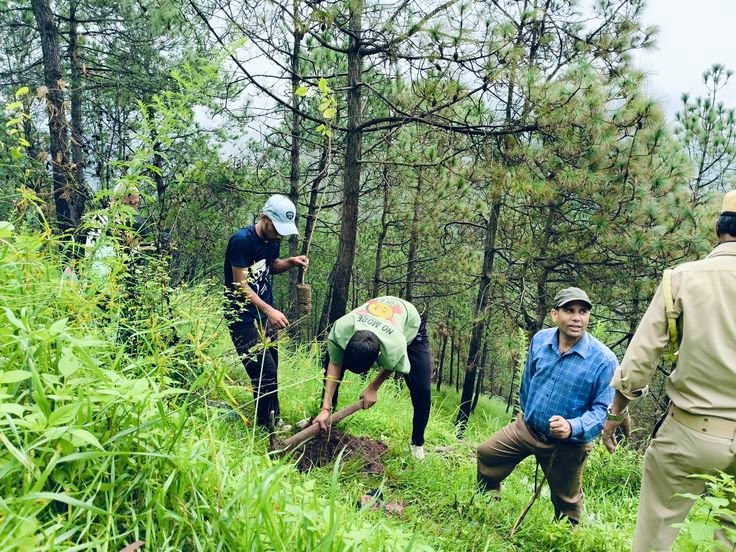
Authorities have suspended the joint plantation effort in Rengma Forest at Uriamghat (Assam–Nagaland frontier), pending high-level consultations. Although both Assam and Nagaland supported the initiative, Nagaland emphasized the need for coordination in this sensitive area, which remains under Supreme Court review.
This pause reflects growing concern over the fragile status of the Disputed Area Belt (DAB) and the need to uphold legal processes and inter-state harmony.
Why the Joint Plantation Effort in Rengma Forest Was Halted
To start with, Assam’s Environment Minister, Chandra Mohan Patowary, and Nagaland Deputy Chief Minister Y. Patton met to discuss the future of afforestation along the contested border, but they agreed to maintain the status quo until their Chief Ministers finalize decisions.
Furthermore, Nagaland insisted on joint planning for any forestry projects in the disturbed area belt, asserting that unilateral efforts could disrupt long-standing inter-state understandings.
Context: Prior Eviction and Plantation Activities
Eviction Drive and Early Green Revival
Earlier, Assam launched one of its largest eviction drives in July, clearing more than 11,000 bighas of encroached forest land in the Rengma Reserve at Uriamghat. The effort involved over 2,000 personnel and bulldozers, leading to the demolition of nearly 2,500 homes.
Encroacher families were relocated, enabling local officials to commence a plantation drive. By early August, officials had planted 15,000 saplings—primarily Uriam species—across nearly 60 hectares. The goal extended beyond afforestation to transforming the area into an eco-tourism and community-centric zone.
Legal and Communal Sensitivities
However, land claims by indigenous groups—particularly the Rengma Nagas—had surfaced. The All Rengma Welfare Organisation (ARWO) urged Assam to legally recognize Rengma ancestral rights over the reserve forest.
Moreover, Nagaland asserted that any ecological activity in this region affects territorial claims still under Supreme Court litigation, demanding joint action and preservation of the contested status.
Implications of Suspending the Plantation Drive
This suspension carries multiple implications:
- It demonstrates legal prudence by honoring the pending Supreme Court litigation.
- It underscores the necessity of coordinated inter-state action in border areas, preventing future friction.
- It provides time to formulate a joint environmental-security approach that respects tribal claims and ecological goals.
Path Forward: What Needs to Happen Next
Even now, the forest restoration remains crucial. Authorities can restart the afforestation project—once both state Chief Ministers reach a consensus.
Hence, they should:
- Expedite high-level consultations.
- Develop a joint framework combining ecological restoration with legal clarity.
- Craft a plan that includes representation from Rengma tribal bodies to honor historical and cultural contexts.
- Consider adaptive measures that ensure environmental gains do not compromise inter-state trust or indigenous claims.
This combined approach will promote peaceful restoration while upholding the rule of law.
Balance Ecology, Law, and Community
Restoring Rengma Forest holds great ecological and community promise. Still, stakeholders must act thoughtfully. This demands:
- State leaders should finalize joint protocols before restarting afforestation.
- Tribal and civil society groups must have consultation roles to preserve cultural heritage.
- Local residents can support ongoing conservation while respecting legal boundaries.
- Media and public discourse should encourage transparent, inclusive solutions—not reactionary moves.
When dialogue and action go hand in hand, ecological initiatives can succeed without compromising justice or regional harmony.
READ MORE: Viksit Tripura 2047 Blueprint Unveiled for Inclusive and Regional Growth
The joint plantation effort in Rengma Forest shows promise for restoring ecological balance and reclaiming lost green cover. Yet, with the Supreme Court still reviewing territorial claims and regional sensitivity running high, leaders must prioritize coordinated action and legal certainty.
Indeed, only by aligning environmental restoration with mutual respect and legal clarity can the forest thrive—and with it, regional peace.