


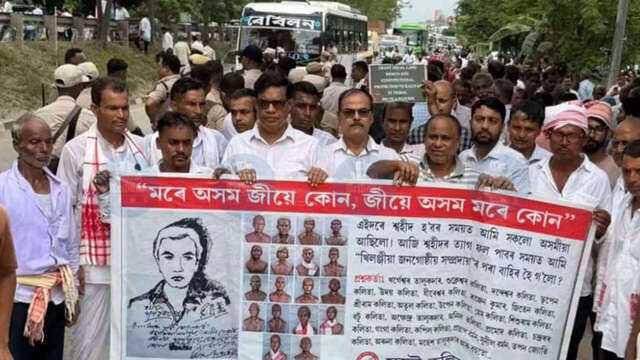
Members of the Kalita community have intensified their opposition to the Assam Land and Revenue Regulation (Amendment) Bill, 2026. Kalita organisations say the proposed land rules could affect the community’s land rights. They are seeking explicit inclusion in the categories protected under the amended law.
The latest protest took place in Nalbari, where Kalita groups held a demonstration and partial highway blockade. Protesters called for safeguards for their land rights and demanded recognition of the community within the law’s framework for indigenous ethnic communities.
The issue has sparked a wider debate over the definition of an “Original Inhabitant” and the groups that qualify for special land protections in Assam.
Read More: Tripura Antyodaya Diwas Focuses on Taking Technology to Rural Communities
Kalita Groups Raise Concerns Over Land Bill
The Kalita Alpine Community Association has opposed the 2026 amendment. The organisation has asked the Assam government to review the legislation and clarify its position on the status of the Kalita community.
The association has raised particular concerns about the definition of an “Original Inhabitant”. According to the organisation, the amendment requires a person and their family to have lived in a specified area for three generations.
The association says the definition could create difficulties for some Kalita families. It has also questioned how the rules would apply to families that moved within Assam several decades ago.
Dispute Over the Definition of ‘Original Inhabitant’
The amendment has introduced a revised framework for identifying people who qualify as “Original Inhabitants” in certain protected areas.
According to the Kalita Alpine Community Association, the definition refers to three generations of residence. The organisation has calculated this requirement as 75 years, based on a 25-year period for each generation.
The group argues that this provision could affect Kalita families who have lived in Assam for generations but may not meet the specific residence requirement in a particular area.
The association has therefore asked the government to examine the provision and provide greater clarity.
Community Seeks Explicit Inclusion
Kalita organisations have also objected to the way the amendment identifies protected communities.
The Kalita Alpine Community Association said the legislation refers to indigenous ethnic communities, disadvantaged groups, Scheduled Castes and Scheduled Tribes. However, it claims that the Kalita community does not receive explicit recognition within these categories.
The organisation wants the government to address this concern. It has called for the Kalita community to receive clear protection under the land law.
The demand has become a central issue in the community’s campaign against the amendment.
Concerns Over Land Transfers
The Kalita group has also raised concerns about restrictions on land transactions.
Under the amended provisions, people who do not qualify as “Original Inhabitants” may face restrictions on the transfer, exchange or lease of land in specified areas. Such transactions may require prior government approval.
The association says these provisions could create difficulties for Kalita families who do not fall within the defined category.
It has also raised questions about inheritance. The organisation wants the government to clarify how succession rights will work under the amended land framework.
Protest Held in Nalbari
Kalita organisations recently took their concerns to the streets in Nalbari.
The groups staged a protest near Madanpur and partially blocked the highway. They demanded safeguards for Kalita land rights and sought inclusion within the indigenous ethnic category covered by the law.
The protest reflects growing concern among sections of the community over the possible impact of the amendment.
The groups have called for the government to consider their demands before implementing the new provisions.
Government’s Land Protection Framework
The Assam government introduced the amendment as part of its broader approach to protecting land associated with heritage institutions and communities.
The debate over the legislation has focused heavily on who should receive protection under the law.
The Assam Legislative Assembly passed the revised amendment in July 2026. The legislation changed the definition of “Original Inhabitant” from the earlier framework. The 2024 version had also sought to restrict land transactions around certain heritage structures to people who met the definition.
The changes have since generated questions from different groups about land ownership and eligibility.
Other Communities Also Raise Land Concerns
The debate over land rights extends beyond the Kalita community.
Several indigenous and community organisations in Assam have raised concerns about land protection, eviction and access to land.
For example, the All Dimasa Students’ Union recently submitted a memorandum to Chief Minister Himanta Biswa Sarma. The union sought stronger safeguards for Dimasa land and several other measures related to identity and community welfare.
Other organisations have also demanded land protections in different parts of the state.
These developments show the wider sensitivity surrounding land rights and community protections in Assam.
Kalita Community Seeks Government Clarification
The Kalita organisations have urged the state government to clarify how the new provisions will affect the community.
They want authorities to address questions surrounding the “Original Inhabitant” definition. They also want clarification on land transfers, inheritance and protection for Kalita families.
The Kalita Alpine Community Association has specifically called for a review of the amendment. It has also referred to remarks attributed to Chief Minister Himanta Biswa Sarma about the classification of communities under the new framework. The organisation says those remarks caused concern among members of the community.
Land Bill Debate Continues in Assam
The Kalita community’s protest has added another dimension to the ongoing debate over Assam’s land legislation.
The central issue involves how the state should define protected communities and determine eligibility for land safeguards. Kalita organisations argue that the community needs explicit recognition within the framework.
The government, meanwhile, has framed the legislation around land protection and the identification of eligible residents in specified areas.
As protests and demands continue, the state government’s response to the Kalita community’s concerns will remain closely watched. Further clarification could determine how the amended provisions affect land ownership, transfers and inheritance for families across Assam.