


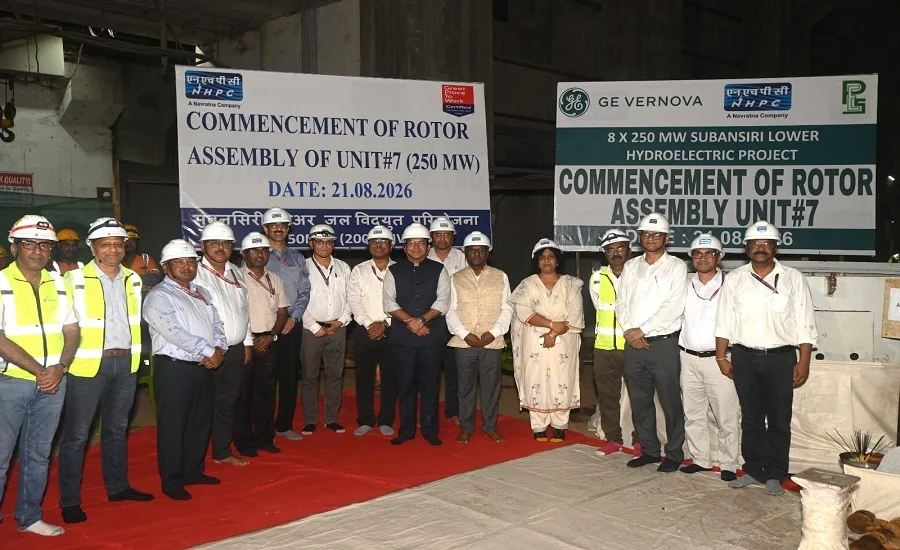
Lower Subansiri hydro testing and commissioning work has entered another important phase as NHPC advances the installation of major electromechanical equipment at the 2,000 MW Subansiri Lower Hydroelectric Project. During a senior-level inspection in August 2026, NHPC confirmed the commencement of rotor assembly for Unit 7, a 250 MW generating unit.
The development marks another step toward completing the remaining generating units of the project. Meanwhile, Units 1 to 4 had reached commercial operation, while NHPC continued preparations for Unit 5 and construction and commissioning work on Units 6 to 8.
The project, located on the Subansiri River along the Arunachal Pradesh-Assam boundary, has eight 250 MW units. Once fully commissioned, it is designed to produce about 7,422 million units of electricity annually.
European Tea Export Milestone: Tripura Tea Begins Journey Toward European Markets
Lower Subansiri Hydro Testing Moves Into Advanced Equipment Work
Lower Subansiri Hydro Testing Advances With Unit 7 Rotor Assembly
NHPC senior officials visited the Subansiri Lower project from August 20 to 22, 2026. They reviewed major construction, electromechanical and hydro-mechanical works at the 2,000 MW hydropower project.
Director (Technical) Suprakash Adhikari and Director (Finance) Mahesh Kumar Sharma inspected the power house, dam areas and head-race tunnel intake facilities. Project officials also briefed them on the status of different generating units.
The team reviewed power generation from Units 1 to 4. Officials also discussed preparations for Unit 5 and ongoing work on Units 6 to 8.
Most significantly, NHPC recorded the commencement of rotor assembly for Unit 7. The 250 MW unit forms part of the final group of machines required to complete the project’s planned eight-unit configuration.
Therefore, the latest development represents an equipment-assembly milestone. It does not mean that Unit 7 has entered trial operation. The unit must pass further installation, testing and commissioning stages before commercial generation.
Unit 7 Rotor Assembly Strengthens Commissioning Preparation
The Subansiri Lower project has eight generating units. Each unit has a capacity of 250 MW, giving the project a total installed capacity of 2,000 MW.
The project uses Francis turbines. These turbines drive the generating units inside the surface power house.
Rotor assembly marks an important stage in installing a hydroelectric generating unit. However, the assembly alone cannot bring a unit into operation. Engineers must complete mechanical, electrical, control and safety systems first.
The project has already demonstrated this commissioning process. NHPC declared Unit 1 commercially operational on March 20, 2026, after its successful trial run from February 27 to 28.
Similarly, the later units must undergo testing and other required procedures before commercial operation. Consequently, Unit 7 rotor assembly shows progress toward commissioning rather than completed power generation.
The equipment work also reflects the scale of the project. Earlier government information described the project as having some of India’s largest hydro-generator components, including heavy rotors and large stators.
Project Progress Supports Phased Power Generation
The Union Ministry of Power stated in March 2026 that two Subansiri Lower units had been commissioned. It also said the remaining units would enter operation in phases through December 2026.
By August, NHPC had reported commercial operation of Units 1 to 4. At the same time, officials were preparing Unit 5 for commissioning and continuing work on Units 6, 7 and 8.
The phased approach allows engineers to complete individual generating units while work continues on other parts of the project. Moreover, each additional unit can increase the project’s contribution to the regional power system after successful commissioning.
Transmission infrastructure also remains important as more units enter service. Regional power coordination documents have highlighted transmission requirements linked to additional generation from Subansiri Lower.
The 400 kV Lower Subansiri-BNC circuits form part of the arrangements required for power evacuation. Therefore, generation and transmission work must progress together to support reliable grid integration.
Furthermore, hydropower can provide flexible generation alongside variable renewable sources such as solar and wind. The Ministry of Power has also highlighted the project’s potential for peaking support and flood moderation.
Lower Subansiri Hydro Testing Has Wider Regional Significance
The Subansiri Lower Hydroelectric Project ranks among India’s major hydropower developments. Its eight units will provide a combined capacity of 2,000 MW.
The project has an annual design generation of about 7,422 million units. It is located near the Arunachal Pradesh-Assam boundary and uses the Subansiri River.
Therefore, the project’s completion has significance for the wider Northeast power network. Additional generation can strengthen the region’s electricity supply once the units complete the required commissioning process.
The government has stated that the project has received the required environmental and forest clearances. It has also reported riverbank protection and erosion-control measures downstream.
Meanwhile, dam-safety arrangements form another part of the project’s development. Authorities have linked these measures with the Dam Safety Act, 2021 and guidance from the National Dam Safety Authority.
The project has also generated local employment and supported community initiatives. The Ministry of Power said around 7,000 local workers received employment opportunities during construction. NHPC has also reported livelihood initiatives that benefited about 5,000 women.
As more units move toward commissioning, the focus will increasingly shift toward systematic testing, equipment verification and grid integration. Safety checks will also remain important before commercial operation.
The commencement of Unit 7 rotor assembly therefore confirms continued progress on the later stages of the project. Nevertheless, Unit 7 must complete all required engineering, testing and regulatory steps before it can supply commercial power.
Conclusion
Lower Subansiri hydro testing and commissioning work continues at the 2,000 MW Subansiri Lower project. The August 2026 inspection confirmed the commencement of rotor assembly for Unit 7.
Units 1 to 4 were already under commercial operation by August. Meanwhile, Unit 5 was under preparation for commissioning, while work continued on Units 6 to 8.
The latest Unit 7 milestone does not indicate that the unit has started trial operation. Instead, it marks an important equipment-installation stage before testing and commissioning.
Moreover, the project’s eight-unit configuration will add substantial hydropower capacity once all units become operational. Continued work on Units 5 to 8 will therefore remain important for completing the project’s planned generation capacity.
FAQs
What is the latest Lower Subansiri hydro testing development?
NHPC has commenced rotor assembly for Unit 7, a 250 MW generating unit, as part of ongoing electromechanical and commissioning work.
How many units does the Subansiri Lower project have?
The project has eight generating units. Each unit has a capacity of 250 MW, giving the project a total installed capacity of 2,000 MW.
Are all Subansiri Lower units operational?
No. Units 1 to 4 were under commercial operation by August 2026. Unit 5 was being prepared for commissioning, while work continued on Units 6 to 8.
Does rotor assembly mean Unit 7 has started generating electricity?
No. Rotor assembly represents an equipment-installation stage. Unit 7 must complete further installation, testing and commissioning before commercial generation can begin.
Why is the Subansiri Lower project important?
The project has a planned annual generation of about 7,422 million units. It is also designed to support regional electricity supply and flexible hydropower generation.