


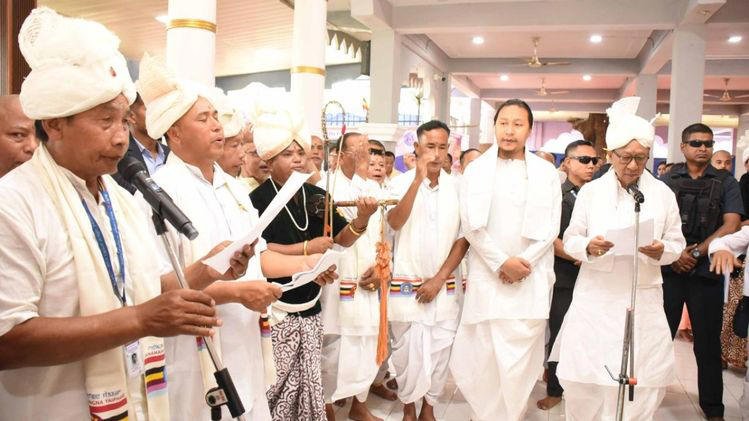
Manipur Chief Minister N. Biren Singh has formally assumed charge as the president of the Lainingthou Sanamahi Temple Board, marking a significant development in the management and promotion of one of the state’s most important religious and cultural institutions. The move reflects the government’s continued focus on preserving Manipur’s rich cultural heritage while strengthening the administration of religious sites that hold deep historical and spiritual significance.
The assumption of charge took place during a ceremony attended by government officials, board members, religious leaders, and community representatives. The event highlighted the importance of the Lainingthou Sanamahi Temple in the cultural and spiritual life of the people of Manipur.
Speaking on the occasion, the Chief Minister reaffirmed his commitment to protecting and promoting the state’s indigenous traditions and cultural identity.
Read More: Assam Launches ‘Mission 2 Lakh Govt Jobs’ With Dedicated Task Force Push
Significance of the Lainingthou Sanamahi Temple
The Lainingthou Sanamahi Temple occupies a special place in Manipur’s cultural and religious landscape. It serves as a major center of worship for followers of the Sanamahi faith, one of the oldest indigenous religious traditions of the region.
For generations, the temple has functioned as a symbol of spiritual devotion and cultural continuity. It attracts devotees from different parts of Manipur and remains an important institution for preserving traditional beliefs and practices.
The temple also plays a key role in maintaining the customs, rituals, and values associated with the Sanamahi faith. As a result, it holds immense significance for communities seeking to preserve their cultural roots and historical identity.
The Chief Minister noted that protecting such institutions remains essential for safeguarding Manipur’s unique heritage.
Chief Minister Takes Over Leadership Role
By assuming charge as president of the Temple Board, N. Biren Singh has taken on a leadership role that involves overseeing the administration, development, and preservation of the temple and its associated activities.
The board is responsible for managing temple affairs, maintaining infrastructure, organizing religious events, and ensuring that traditions continue in accordance with established customs.
Officials stated that the leadership transition is expected to strengthen the board’s functioning and facilitate better coordination between government agencies and temple authorities.
The Chief Minister emphasized the need for transparent administration and effective management to ensure that the temple continues serving devotees while preserving its historical importance.
Focus on Heritage Preservation
One of the key themes highlighted during the ceremony was the importance of cultural preservation. Manipur possesses a rich and diverse heritage shaped by centuries of history, tradition, and community practices.
The Chief Minister stressed that indigenous cultural institutions must receive adequate support to ensure their long-term sustainability. He noted that preserving heritage sites contributes to cultural education and helps younger generations understand their historical roots.
According to Singh, religious and cultural institutions serve as living symbols of identity and play a crucial role in maintaining social cohesion.
The government has undertaken various initiatives in recent years to protect historical monuments, traditional practices, and cultural landmarks across the state.
Promoting Indigenous Traditions
The assumption of charge also highlighted efforts to promote indigenous traditions and strengthen awareness about Manipur’s cultural heritage.
The Sanamahi faith forms an integral part of the state’s historical and cultural identity. Community leaders attending the event emphasized the importance of preserving traditional knowledge and passing it on to future generations.
The Chief Minister stated that cultural promotion should go hand in hand with modernization and development. He said preserving heritage does not hinder progress but rather enriches society by maintaining a connection with the past.
Government initiatives aimed at documenting and promoting traditional customs have gained importance in recent years as communities seek to preserve their distinct cultural identities.
Enhancing Temple Infrastructure
Another area of focus under the Temple Board involves improving infrastructure and facilities for devotees. Religious sites often attract large numbers of visitors during festivals and special occasions.
Officials indicated that efforts will continue to improve visitor amenities, maintain temple premises, and enhance the overall experience for pilgrims and tourists.
Infrastructure development can help accommodate growing numbers of visitors while ensuring that the sanctity and cultural significance of the site remain protected.
The Chief Minister emphasized the need to balance modernization efforts with heritage conservation. Any improvements, he noted, should respect the traditional character of the temple.
Strengthening Community Participation
Community involvement remains a vital aspect of temple administration and cultural preservation. Religious institutions often serve as gathering places where traditions, values, and social bonds are strengthened.
The Chief Minister encouraged active participation from devotees, community organizations, scholars, and cultural groups in preserving and promoting the Sanamahi faith.
He noted that collaborative efforts can help ensure that heritage preservation remains a shared responsibility rather than the task of a single institution.
Community leaders welcomed the government’s commitment and expressed hope that increased engagement would strengthen cultural awareness among younger generations.
Cultural Tourism Opportunities
The Lainingthou Sanamahi Temple also holds potential as a destination for cultural tourism. Visitors interested in Manipur’s history and indigenous traditions often seek opportunities to learn about the state’s unique heritage.
Officials believe that promoting cultural tourism can create economic opportunities while increasing awareness about local traditions and historical sites.
The government has identified cultural tourism as an important component of broader efforts to showcase Manipur’s heritage at the national and international levels.
However, authorities stressed that tourism development must remain sensitive to the religious significance of the temple and prioritize preservation.
Looking Ahead
The assumption of charge by Chief Minister N. Biren Singh as president of the Lainingthou Sanamahi Temple Board marks an important step in the ongoing efforts to preserve and promote Manipur’s cultural and spiritual heritage.
The move underscores the government’s commitment to protecting indigenous traditions, improving temple administration, and enhancing cultural awareness among citizens. Through effective management, community participation, and heritage-focused initiatives, the Temple Board aims to strengthen the role of the institution in the years ahead.
As Manipur continues to balance development with cultural preservation, institutions such as the Lainingthou Sanamahi Temple will remain central to the state’s identity. The Chief Minister’s new role is expected to support efforts to safeguard traditions, improve facilities, and ensure that future generations remain connected to their rich cultural heritage.
The development has received positive responses from devotees, cultural organizations, and community leaders who view it as a significant step toward preserving one of Manipur’s most treasured spiritual and historical institutions.
Read More: Viksit Assam: CM Sarma and Sonowal Review State’s Development Journey