


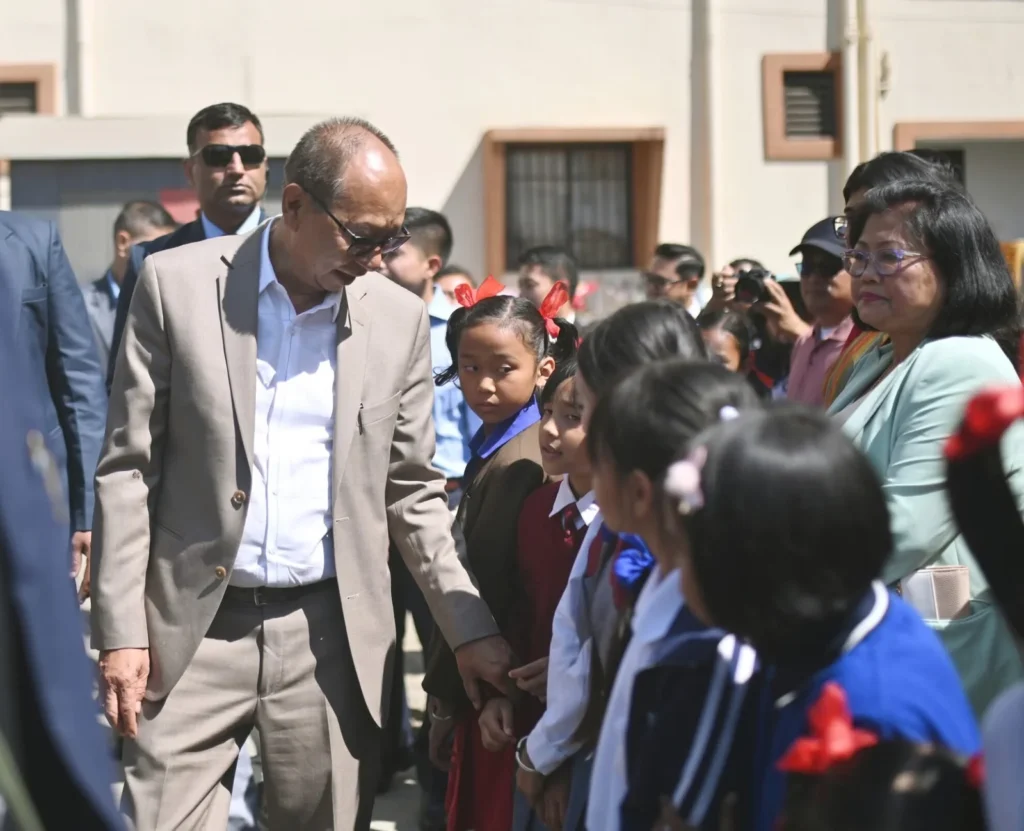
Manipur Chief Minister Yumnam Khemchand Singh on Thursday interacted with internally displaced persons (IDPs) from both hill and valley communities for the first time since violence erupted in the state. He reaffirmed his government’s commitment to their welfare, rehabilitation, and eventual resettlement.
The interaction took place in a hybrid format. The Chief Minister met displaced families in person at the Alternative Housing Complex in Langol. Meanwhile, IDPs staying in relief camps in Kangpokpi district and Churachandpur district joined virtually.
Senior leaders also participated online. Among them were Deputy Chief Minister Nemcha Kipgen, MLA L M Khaute, and Saikot MLA Paolianlal Haokip.
Read More: 22 Acres of Illegal Poppy Destroyed in Kangpokpi
₹32 Crore DBT Assistance for Nearly 19,000 IDPs
During the programme, the government disbursed financial assistance to nearly 19,000 displaced persons through Direct Benefit Transfer (DBT). The total amount released stood at approximately ₹32 crore.

The distribution ceremony took place at Langol. There, the Chief Minister personally interacted with families affected by the violence. Many IDPs shared their hardships and urged the government to facilitate their return to their native villages at the earliest.
Trust Deficit Between Communities
Responding to their concerns, Khemchand Singh acknowledged that the conflict had deepened mistrust between hill and valley communities. He noted that the social and psychological divide has widened significantly.
“The trust deficit between the communities has widened. In some areas, even if people return, they may not live freely without security arrangements and restrictions,” he said.
Therefore, he emphasised that reconciliation must precede resettlement. Manipur, he noted, is home to 36 communities. Each community must coexist peacefully with a shared sense of unity.
Rehabilitation Remains Top Priority
The Chief Minister reiterated that IDP welfare and rehabilitation remain a top government priority. He said authorities continued efforts to facilitate the return of displaced families even during the period of President’s Rule.
However, he admitted that certain areas, including Churachandpur and Moreh, did not offer conducive conditions for immediate resettlement at that time.
Since the formation of the present government, officials have regularly reviewed the IDP issue in meetings. The administration continues to coordinate with stakeholders and civil society organisations from both hill and valley regions.
No Fixed Timeline, But Continued Efforts
While the Chief Minister did not announce a specific timeline for resettlement, he assured displaced families that the government remains committed to restoring normalcy.
“Though we cannot fix an exact timeline now, your wish to return home will certainly be realised,” he said.
He added that authorities are working to create secure and stable conditions before facilitating large-scale returns. Security arrangements, confidence-building measures, and dialogue initiatives form part of the broader strategy.
Focus on Peace and Long-Term Stability
The interaction marked a significant step in the government’s outreach to affected communities. By combining financial support with dialogue, the administration aims to rebuild trust and promote reconciliation.
Observers note that sustained engagement between communities and government agencies will prove crucial in ensuring long-term peace. The ₹32 crore DBT assistance offers immediate relief. However, reconciliation and security remain central to the resettlement process.
As Manipur continues to navigate the aftermath of violence, the government has signalled that humanitarian assistance and inclusive dialogue will guide its approach to restoring harmony across the state.