


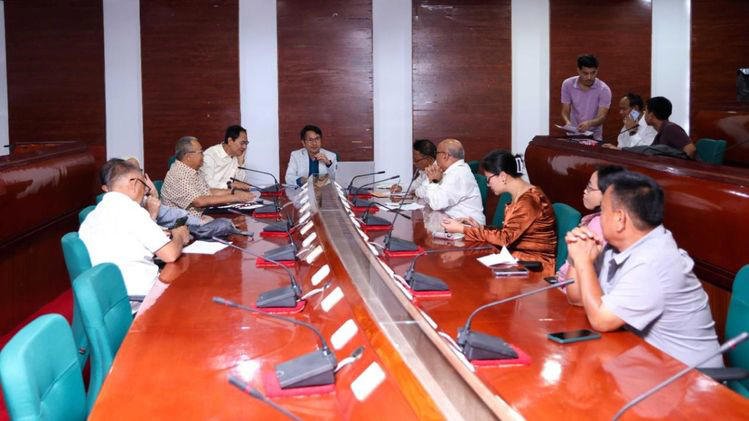
The Manipur government has formed a high-level monitoring committee to oversee the ongoing restoration of the historic Rajbari in Shillong. The initiative aims to revive the architectural and cultural heritage linked to Manipur’s royal lineage while strengthening the cultural connection between Manipur and Meghalaya.
Read More: Tripura Civil Society Calls Bandh Over Tiprasa Accord, Infiltration
A Symbol of Shared Heritage
The Manipur forms committee for Rajbari restoration marks a major step in safeguarding one of the most important landmarks representing Manipuri royalty. The Rajbari, located in Shillong’s Redlands area, served as the residence of Manipur’s royal family during the colonial era. Over the years, the structure fell into disrepair, prompting demands from scholars, historians, and Manipuri associations for its urgent restoration.
The Rajbari holds deep historical significance for Manipuris living in Meghalaya and across the Northeast. It symbolizes the period when Manipur’s royal family maintained close political and cultural ties with Shillong, then a prominent administrative hub under British rule.
Speaking about the initiative, Manipur Chief Minister N. Biren Singh stated that the restoration project aims not only to rebuild a structure but also to revive a crucial part of Manipur’s identity. “This heritage site connects generations of Manipuris to their ancestral roots,” he said. “The committee will ensure that every step of the restoration preserves the original essence of the Rajbari.”
Composition and Objectives of the Committee
The newly formed monitoring committee comprises senior officials from the Manipur Department of Art and Culture, members of the Royal Family, and representatives from Manipuri communities residing in Shillong. Heritage conservation experts have also been included to provide technical guidance on restoration methods and materials.
According to officials, the Manipur forms committee for Rajbari restoration to guarantee transparency and efficiency in project execution. The committee will inspect ongoing works, review progress reports, and recommend conservation measures that align with traditional architectural principles.
The restoration will involve structural reinforcement, roofing repairs, and the careful restoration of the wooden interiors and decorative elements. Special attention will be given to retaining the original design aesthetics while ensuring the building’s long-term durability.
The committee will also coordinate with the Meghalaya government to address administrative matters and ensure compliance with local heritage regulations. This collaborative approach highlights the shared cultural bond between the two northeastern states.
Restoring a Legacy of Cultural Diplomacy
The Rajbari restoration project is not just an architectural task—it is a cultural mission. The palace once hosted several historical meetings and gatherings that shaped political relations in the region. Historians believe that the restoration will help the younger generation rediscover the enduring legacy of Manipur’s royal family and its contribution to Northeast India’s history.
Cultural scholars view this project as an effort to bridge the past and the present. “The Rajbari represents more than royal heritage—it symbolizes cultural diplomacy and historical coexistence,” said historian Dr. L. Chingtham. “Through this restoration, Manipur is reclaiming a lost narrative that deserves recognition.”
The government plans to convert part of the restored building into a cultural museum that showcases Manipuri artifacts, manuscripts, and photographs from the royal era. This museum will not only educate visitors but also strengthen cultural tourism between Manipur and Meghalaya.
Promoting Tourism and Cultural Exchange
Officials believe the Manipur forms committee for Rajbari restoration to also promote cultural tourism in Shillong. Once restored, the Rajbari could become a center for Manipuri festivals, dance performances, and exhibitions, fostering greater awareness of Manipur’s artistic heritage.
Chief Minister Biren Singh emphasized that such initiatives contribute to the larger goal of promoting unity among the northeastern states through shared culture. “Preserving heritage is not only about the past—it is about shaping the future,” he remarked. “The Rajbari will stand as a symbol of peace, pride, and identity for Manipuris everywhere.”
Local Manipuri associations in Shillong have welcomed the move. They believe the project will enhance cultural engagement and serve as a hub for community activities. “The restoration gives us a sense of belonging,” said a member of the Manipuri Welfare Society, Shillong. “For decades, we’ve dreamed of seeing the Rajbari revived. This committee finally makes that possible.”
Challenges and the Way Forward
Despite widespread enthusiasm, the project faces logistical and environmental challenges. Frequent monsoon rains in Shillong often delay construction work, and sourcing traditional materials requires meticulous planning. However, the committee aims to complete the first phase of restoration by mid-2026.
The Manipur forms committee for Rajbari restoration to monitor these issues closely and find sustainable solutions. Experts have recommended eco-friendly restoration techniques, including locally sourced wood and natural paints, to preserve authenticity while minimizing environmental impact.
The government also plans to introduce digital archiving of restoration processes. This documentation will serve future conservation efforts and allow scholars to study traditional construction practices.
A Living Monument of Manipuri Identity
Once completed, the Rajbari is expected to emerge as a cultural landmark that honors Manipur’s royal heritage and its deep connection with Shillong. The site will symbolize resilience, continuity, and pride in the state’s enduring traditions.
The initiative comes at a time when many historical structures in India face neglect due to urbanization and lack of awareness. By setting up a dedicated monitoring committee, the Manipur government hopes to inspire similar preservation projects across the Northeast.
Cultural minister L. Susindro Meitei summed up the vision, saying, “Our heritage is our strength. The Rajbari restoration is not just about preserving bricks and walls—it’s about keeping our stories alive for generations to come.”
The Manipur forms committee for Rajbari restoration stands as a milestone in cultural preservation. It reflects the government’s commitment to honoring its past while nurturing a shared sense of pride among Manipuris in and beyond the state. When completed, the restored Rajbari will shine as a bridge between history and the present—a timeless symbol of Manipur’s royal legacy and enduring spirit.
Read More: Eco-Tourism In Guwahati: The Future Of Sustainable Travel