


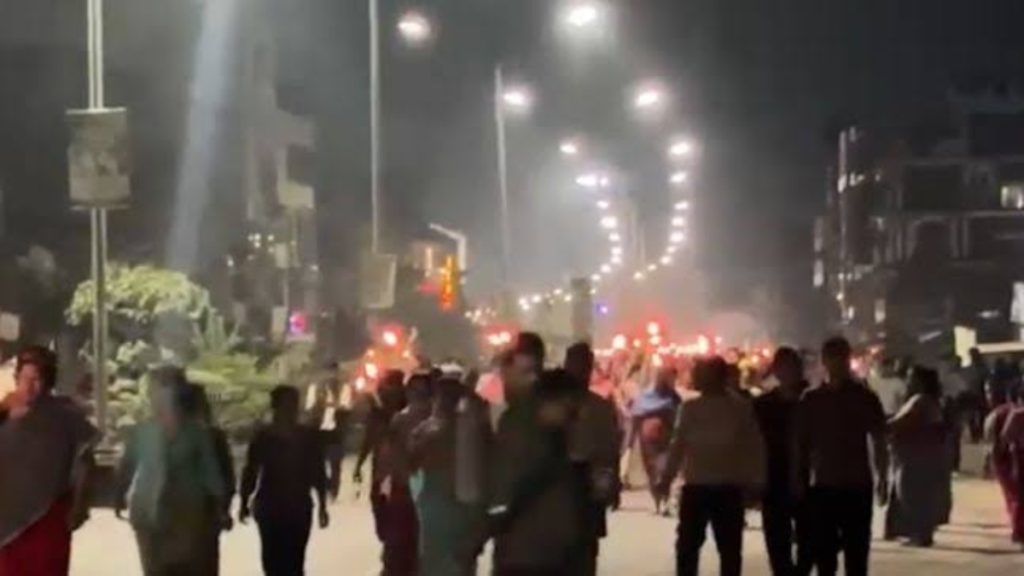
A Manipur NRC protest turned tense in Imphal on August 16 when police used tear gas to disperse students demanding that the National Register of Citizens be updated before the Census. The demonstration took place outside the Directorate of Census Operations at Porompat in Imphal East.
The protesters, linked to the Students’ Wing of the Campaign for Just and Fair Delimitation (JFD), raised “No NRC, No Census” slogans. Police said one protester suffered minor injuries during the action, while protest organisers reported a higher number of injured participants.
Manipur NRC protest and security action
The Manipur NRC protest escalated after security personnel stopped demonstrators from entering the census office premises. Protesters also attempted to lock the main gate, prompting police to fire tear gas shells to clear the area.
The August 16 incident came as the first phase of Census 2027 approached in the state. The Manipur government had scheduled self-enumeration from August 17 to 31, followed by house-listing operations from September 1 to 30.
The JFD Students’ Wing had opposed starting census work without first updating the NRC. The group argued that the exercise should help identify people it alleges entered the state illegally. Such claims remain positions advanced by the protesters and should not be treated as established findings about individual residents.
Manipur NRC protest gains wider support
The Manipur NRC protest movement has continued beyond the August confrontation. During September, civil society groups, local organisations and student bodies staged demonstrations and sit-ins in several parts of Imphal and other districts.
Many of these protests have focused on using 1951 as the base year for updating the NRC. Protesters have also linked the demand to concerns over demographic change, internally displaced persons and the timing of the census.
On September 2, the Manipur Legislative Assembly unanimously passed a resolution reaffirming earlier resolutions seeking an NRC update before the census. However, the September 2 resolution itself did not specify 1951 as the base year, prompting the JFD to continue its campaign.
State government clarifies its position
The situation shifted further on September 7 when Manipur Home Minister Govindas Konthoujam told the Assembly that 1951 would be the base year for the proposed NRC update. He also said the state government would pursue the matter with the Centre.
Konthoujam said officials were tracing the original physical records of the 1951 NRC. He also stated that the state government could not implement the NRC without approval from the central government.
The minister’s statement addressed a central demand of the Manipur NRC protest movement. However, the process still depends on coordination with the Centre, leaving protesters seeking a formal assurance and a clear implementation schedule.
Census process remains a flashpoint
The census has become a point of contention because protest groups want the NRC process to precede census-related work. Official notifications had set Manipur’s house-listing period for September, with self-enumeration scheduled immediately before it.
At the same time, not all groups support delaying the census until an NRC is updated. The Kuki-Zo Council has opposed the “No Census Before NRC” demand and questioned the use of an unverified 1951 baseline, according to Hindustan Times.
Therefore, the issue involves competing views over documentation, demographic data and the sequencing of government exercises. The debate has also unfolded against the wider backdrop of Manipur’s continuing political and social tensions.
Manipur NRC protest continues as demands evolve
The Manipur NRC protest campaign has remained active even after the Imphal clash. Demonstrations in September have repeatedly called for a 1951-based NRC, while some groups have demanded action on related issues.
For authorities, the challenge is to manage demonstrations while keeping census operations and other administrative work on track. For protest groups, the focus remains on securing a formal process for NRC updation before census and delimitation exercises.
Overall, the August confrontation marked one of the sharper moments in a campaign that has continued through September. With the state government now publicly supporting 1951 as the proposed base year, attention has shifted toward the Centre’s response and the steps needed to move the NRC process forward.
The next stage will depend on the Centre’s response and the government’s ability to address competing concerns through a transparent process.