


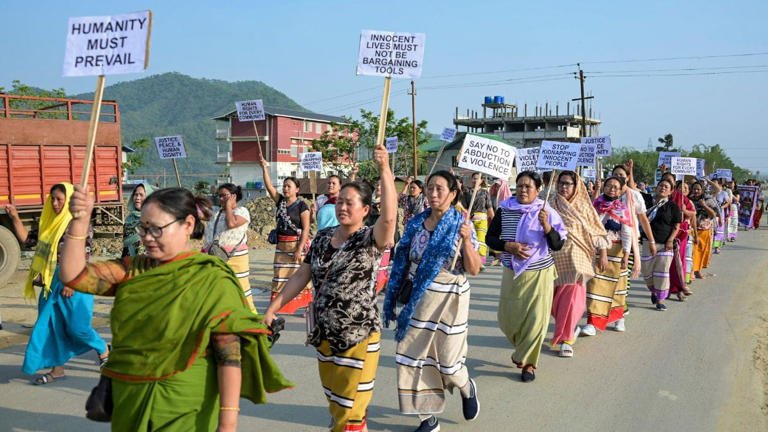
The hostage crisis involving Kuki and Naga groups in Manipur has entered its second week, with negotiations yet to produce a breakthrough and authorities continuing efforts to secure a peaceful resolution. The prolonged standoff has heightened concerns across the region and added fresh pressure on administrative and security agencies already dealing with complex ethnic tensions.
Despite multiple rounds of communication and intervention attempts by community leaders and officials, the situation remained unresolved at the time of reporting. The continuing impasse has raised anxiety among families of those held and prompted renewed appeals for restraint from civil society organisations.
Read More: Assam’s Joha Rice Reaches Global Spotlight As PM Modi Gifts Sample To FAO Chief
Talks Continue But No Agreement Emerges
Negotiations aimed at ending the hostage situation have continued over recent days, involving local intermediaries, community representatives, and officials attempting to establish common ground.
However, discussions have reportedly failed to produce a final agreement, extending uncertainty and complicating efforts to bring those involved to safety.
Sources familiar with the developments indicated that dialogue channels remain open, but differences over conditions and demands have slowed progress. Authorities have maintained that peaceful engagement remains the preferred path to resolving the crisis.
Officials have also emphasised that maintaining calm on the ground remains essential while discussions continue.
Security Agencies Maintain Vigil Across Sensitive Areas
Security deployment has remained heightened in parts of Manipur as authorities monitor developments and seek to prevent escalation.
Officials have increased coordination between agencies and local administration to maintain public order and ensure that tensions do not spread to nearby areas.
The prolonged nature of the crisis has prompted authorities to adopt a cautious approach. Security agencies have reportedly prioritised communication and confidence-building measures while avoiding actions that could worsen the situation.
Additional monitoring and intelligence gathering continue as officials assess movement patterns and local responses.
Authorities have appealed to residents not to circulate unverified information, warning that misinformation could intensify tensions.
Community Leaders Push for Peaceful Resolution
Community leaders from both Kuki and Naga groups have continued efforts to reduce tensions and encourage dialogue.
Several local organisations have urged all parties involved to prioritise humanitarian concerns and ensure the safe release of those affected.
Representatives have stressed that long-term peace in Manipur requires trust-building and sustained communication rather than confrontation.
Community members expressed concern that prolonged uncertainty may deepen divisions and affect ongoing reconciliation efforts in sensitive regions.
Leaders involved in outreach efforts said preserving social harmony remains critical at a time when communities continue to recover from earlier episodes of unrest.
Families Await Progress Amid Growing Anxiety
As the crisis stretches into a second week, uncertainty has placed emotional strain on affected families.
Relatives have repeatedly appealed for swift intervention and a peaceful outcome. Many have called on all stakeholders to avoid steps that may prolong the deadlock.
Local residents have also voiced concerns about daily disruptions and the broader impact on social stability.
Humanitarian concerns have increasingly become central to public discussion, with calls for immediate measures to prioritise safety and welfare.
Civil society groups have urged authorities to maintain transparency and provide regular updates to reduce speculation and public anxiety.
Broader Concerns Over Stability in Manipur
The latest hostage crisis has renewed attention on the fragile security and social environment in parts of Manipur.
Observers note that localised incidents can quickly affect wider perceptions of peace and stability in the state. As a result, authorities have remained focused on containing tensions while pursuing dialogue.
Analysts believe confidence-building measures and stronger local engagement may become necessary to prevent similar situations in the future.
Development programmes, stronger administrative outreach, and continued engagement with local stakeholders are also being viewed as important elements in maintaining long-term stability.
The situation has once again highlighted the importance of community-based conflict resolution mechanisms in areas with complex social dynamics.
Authorities Continue Efforts for Breakthrough
Officials have indicated that efforts remain underway to resolve the crisis without confrontation.
Negotiators and local representatives continue to explore options that may create conditions for progress and bring an end to the standoff.
Authorities reiterated that safeguarding lives remains the top priority and appealed for patience while discussions proceed.
Although the second week of the crisis has passed without a resolution, officials expressed hope that ongoing engagement would eventually help narrow differences and move toward an acceptable outcome.
For now, attention remains fixed on negotiation efforts and the possibility of a breakthrough that can end the deadlock peacefully.
The coming days are expected to be critical as authorities, community leaders, and stakeholders continue attempts to secure the safe release of those involved and restore confidence across affected areas.
Read More: Tripura CM Calls for Urgent Sealing and Modernisation of India-Bangladesh Border