


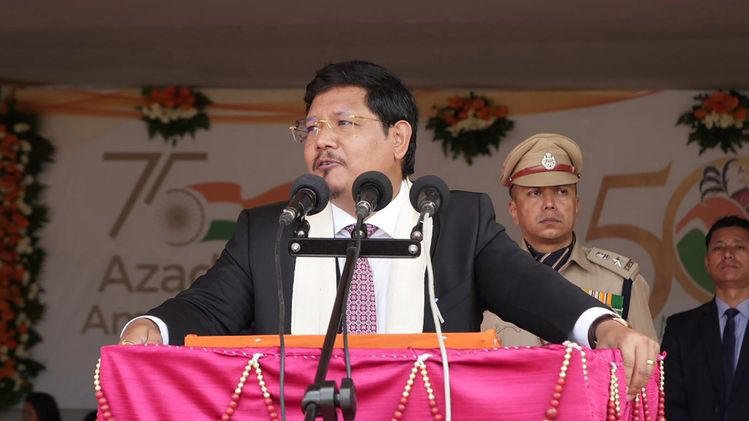
Meghalaya Chief Minister Conrad Sangma has called for a more outcome-oriented approach to policing, urging security agencies and law enforcement officials to strengthen intelligence systems and place greater emphasis on public safety.
The chief minister stressed that modern policing must move beyond traditional methods and focus on measurable outcomes, timely response, and stronger coordination across departments. He also highlighted the importance of intelligence gathering and proactive engagement to improve security and build public confidence.
According to officials, the state government aims to strengthen institutional capabilities while ensuring that law enforcement remains responsive to changing security challenges.
CM Emphasises Results-Driven Policing
Addressing officials and stakeholders, Conrad Sangma underlined the need for policing strategies that produce visible outcomes and improve service delivery.
He stated that the effectiveness of law enforcement should not depend solely on routine operations but on measurable improvements in safety and public confidence.
The chief minister encouraged agencies to adopt practices that focus on prevention, rapid response, and stronger field coordination.
Moreover, he stressed that modern governance requires institutions to continuously improve efficiency and accountability.
Officials noted that outcome-oriented policing can help agencies respond more effectively to emerging challenges while strengthening public trust.
The government believes that focusing on outcomes can improve operational performance and support long-term institutional development.
Intelligence Gathering Identified as a Key Priority
A major focus of the chief minister’s remarks centred on strengthening intelligence capabilities across the state.
He emphasised that timely information and effective coordination play a critical role in maintaining public order and preventing security concerns from escalating.
Officials stated that stronger intelligence systems allow authorities to identify risks earlier and take preventive action.
The government also encouraged better information sharing among departments and local units.
Additionally, authorities highlighted the need to improve data collection and analytical capabilities to support decision-making.
Officials believe that investing in intelligence infrastructure can strengthen preparedness and enhance overall public safety.
Public Safety Placed at the Centre of Governance
Conrad Sangma stressed that public safety must remain at the centre of policing and governance efforts.
He noted that security institutions play a direct role in improving quality of life and creating conditions for development.
Officials stated that safer communities encourage economic activity, strengthen social stability, and improve public confidence.
Therefore, the government wants agencies to focus not only on enforcement but also on creating secure and supportive environments.
Authorities also highlighted the importance of citizen engagement and community cooperation.
According to officials, stronger relationships between institutions and citizens can improve communication and lead to better outcomes.
Technology and Coordination Expected to Strengthen Policing
The Meghalaya government has increasingly highlighted the role of technology in improving governance and public services.
During discussions on policing priorities, officials pointed to the importance of modern tools and coordinated systems.
Authorities stated that technology can improve communication, support intelligence efforts, and increase operational efficiency.
At the same time, departments have been encouraged to strengthen internal coordination and improve implementation standards.
Officials believe integrated approaches can help agencies respond more effectively to complex situations.
Moreover, stronger coordination can reduce delays and improve service delivery across administrative levels.
Building Institutional Capacity for Future Challenges
The chief minister also called for continuous efforts to strengthen institutional capacity and professional development.
Officials stated that evolving challenges require agencies to remain adaptive and responsive.
Training, skill enhancement, and improved operational systems remain important components of this approach.
The government believes stronger institutions can create long-term improvements in governance and public administration.
Additionally, officials emphasised the importance of maintaining high professional standards and improving accountability.
Authorities stated that investing in institutional capacity creates stronger foundations for sustainable progress.
Community Engagement Remains Important
Alongside intelligence and operational readiness, the chief minister highlighted the importance of public participation.
Officials stated that policing becomes more effective when communities actively cooperate and share information.
Therefore, authorities encouraged stronger engagement between local institutions and citizens.
Community participation can support preventive measures and strengthen trust in public systems.
The government also emphasised awareness-building efforts that encourage responsible civic participation.
Officials believe such approaches can improve responsiveness and create stronger public confidence.
Meghalaya Aims for a Modern and Responsive Security Framework
The chief minister’s call for outcome-oriented policing reflects Meghalaya’s broader focus on strengthening governance and improving institutional performance.
Officials stated that the government wants policing systems to remain efficient, accountable, and aligned with public expectations.
By strengthening intelligence networks and prioritising safety, authorities aim to create a more responsive security environment.
The government also sees improved policing as an important element of long-term development and social stability.
Moreover, officials believe that stronger coordination and modern practices can improve public outcomes.
As Meghalaya continues to strengthen governance systems, authorities expect law enforcement institutions to play a greater role in supporting growth, maintaining stability, and building confidence among citizens.
The renewed focus on results, intelligence, and public safety signals the state’s intention to prepare its institutions for future challenges while ensuring that people remain at the centre of governance priorities.