


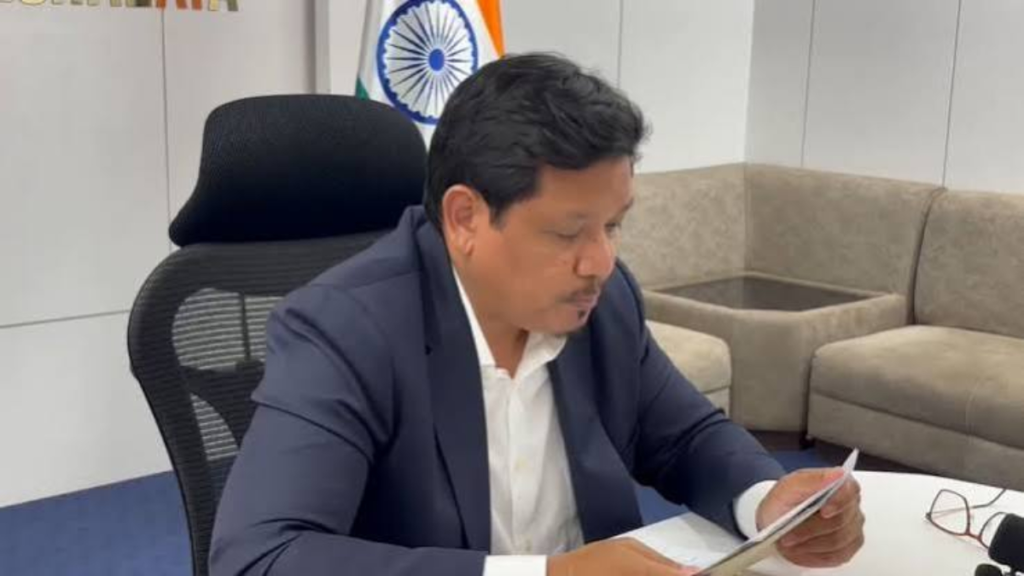
Meghalaya coalition government will remain stable despite eight United Democratic Party (UDP) MLAs joining the Bharatiya Janata Party (BJP), Chief Minister Conrad K Sangma has maintained.
The development has changed the numbers of the parties in the Meghalaya Assembly. However, Sangma has said the change will not affect the functioning of the NPP-led Meghalaya Democratic Alliance government.
Meghalaya coalition government faces a major political shift
Eight UDP legislators joined the BJP at the party headquarters in New Delhi on Wednesday. The group includes Education Minister Lahkmen Rymbui, former minister Kyrmen Shylla, Pius Marwein, Mayralborn Syiem, Matthew Kurbah, Ollan Sing Suin, Balajied Kupar Synrem and Synshar Kupar Roy.
The move followed weeks of speculation about a possible shift by UDP legislators. Rymbui said the discussions had been continuing for some time and linked the decision to issues concerning Meghalaya.
The BJP has said the legislators received a positive response from its central leadership on several demands. These include the inclusion of Khasi in the Eighth Schedule of the Constitution, changes related to the Meghalaya Residents Safety and Security Act and simplification of coal mining rules.
BJP strength rises as UDP loses eight MLAs
The latest development has altered the party-wise strength in the 60-member Meghalaya Assembly. The UDP, which had 12 MLAs, is now left with four legislators. Meanwhile, the BJP’s strength has risen from two to 10, making it the second-largest party in the House after the National People’s Party (NPP).
Both the UDP and BJP remain constituents of the NPP-led Meghalaya Democratic Alliance. Therefore, the movement of legislators has taken place within the broader ruling coalition rather than between the government and the opposition.
The NPP continues to hold 33 seats, according to recent reports. Sangma had also stressed before the BJP induction that the NPP remained united and had sufficient numbers to continue leading the government.
Meghalaya coalition government remains the focus
Sangma had earlier rejected speculation that a possible movement of UDP MLAs would destabilise the administration. In September, he said the NPP was united and that the government remained stable despite reports about a possible political realignment.
At that stage, the chief minister said he had not received concrete information from a reliable source about the reported move. He also said political developments should be assessed after facts emerged rather than on the basis of social media posts and reports.
The subsequent BJP induction has now confirmed the move. Yet, the government’s basic political structure remains unchanged, with the NPP continuing to lead the administration.
BJP gains a larger role inside the alliance
The BJP’s expanded strength could give it a larger presence within the ruling arrangement. Before the switch, the party had two MLAs in the House. The addition of eight UDP legislators takes its tally to 10.
At the same time, the move raises questions about ministerial representation because two of the UDP legislators were part of the government. Any changes to the Council of Ministers would be a separate political and administrative decision.
For now, the key point for the ruling alliance is that the NPP remains the largest party in the Assembly. The BJP and the remaining UDP legislators also continue to be associated with the coalition.
Meghalaya coalition government enters a new phase
The latest shift marks a significant change in Meghalaya’s political landscape ahead of the 2028 Assembly election. The BJP now has a substantially larger legislative presence, while the UDP has been reduced to four MLAs.
Nevertheless, the immediate focus remains on the functioning of the NPP-led administration. Sangma’s position is that the change in party affiliation will not affect the government’s stability.
The eight legislators, meanwhile, have said their decision was linked to Meghalaya-specific issues and their expectation of stronger support from the Centre. As the new political arrangement takes shape, the government’s next steps will show how the coalition manages the changed balance among its partners.
Assam Down Town University Rewards 80 Researchers with Rs 67.48 Lakh