


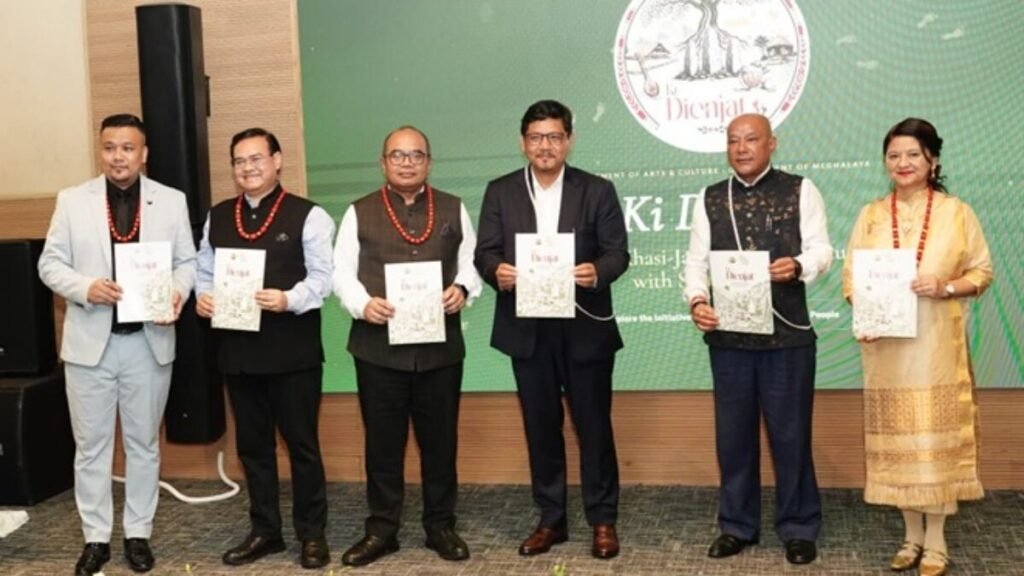
Meghalaya Chief Minister Conrad K. Sangma has reportedly launched the ‘Ki Dienjat’ initiative, a cultural project focused on tracing the historical connections between the Khasi-Jaintia communities and Southeast Asia. The initiative aims to explore shared cultural heritage, historical traditions, and connections that extend beyond Meghalaya’s present-day borders.
The project places indigenous history and cultural identity at the centre of Meghalaya’s heritage efforts. Moreover, documenting historical links with Southeast Asia could encourage research, cultural exchanges, and greater public awareness of the region’s diverse past.
However, historical connections can involve different interpretations and sources. Therefore, academic research and documented evidence will remain important as the initiative develops.
Dr. Thejo Kumari Amudala Honoured at Rashtriya Gourav Awards
Meghalaya Ki Dienjat Initiative Highlights Indigenous Heritage
The Meghalaya Ki Dienjat initiative focuses on the historical and cultural heritage of the Khasi-Jaintia communities.
The project seeks to examine connections between these communities and societies across Southeast Asia. Furthermore, such research can bring greater attention to indigenous traditions that have historically received less representation in mainstream historical narratives.
The initiative could therefore contribute to Meghalaya’s broader cultural preservation efforts.
However, the available information does not provide the project’s complete research framework or timeline.
Khasi-Jaintia Connections With Southeast Asia
The initiative centres on historical links between Khasi-Jaintia communities and Southeast Asia.
Researchers can examine linguistic similarities, oral traditions, cultural practices, migration histories, trade routes, and archaeological evidence when studying historical connections. Additionally, comparative research can help identify both shared traditions and important differences between communities.
Such work could provide a broader perspective on the region’s history.
However, cultural similarities alone do not necessarily establish direct historical relationships, making rigorous research important.
Chief Minister Conrad Sangma Supports Cultural Research
Chief Minister Conrad K. Sangma has reportedly launched the initiative as part of Meghalaya’s cultural efforts.
Government support can provide resources and institutional backing for research, documentation, exhibitions, and cultural programmes. Moreover, involving academic and cultural institutions could help ensure that historical claims receive appropriate scholarly examination.
The project could therefore create a platform for wider research into Meghalaya’s indigenous heritage.
Oral Traditions Could Play an Important Role
Oral history remains an important source of cultural knowledge among many indigenous communities.
Stories, traditional practices, songs, genealogies, and community narratives can preserve information that may not appear in written historical records. Furthermore, documenting these traditions can help protect cultural knowledge for future generations.
The Ki Dienjat initiative could provide opportunities to record such material systematically.
However, researchers would need to compare oral traditions with other historical and archaeological evidence.
Cultural Exchange Could Expand
Exploring historical links could also create opportunities for contemporary cultural exchanges.
Meghalaya could potentially collaborate with institutions and communities in Southeast Asian countries through exhibitions, academic conferences, heritage programmes, and artistic exchanges. Additionally, such partnerships could encourage young people to learn more about their cultural history.
This could give the initiative an international dimension.
However, the available information does not identify specific Southeast Asian institutions participating in the project.
Tourism Could Gain a New Cultural Dimension
Historical heritage can contribute to cultural tourism when presented responsibly.
Research into Khasi-Jaintia connections could support museums, heritage trails, educational programmes, and cultural exhibitions. Moreover, international cultural connections could make Meghalaya’s heritage narrative more attractive to visitors interested in indigenous history.
Such initiatives could generate opportunities for local communities.
However, tourism development should respect cultural traditions and avoid reducing complex histories to simplified narratives.
Young People Could Benefit
The project could encourage younger generations to engage with Meghalaya’s history.
Educational materials, digital archives, workshops, and cultural programmes can make indigenous history more accessible to students. Furthermore, documenting traditions can help preserve knowledge that might otherwise become less accessible over time.
This could strengthen awareness of Meghalaya’s cultural diversity.
Research and Documentation Will Be Important
A project exploring ancient historical connections requires careful documentation.
Researchers may need to examine archaeological findings, linguistic evidence, historical records, oral traditions, and cultural practices. Additionally, collaboration between historians, anthropologists, archaeologists, linguists, and local knowledge holders could produce a more comprehensive picture.
Such multidisciplinary research can help distinguish established findings from historical hypotheses.
Indigenous Voices Should Remain Central
Community participation can strengthen cultural research.
Local scholars, elders, artists, historians, and cultural organisations can contribute knowledge and perspectives that external researchers may not capture. Moreover, involving communities in documentation can help ensure that cultural material receives appropriate context and respect.
The initiative can therefore serve as both a research and community-preservation project.
Meghalaya’s Broader Heritage Strategy
The Ki Dienjat initiative fits into a wider effort to highlight Meghalaya’s indigenous identity and cultural heritage.
Documenting traditional knowledge can support cultural preservation while creating opportunities for education and public engagement. Furthermore, international historical connections can place Meghalaya within a broader regional story rather than viewing its history in isolation.
This could strengthen the state’s cultural profile.
What Happens Next?
The project’s long-term impact will depend on the research and documentation that follow its launch.
Future activities could include academic studies, cultural exchanges, exhibitions, oral-history documentation, and educational programmes. Moreover, collaboration with institutions across Southeast Asia could expand the initiative’s scope.
Clear documentation and scholarly engagement will remain important as researchers investigate the historical connections highlighted by the project.
Conclusion
The Meghalaya Ki Dienjat initiative, launched under Chief Minister Conrad K. Sangma, aims to explore the historical and cultural connections between the Khasi-Jaintia communities and Southeast Asia. The project places indigenous heritage at the centre of a broader effort to understand Meghalaya’s historical identity.
Moreover, research into oral traditions, language, archaeology, and cultural practices could provide valuable insights into the region’s past. At the same time, careful scholarship and community participation will remain essential when examining complex historical connections.
Overall, the Ki Dienjat initiative could become an important platform for cultural research, heritage preservation, and wider recognition of Meghalaya’s indigenous history.
FAQs
1. What is the Ki Dienjat initiative?
It is a cultural project in Meghalaya focused on exploring historical connections between the Khasi-Jaintia communities and Southeast Asia.
2. Who launched the initiative?
Meghalaya Chief Minister Conrad K. Sangma reportedly launched the project.
3. What will the project examine?
It may examine areas such as oral traditions, cultural practices, language, historical records, archaeology, and possible regional connections.
4. Why is the initiative significant?
It could strengthen research and public awareness surrounding Meghalaya’s indigenous heritage and its broader regional history.
5. Could the initiative promote cultural tourism?
Potentially. Research and documentation could support museums, exhibitions, heritage programmes, and culturally responsible tourism initiatives.