


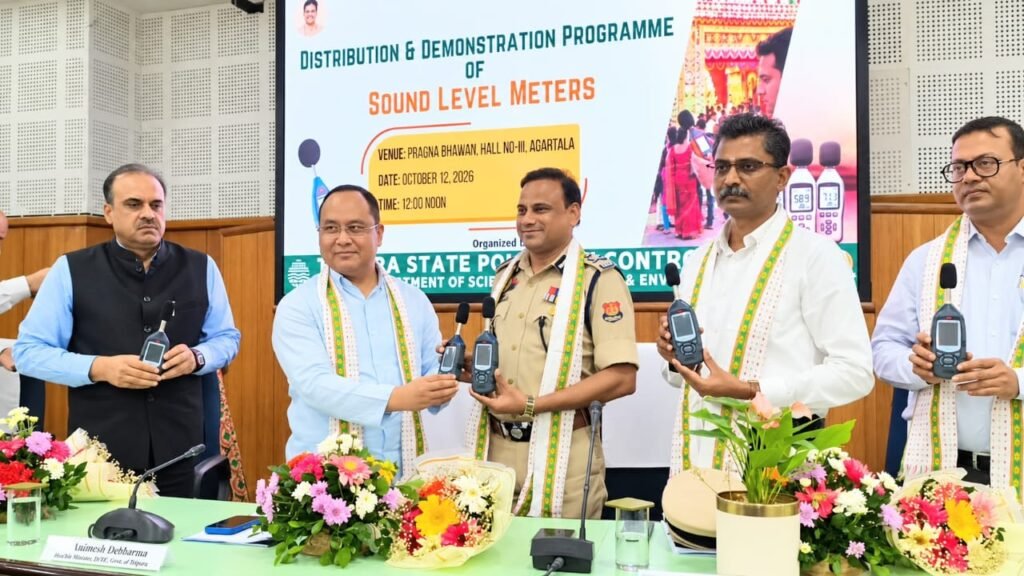
Agartala, October 12, 2026: Tripura Science, Technology and Environment Minister Animesh Debbarma has called for stronger enforcement of noise pollution regulations across both urban and rural areas, emphasising that technological interventions, public awareness and community participation are essential to building a cleaner, quieter and healthier Tripura.
Addressing the Distribution and Demonstration Programme of Sound Level Meters organised by the Tripura State Pollution Control Board at Pragna Bhawan in Agartala on Monday, the minister stressed that the success of noise pollution control should be measured by the actual reduction in noise levels across the state, rather than merely by the number of monitoring devices distributed.
Congratulating the Tripura State Pollution Control Board and the Department of Science and Technology on the inauguration of the Dr. C. V. Raman Planetarium, the minister described the facility as a crown jewel of Science City, Agartala. He shared his personal experience of visiting the planetarium and praised the team involved in the project, while also suggesting improvements to its exterior appearance.
Turning to the sound level meter distribution programme, Debbarma noted that 45 sound level meters had previously been distributed and another 35 had been distributed under the current initiative, bringing the total to 80. However, he said the number was still insufficient to effectively monitor noise pollution throughout Tripura. He called for a larger, technology-driven project to provide the police department with adequate technological support and strengthen monitoring mechanisms.
“Nothing goes without technology. The more technology we use, the stronger our monitoring will become,” the minister said, underlining the importance of moving beyond the distribution of equipment towards effective action on the ground.
The minister expressed concern that noise pollution monitoring and enforcement were largely concentrated in urban areas, while residents of rural villages also faced considerable difficulties. Referring to loudspeakers used during weddings, religious festivals and other social gatherings, he pointed out that excessive noise often continued throughout the night in rural areas, disturbing residents and depriving them of sleep.
He urged the authorities to extend noise pollution monitoring to villages and ensure that regulations were implemented consistently across the state. He also emphasised the need to follow existing legal provisions, including the Noise Pollution (Regulation and Control) Rules, 2000, and the Environment (Protection) Act, 1986.
Debbarma said that the real achievement of the Pollution Control Board would be reflected in measurable improvements in noise pollution levels. He cautioned against judging the success of the initiative solely by the number of sound level meters distributed, stressing that authorities should instead assess how much progress Tripura had made in controlling noise pollution over the coming years.
Acknowledging the challenges faced by police personnel during enforcement, the minister said that simply instructing officers to stop loudspeakers or sound systems was not enough. Enforcement often became difficult when local groups or members of the public opposed restrictions. He therefore called on political representatives, club organisers, NGOs, community leaders and citizens to take collective responsibility for controlling noise pollution.
Using the example of a household celebrating a birthday with loud music, he highlighted the competing needs of neighbours, including students preparing for examinations and elderly or ill people recovering from illness. He said public enjoyment should not come at the cost of another person’s suffering.
“My enjoyment should not be at the cost of someone else’s suffering,” he emphasised, calling for greater sensitivity and civic responsibility among citizens.
The minister also appreciated the cooperation of the Tripura Police and the Pollution Control Board during the previous Durga Puja celebrations. He credited the use of sound limiters and the efforts of police personnel for helping improve noise management during the festival, while acknowledging that effective enforcement would not have been possible without their support and dedication.
Debbarma further called for action against businesses allegedly involved in the illegal sale and modification of vehicle silencers that produce excessive noise. He said enforcement should target not only vehicles violating noise standards but also the sources supplying the modified equipment.
“If we keep catching violations but ignore the source supplying the equipment, we are treating only the symptoms, not the disease,” he said, urging the authorities to examine the supply chain behind such violations.
Highlighting the broader economic implications of environmental protection, the minister said a clean, peaceful and less polluted environment could make Tripura more attractive to tourists, investors and businesses. According to him, a healthier environment and better noise management would contribute to public well-being while supporting tourism, hospitality and economic growth.
He also referred to the potential health consequences of prolonged exposure to excessive noise and urged citizens to take the issue seriously. He called for greater public awareness to ensure that the negative effects of noise pollution did not become a growing concern for future generations.
As Minister for Science and Technology, Debbarma assured that his office would remain open to innovative ideas and proposals for technology-assisted environmental protection projects. He supported the suggestion to develop a larger initiative that would strengthen the state’s noise monitoring capacity beyond the existing distribution of sound level meters.
Concluding his address, the minister thanked the Pollution Control Board, the police department, club leaders, NGOs and other stakeholders for their cooperation. He also extended advance greetings to the people for Durga Puja, expressing hope that celebrations would remain peaceful, with noise levels maintained within permissible limits.
He called for a collective commitment to building a safe, peaceful and prosperous Tripura, where festivals and public celebrations could be enjoyed without causing unnecessary disturbance to others.