


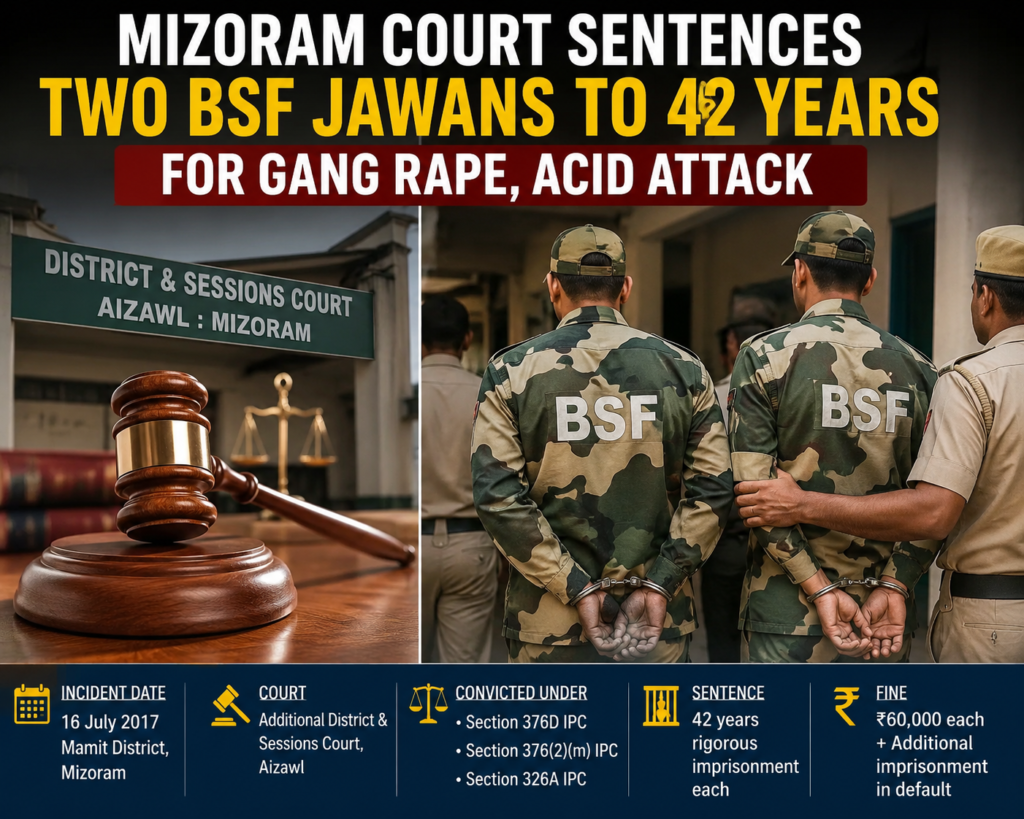
A court in Mizoram has sentenced two Border Security Force (BSF) jawans to 42 years of rigorous imprisonment each for gang raping a woman and attacking her with a corrosive substance in Mamit district in 2017. The Additional District and Sessions Court in Aizawl convicted the two men under multiple provisions of the Indian Penal Code, including gang rape, rape causing grievous bodily harm, and acid attack.
The court announced the quantum of punishment on Tuesday after delivering the conviction on June 12. The survivor suffered severe injuries, permanent facial disfigurement, and loss of vision in one eye. However, the court acquitted the accused of a separate murder charge due to insufficient evidence linking them to the death of the victim’s companion.
Read More: Dibrugarh Shifts Bus Stand to MJBT from June 19
Key Facts
- Location: Mamit district, Mizoram
- Court: Additional District and Sessions Court, Aizawl
- Judge: Sylvie Zomuanpuii Ralte
- Convicts: Two BSF jawans
- Crime Year: 2017
- Sentence: 42 years rigorous imprisonment each
- Charges Proven: Gang rape, rape causing grievous bodily harm, and acid attack
- Fine Imposed: ₹60,000 each
- Victim’s Injuries: Permanent facial disfigurement and loss of vision in one eye
- Murder Charge: Accused acquitted due to lack of sufficient evidence
Court Awards 42-Year Prison Term
A Mizoram court has awarded 42 years of rigorous imprisonment to two Border Security Force (BSF) personnel convicted in a 2017 gang rape and acid attack case.
The judgment was delivered by Additional District and Sessions Judge Sylvie Zomuanpuii Ralte. The court had convicted the two accused on June 12, while the sentence was announced on Tuesday.
The case involved the gang rape of a woman and a subsequent attack using a corrosive substance in west Mizoram’s Mamit district.
Conviction Under Multiple IPC Sections
The court found the two accused guilty under Sections 376D, 376(2)(m), and 326A of the Indian Penal Code.
Under Section 376D, which deals with gang rape, both convicts received 20 years of rigorous imprisonment. Additionally, they were sentenced to 10 years under Section 376(2)(m) for rape causing grievous bodily harm.
Furthermore, the court imposed a 12-year sentence under Section 326A for the acid attack. As a result, the combined punishment totals 42 years of rigorous imprisonment for each convict.
Importantly, the court directed that all sentences would run consecutively.
Fine and Additional Penalty
Besides imprisonment, the court imposed a fine of ₹60,000 on each convict.
The fine covers all three offences for which they were convicted. Moreover, the court stated that failure to pay the fine would result in additional imprisonment.
Accordingly, each convict would have to undergo two extra months of imprisonment under each count in case of default.
Incident Took Place in 2017
The case dates back to July 16, 2017, when the survivor and her companion went to a forested area near the Gaskata stream in Silsuri West village.
According to court records, the two women had gone there to collect crabs and wild vegetables.
During that time, they allegedly encountered the accused, who were posted at a BSF camp along the Mizoram-Bangladesh border.
The survivor stated that she was forcibly taken to a nearby plantation and sexually assaulted. Subsequently, a corrosive substance was allegedly poured on her face.
As a result, she suffered severe burns, permanent facial disfigurement, and partial loss of eyesight.
Investigation and Evidence
Police registered the case at Marpara Police Station on July 18, 2017, following a complaint filed by the victim’s brother.
Investigators collected forensic evidence from the survivor’s clothing and other materials connected to the case.
Furthermore, laboratory examinations confirmed the presence of a corrosive substance associated with the attack.
Officials also examined duty rosters at the BSF camp. Consequently, investigators identified the two accused as personnel deployed on duty in the area on the day of the incident.
The survivor later identified both accused during a Test Identification Parade conducted before a Judicial Magistrate in September 2017.
Court Relies on Survivor’s Testimony
During the trial, the prosecution examined 18 witnesses.
These included medical experts, investigating officers, and local residents. In addition, documentary and forensic evidence was presented before the court.
The judge described the survivor’s testimony as consistent, reliable, and trustworthy. Moreover, the court observed that her statement was supported by medical findings and scientific evidence.
Therefore, the court concluded that the prosecution had successfully established the offences related to gang rape and the acid attack.
Murder Charge Not Proven
The victim’s companion was later found dead near the crime scene. Medical examinations concluded that she had been murdered.
However, the court acquitted both accused of the murder charge under Section 302 IPC.
According to the judgment, the prosecution failed to establish a complete chain of circumstances linking the accused to the death.
Therefore, the court ruled that the charge of murder could not be proven beyond reasonable doubt.
Significance of the Verdict
The verdict marks the conclusion of a long-running criminal case that remained under judicial scrutiny for several years.
The judgment also highlights the role of survivor testimony, forensic evidence, and medical findings in securing convictions in serious crimes involving sexual violence and acid attacks.
Furthermore, the case underscores the importance of thorough investigations and judicial review in ensuring accountability under the law.
Question & Answer
Q1: What did the Mizoram court decide?
The court sentenced two BSF jawans to 42 years of rigorous imprisonment each for gang rape and acid attack.
Q2: When did the incident occur?
The crime took place on July 16, 2017, in Mamit district of Mizoram.
Q3: What offences were proven in court?
The court convicted the accused for gang rape, rape causing grievous bodily harm, and acid attack.
Q4: What punishment was imposed?
Each convict received a total of 42 years of rigorous imprisonment and a fine of ₹60,000.
Q5: Were the accused convicted of murder?
No. The court acquitted them of the murder charge due to insufficient evidence.
Location Context
Mamit district is located in western Mizoram along the India-Bangladesh border. The district is strategically important due to the presence of border security forces and serves as a key administrative region in the state’s border management framework.
Also Read: Assam Launches New PNG and CNG Projects