


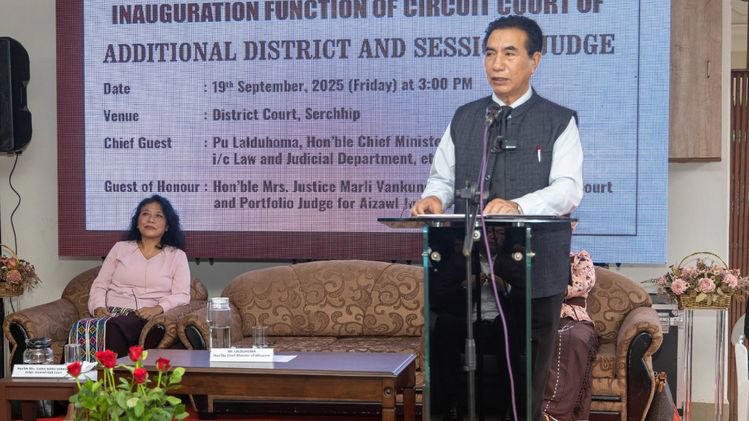
Mizoram has inaugurated a new Serchhip district and sessions court, marking a significant step toward strengthening judicial infrastructure in the state. The new court aims to improve access to justice for citizens while reducing the pressure on existing courts. Officials believe this expansion will also make legal services faster and more efficient for people living in and around Serchhip.
The event drew the attention of senior officials, members of the judiciary, and community leaders. They welcomed the decision as a long-awaited demand of the people, who had faced challenges in accessing timely justice due to geographical barriers. With this development, the state government continues to show its commitment to strengthening rule of law and legal rights.
Read More: Arunachal DC warns contractors on Keyi Panyor projects
Purpose of the Serchhip district and sessions court
The inauguration of the Serchhip district and sessions court reflects Mizoram’s plan to decentralize judicial services. Until now, many citizens had to travel long distances to courts located in other districts. This created delays in cases, higher expenses, and a general sense of frustration among litigants.
By establishing the new court, the government seeks to make justice more approachable and less time-consuming. The sessions court will handle both civil and criminal cases, while also addressing appeals from lower courts. Additionally, it will take up cases that require urgent attention, thereby speeding up the judicial process.
Officials emphasized that easy access to the judiciary is a constitutional right. Therefore, opening a new court in Serchhip not only eases the burden on existing courts but also ensures that people’s grievances are heard and resolved closer to their homes.
Strengthening access to justice in Mizoram
The establishment of the Serchhip district and sessions court also underlines the broader vision of strengthening access to justice across Mizoram. The state has seen a steady rise in the number of cases filed each year. Without adequate infrastructure, courts often face backlogs that delay justice delivery.
The new court is expected to reduce pendency by distributing caseloads more evenly. It will also allow judges to devote more time to individual cases, improving the quality of judgments. Citizens will no longer need to travel to distant courts, saving both time and money.
Moreover, the expansion helps bring legal aid services closer to rural communities. Lawyers, NGOs, and paralegal volunteers can now coordinate more effectively within Serchhip, making legal advice and representation accessible even for marginalized groups.
Community response to the new court
Local residents have welcomed the inauguration of the Serchhip district and sessions court. For years, they have demanded better judicial facilities, citing the difficulties faced while traveling to courts in other districts. Many believe the new court will finally bridge this gap and bring justice closer to their doorsteps.
Community leaders also highlighted the economic benefits of the court’s presence. As legal professionals, clerical staff, and support services increase in Serchhip, local employment opportunities are expected to grow. The court will also strengthen civic awareness, as people gain greater knowledge about their rights and the legal process.
Civil society groups have expressed hope that the court will prioritize speedy disposal of pending cases, particularly those related to land disputes, family matters, and criminal offenses. These cases often carry heavy emotional and financial costs, making timely resolution essential.
Judicial officers highlight accountability
During the inauguration, senior judicial officers stressed that the Serchhip district and sessions court should set a benchmark for accountability and fairness. They reminded both judges and lawyers that the primary duty of the judiciary is to uphold justice without fear or favor.
The officers urged judicial staff to maintain transparency in procedures, respect timelines, and remain sensitive to the needs of litigants. They also emphasized the importance of technology in modern courts. Digital case management systems, e-filing, and online updates should be integrated into the functioning of the new court to improve efficiency.
Furthermore, training programs for staff and awareness sessions for the public will be conducted regularly. These efforts aim to build a culture of trust in the legal system and reduce delays caused by procedural confusion.
Future plans for judicial expansion
The inauguration of the Serchhip district and sessions court is part of Mizoram’s larger plan to improve its judicial infrastructure. Officials revealed that more projects are in the pipeline to strengthen lower courts, improve digital connectivity, and provide training facilities for legal professionals.
The state also plans to invest in infrastructure upgrades, including courtrooms equipped with modern technology, libraries, and comfortable waiting areas for litigants. These improvements will make the legal environment more user-friendly and reduce the traditional barriers associated with court visits.
The government has assured that it will continue working closely with the judiciary to identify gaps and allocate resources effectively. With strong collaboration, Mizoram hopes to create a legal system that matches the growing needs of its people.
The opening of the Serchhip district and sessions court marks a historic milestone for Mizoram’s judicial landscape. It represents a step toward decentralization, inclusivity, and faster justice delivery.
For the people of Serchhip, the new court means fewer obstacles in pursuing their legal rights. For the state, it symbolizes progress toward a transparent and accountable judiciary. With effective implementation, the court can serve as a model for other districts that face similar challenges.
By addressing long-standing demands and reducing geographical barriers, Mizoram has strengthened both access to justice and public trust in the legal system. The Serchhip district and sessions court now stands as a symbol of the state’s commitment to fairness, equality, and the rule of law.
Read More: USTM fined Rs 150 crore for forest encroachment in Meghalaya