


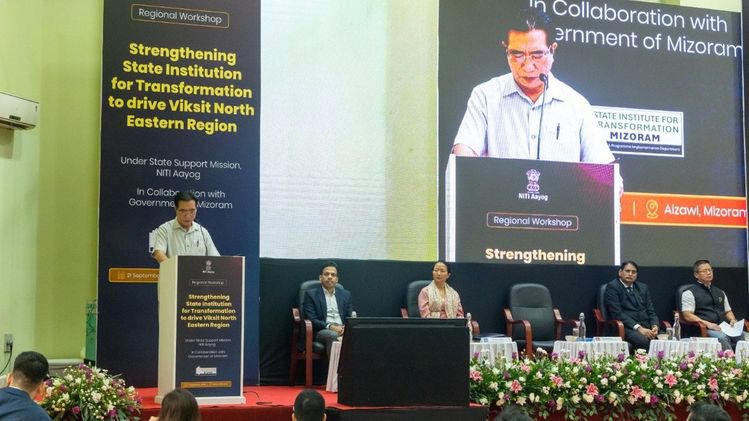
Mizoram has set an ambitious economic target under its Transformed Mizoram Vision 2047, with Chief Minister Lalduhoma saying the state aims to raise its Gross State Domestic Product (GSDP) to around Rs 25 lakh crore by 2047. He also stressed the need for stronger institutions, better planning and effective delivery systems to achieve the long-term goal.
Lalduhoma made the remarks on September 21 while addressing the inaugural session of a NITI Aayog regional workshop on strengthening State Institutions for Transformation (SITs) in Aizawl. Representatives from State Institutions for Transformation across the Northeast and senior Mizoram government officials attended the workshop.
Mizoram Sets Ambitious Vision 2047 Target
Under its Vision 2047 roadmap, Mizoram aims to contribute one per cent to India’s projected USD 30 trillion economy by 2047. The state has linked this goal with a target GSDP of about Rs 25 lakh crore.
The government also aims to raise the state’s per capita income to more than Rs 16 lakh during the same period. These targets form part of Mizoram’s broader plan to move from incremental development towards long-term structural and institutional transformation.
Lalduhoma said ambitious targets alone would not guarantee development. He stressed that the state must create the systems required to turn its vision into measurable results.
According to the Chief Minister, development plans need clear priorities, defined responsibilities, proper timelines, adequate resources and measurable outcomes.
Strong Institutions Seen as Key to Growth
Lalduhoma placed institutional development at the centre of Mizoram’s Vision 2047 strategy. He said the state needs institutions that can support strategic planning, evidence-based policymaking and effective implementation.
The Chief Minister highlighted the role of State Institutions for Transformation (SITs) in this process. These institutions can help government departments work together, identify development priorities and track the results of different programmes.
He also stressed the importance of using reliable data when governments make policy decisions. Data can help officials identify gaps, assess the impact of programmes and make changes when existing approaches do not deliver the expected results.
The focus on institutional capacity reflects the government’s effort to connect long-term economic goals with day-to-day governance and implementation.
NITI Aayog Extends Support to Mizoram
The workshop also focused on the role of NITI Aayog’s State Support Mission (SSM) in strengthening Mizoram’s institutional capacity. Lalduhoma welcomed the decision to extend the mission’s support to Mizoram’s State Institution for Transformation for another five years.
The Chief Minister said the programme had helped improve the state’s capacity in areas such as planning, governance and delivery. He had also raised the importance of continued institutional support for Mizoram and the Northeast during a recent NITI Aayog Governing Council meeting.
The extended support will provide more time for the state to strengthen its institutional framework and develop systems that can support the implementation of Vision 2047.
Government Plans Greater Coordination
Mizoram also plans to use its State Institution for Transformation to improve coordination among government departments. Lalduhoma said the government plans to hold a Cabinet retreat through the SIT to discuss Vision 2047.
The proposed exercise will focus on bringing departments together and developing a pipeline of priority projects. Such coordination could help reduce duplication and improve the implementation of development programmes.
The Chief Minister has emphasised that departments must work beyond individual areas of responsibility when addressing complex development challenges. Better coordination can help the government connect infrastructure, education, tourism, agriculture, industry and other sectors within a broader development strategy.
Tourism and Natural Resources Offer Growth Potential
Lalduhoma also pointed to several factors that could support Mizoram’s economic growth. These include the state’s young population, natural resources, cultural diversity, entrepreneurship and tourism potential.
Tourism remains an important area for the state’s long-term development plans. Mizoram’s landscapes, cultural heritage and location in the Northeast offer opportunities for expanding tourism-related economic activity.
The state can also explore greater opportunities in sectors linked to agriculture, natural resources and entrepreneurship. Developing these areas will require better infrastructure, market access, investment and institutional support.
The government has therefore placed its economic ambitions within a broader strategy that combines human resources, natural advantages and improved governance.
Border Location Could Support Act East Strategy
Mizoram’s geographical position also features in the state’s long-term development plans. The state shares international borders with Myanmar and Bangladesh, giving it a strategic location in India’s Northeast.
Lalduhoma highlighted this position while discussing the region’s potential contribution to India’s Act East engagement with Southeast Asia.
Improved connectivity and stronger trade links could create additional opportunities for Mizoram. Better infrastructure could help connect local producers and businesses with markets beyond the state.
However, turning geographical location into economic opportunity will require investment in roads, connectivity, trade infrastructure and supporting institutions. The state’s Vision 2047 strategy therefore links economic growth with improvements in governance and implementation capacity.
Current Economy Provides the Starting Point
Mizoram’s Rs 25 lakh crore target represents a major long-term expansion from its current economic size. The state’s 2026-27 budget projects its GSDP at Rs 43,817 crore at current prices, with an estimated 11 per cent increase over the previous year, according to PRS Legislative Research.
Government documents have also highlighted steady economic growth in recent years. The state’s 2025-26 economic figures showed the services sector as the largest contributor to Gross State Value Added, followed by the secondary and primary sectors.
The figures underline the scale of the transformation that Mizoram seeks to achieve over the next two decades. Reaching the 2047 target will depend on sustained economic expansion and improvements across multiple sectors.
Focus on Evidence-Based Development
The Chief Minister’s message at the NITI Aayog workshop centred on the connection between ambitious targets and effective governance. He argued that Mizoram needs institutions that can turn broad development goals into specific programmes and measurable outcomes.
This approach places data and evidence at the centre of policymaking. Government departments can use data to establish priorities, measure progress and assess whether public resources are producing the intended results.
The State Institutions for Transformation will have a role in supporting this process. They can help departments analyse challenges, coordinate policies and monitor outcomes across different sectors.
Mizoram’s Long-Term Development Roadmap
Mizoram’s Vision 2047 builds on the state’s wider efforts to strengthen its economy and public institutions. The government has already focused on areas such as infrastructure, education, health, agriculture, livelihoods and fiscal management in its recent budgets.
The state also officially achieved full functional literacy in 2025, adding another milestone to its human development record.
With the new economic target, the government now wants to combine these social achievements with stronger economic growth. Lalduhoma’s emphasis on institutions indicates that the state views administrative capacity as an important part of this transition.
Road Ahead for Vision 2047
Mizoram’s target of achieving a Rs 25 lakh crore GSDP by 2047 sets a long-term benchmark for the state’s economic transformation. The government also wants per capita income to cross Rs 16 lakh and Mizoram to contribute one per cent to India’s projected USD 30 trillion economy.
Achieving these targets will require sustained growth, effective public investment, stronger infrastructure and coordination across departments. Lalduhoma has placed particular emphasis on institutional capacity, data-driven policymaking and measurable outcomes.
The extension of NITI Aayog’s State Support Mission gives Mizoram additional institutional support as it works on its Vision 2047 roadmap. The coming years will focus on translating the state’s long-term goals into concrete priorities, projects and development outcomes.